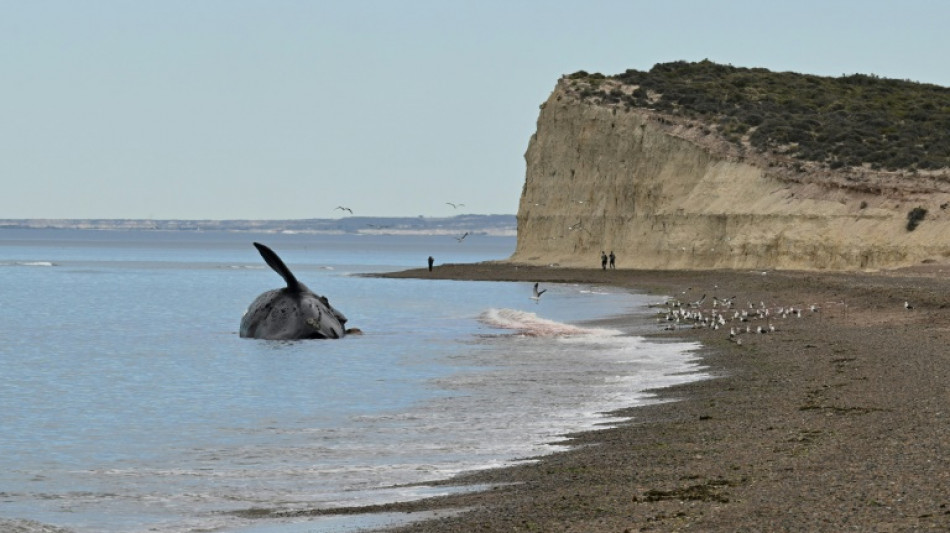
Argentine scientists worried after spate of whale deaths / Photo: Pablo PORCIUNCULA - AFP

 Drone owners rush to offload devices ahead of Beijing ban

 Trump's beef policies irk Texas ranchers, testing their loyalty

 Nvidia, OpenAI CEOs to attend Xi dinner at White House

 Anthropic picks Accenture for in-house AI safety evaluation

 Balogun returns as Monaco beat Lens to continue strong Ligue 1 start

 'Pause' on overt repression in Venezuela, but reforms still needed: HRW

 Global stocks mixed as yen falls despite Bank of Japan rate hike

 Cuba hit with seventh major blackout of the year

 Murray out with concussion so Wentz will start for Vikings

 UN chief 'deeply regrets' US visa refusal to Abbas for annual meeting

 England quick Carse to face no charges over alleged nightclub assault

 Mancini brings nine newcomers into the first squad of his Italy comeback

 Czechs level Davis Cup tie against USA as South Korea eye Finals

 New France boss Zidane confirms Mbappe as captain after naming first squad

 California governor signs order to explore AI 'kill switch'

 Head leads run spree as Australia win Zimbabwe ODI series

 In-form Raphinha wants to finish career at Barcelona

 Warren Buffett steps down as Berkshire Hathaway chairman

 Carrick confident Man Utd can 'work through' tough time

 Mbappe ends Nike partnership to join Swiss brand On

 Liverpool boss Iraola puts Bournemouth love affair on hold

 'A disaster' if Man City do not win says Maresca after flawless start

 Kerry James Marshall: American 'blackness' painter celebrated in Europe

 Spain coach De la Fuente offers 'full support' to people of Ceuta

 Russia seizes assets of Nestle, French firms over West's Ukraine support

A string of whale deaths in recent days in southern Argentina have worried scientists, who think a micro-algae could be to blame.
From September 24 to October 2, at least 13 southern right whales died in the Nuevo Gulf close to the Valdes Peninsula in Argentine Patagonia, an area that is a sanctuary and breeding ground for the huge mammals, the Whale Conservation Institute (ICB) said.
Authorities have started performing autopsies on the whales that have been recovered and have begun testing the water and mollusks "to determine the presence of possible biotoxins linked to the proliferation of harmful algal blooms known as red tides," said whale program coordinator Agustina Donini in an ICB statement released Monday.
None of the whales observed so far have displayed any signs of injuries or trauma, and all were well-fed, the ICB said.
The deaths come at a time when authorities have been celebrating a 50-year-high number of cetaceans for the season in an area that attracts whale watching tourists.
The large number of dead whales in such a short space of time suggests that "a local environmental variable" is to blame, said Marcella Uhart, another whale program director
Algal blooms produce natural toxins that can be harmful to other organisms living in the water.
Their pigment can make the surface of the water look red, giving the phenomenon the name "red tide."
Fabian Gandon, mayor of the nearby town of Puerto Piramides, told reporters there had been "an unusual increase in... red tides" in the Nuevo and San Jose gulfs.
The local population has been advised to avoid eating mollusks, which can store the toxins created by the algal blooms.
Despite the recent deaths, authorities have recorded more than 1,400 whales in the Nuevo and San Jose gulfs, the largest number in more than 50 years.
E.Paulino--PC



