Eleven years since revolt, Libya transition grinds on

 Drone owners rush to offload devices ahead of Beijing ban

 Trump's beef policies irk Texas ranchers, testing their loyalty

 Nvidia, OpenAI CEOs to attend Xi dinner at White House

 Anthropic picks Accenture for in-house AI safety evaluation

 Balogun returns as Monaco beat Lens to continue strong Ligue 1 start

 'Pause' on overt repression in Venezuela, but reforms still needed: HRW

 Global stocks mixed as yen falls despite Bank of Japan rate hike

 Cuba hit with seventh major blackout of the year

 Murray out with concussion so Wentz will start for Vikings

 UN chief 'deeply regrets' US visa refusal to Abbas for annual meeting

 England quick Carse to face no charges over alleged nightclub assault

 Mancini brings nine newcomers into the first squad of his Italy comeback

 Czechs level Davis Cup tie against USA as South Korea eye Finals

 New France boss Zidane confirms Mbappe as captain after naming first squad

 California governor signs order to explore AI 'kill switch'

 Head leads run spree as Australia win Zimbabwe ODI series

 In-form Raphinha wants to finish career at Barcelona

 Warren Buffett steps down as Berkshire Hathaway chairman

 Carrick confident Man Utd can 'work through' tough time

 Mbappe ends Nike partnership to join Swiss brand On

 Liverpool boss Iraola puts Bournemouth love affair on hold

 'A disaster' if Man City do not win says Maresca after flawless start

 Kerry James Marshall: American 'blackness' painter celebrated in Europe

 Spain coach De la Fuente offers 'full support' to people of Ceuta

 Russia seizes assets of Nestle, French firms over West's Ukraine support

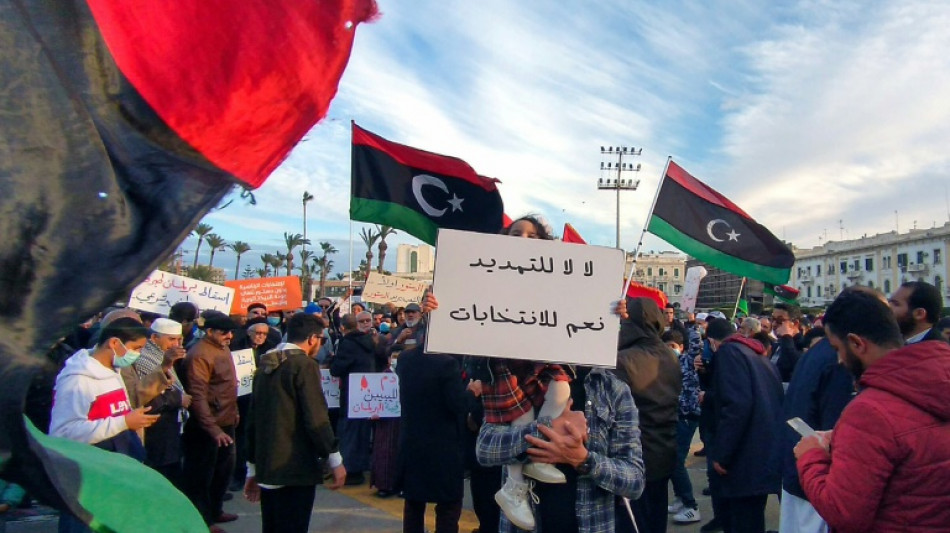
Libyans on Thursday mark 11 years since the revolt that toppled dictator Moamer Kadhafi, but the democracy many hoped for seems as elusive as ever, and many fear a return to conflict.
The anniversary comes as the country, for years plagued by divisions between east and west, finds itself with two rival prime ministers based in the capital Tripoli.
Just weeks after national elections planned for December 24 were indefinitely postponed, the east-based parliament voted to appoint influential former interior minister Fathi Bashagha to replace the interim unity government.
Incumbent Prime Minister Abdulhamid Dbeibah, appointed as part of a United Nations-driven peace process, has insisted he will only hand over power to an elected government.
The resulting showdown has sparked fears of another conflict -- not between east and west, but within Tripoli itself.
As the anniversary approached, the streets of the capital were lined with the red, black and green flags adopted after Kadhafi's fall.
Concerts and fireworks are planned for Friday -- a day late due to bad weather -- in Tripoli's Martyrs' Square, where Kadhafi once gave a famous, desperate speech before the "February 17 revolution" swept him from power.
- Oil and poverty -
The political void that followed the NATO-backed uprising sparked a bitter power struggle, fuelled by regional and tribal rivalries, as well as the involvement of outside groups.
And despite the country's vast oil wealth -- the biggest-proven reserves in Africa -- many Libyans are living in poverty.
"The situation even got worse," said Ihad Doghman, 26.
A civil servant by day and a grocer by night, he holds down two jobs, like many of his compatriots, as "it's the only way to get by".
Since Kadhafi's fall, Libya has had no fewer than nine governments and two full-scale civil wars -- but has yet to organise a presidential election.
Following the parliament's latest move, pro-Bashagha armed groups in Misrata -- both his and Dbeibah's hometown -- converged on Tripoli in a show of force.
- Relative peace -
The uptick in tensions could threaten what has been a long period of relative peace, since a landmark ceasefire in October 2020 formally ended eastern military chief Khalifa Haftar's ruinous year-long bid to seize the capital.
That laid the way for UN-led peace efforts which saw Dbeibah appointed, a year ago this month, at the head of a new unity government with a mandate to lead the country to December 24 elections.
But bitter wrangling over the legal basis of the polls and the presence of divisive candidates -- including Dbeibah as well as Bashagha -- led to them being indefinitely postponed.
Despite the failures, Libya expert Jalel Harchaoui said the country had seen progress on many fronts.
"Libya hasn't seen a major exchange of fire since June 2020," he said.
"Among the elites, many mortal enemies two years ago are talking to each other and in some cases making alliances. That represents the start of a reconciliation."
In December, just days before the elections, Bashagha had headed to Benghazi to meet Haftar -- another controversial presidential candidate -- in what he said was a gesture of national reconciliation.
Haftar's forces have since backed Bashagha's appointment as prime minister.
And now that he has won the backing of the Tripoli-based High State Council, a body that has often opposed the east-based parliament, Bashagha has until February 24 to form a government.
Given the country's tumultuous recent history, the next question will be whether Dbeibah will go peacefully.
S.Pimentel--PC