Tunisians fear more economic pain as IMF talks loom

 Ed Sheeran returns to stage after Palestinian controversy

 Asian Games to open in Japan after troubled build-up

 Drone owners rush to offload devices ahead of Beijing ban

 Trump's beef policies irk Texas ranchers, testing their loyalty

 Nvidia, OpenAI CEOs to attend Xi dinner at White House

 Anthropic picks Accenture for in-house AI safety evaluation

 Balogun returns as Monaco beat Lens to continue strong Ligue 1 start

 'Pause' on overt repression in Venezuela, but reforms still needed: HRW

 Global stocks mixed as yen falls despite Bank of Japan rate hike

 Cuba hit with seventh major blackout of the year

 Murray out with concussion so Wentz will start for Vikings

 UN chief 'deeply regrets' US visa refusal to Abbas for annual meeting

 England quick Carse to face no charges over alleged nightclub assault

 Mancini brings nine newcomers into the first squad of his Italy comeback

 Czechs level Davis Cup tie against USA as South Korea eye Finals

 New France boss Zidane confirms Mbappe as captain after naming first squad

 California governor signs order to explore AI 'kill switch'

 Head leads run spree as Australia win Zimbabwe ODI series

 In-form Raphinha wants to finish career at Barcelona

 Warren Buffett steps down as Berkshire Hathaway chairman

 Carrick confident Man Utd can 'work through' tough time

 Mbappe ends Nike partnership to join Swiss brand On

 Liverpool boss Iraola puts Bournemouth love affair on hold

 'A disaster' if Man City do not win says Maresca after flawless start

 Kerry James Marshall: American 'blackness' painter celebrated in Europe

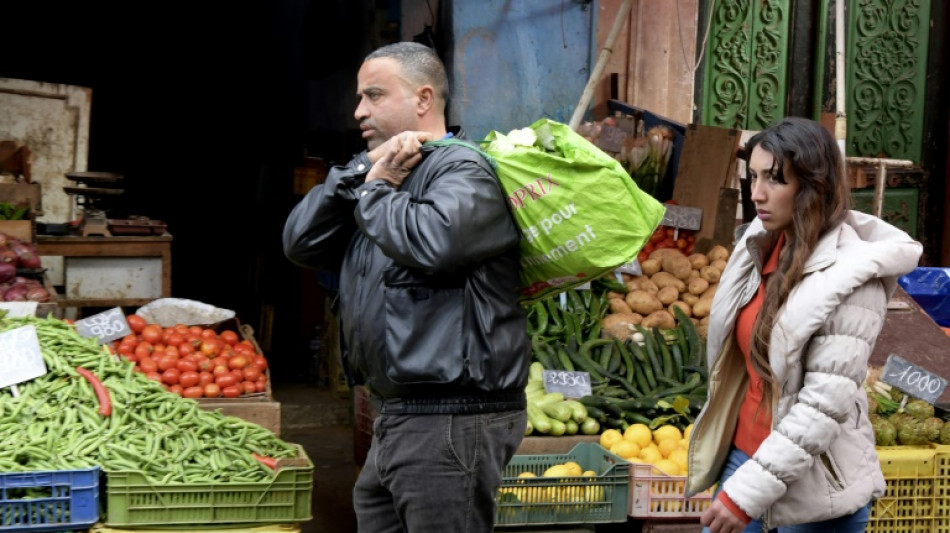
Every day at the family grocery stall in a Tunis market, Bilel Jani sees the reality of a biting economic crisis, which for many has overshadowed Tunisia's latest political turmoil.
"People here are poor," he said, handing a meagre bag of olives to a customer. "Most of our customers are living day-to-day. Monthly salaries these days don't even cover a week."
The small North African country, roiled by years of political turmoil that deepened with President Kais Saied's power grab last July, is also mired in a deep recession.
Surging prices and job losses have hurt families that were already struggling before the coronavirus pandemic.
This week, Tunisia started preliminary talks with the International Monetary Fund over a bailout package.
Such a deal would likely mean cuts to subsidies and public sector wages, which many fear would spell more suffering for the most vulnerable.
That could fuel the same kind of grievances that sparked a revolution a decade ago and brought down autocrat Zine El Abidine Ben Ali after 23 years in power.
The economic crisis since then has pushed tens of thousands of Tunisians to seek better lives overseas.
- Arab Spring's birthplace -
At the Halfaouine market in a winding street near central Tunis, Jani's customers are already feeling the pain.
"People used to buy by the kilogram," he said. "Now they just buy the absolute necessities."
His customer Delila Dridi said life was a struggle on her salary from the education ministry.
"I earn 1,000 dinars ($348, 305 euros) a month and I used to have 100 or 60 dinars left over at the end," she said. "Now I have to borrow to get to the end of the month."
Asked when things had started to deteriorate, she said "since Zine left".
Ben Ali had ruled with an iron fist. But in late 2010, in the neglected town of Sidi Bouzid, vegetable salesman Mohamed Bouazizi set himself on fire in desperate protest against police harassment.
That sparked a revolt which forced Ben Ali into exile and sparked the Arab Spring uprisings around the region.
But rather than addressing corruption and structural economic problems, the dysfunctional democracy that followed was torn by an ideological showdown between Islamists and secularists.
Successive governments staged hiring sprees to tamp down social unrest, inadvertently tripling the wage cost of Tunisia's public sector, one of the world's most bloated.
- Battling inflation -
Little was done to help poorer regions in a country with vast wealth disparities, said Romdhane Ben Amor of the Tunisian Forum for Economic and Social Rights.
Then, in 2020, the pandemic hit and Tunisia's economy shrank by more than nine percent while public debt spiralled.
The International Crisis Group think-tank warned last month that the debt-burdened treasury "can barely cover the salaries owed to public-sector workers or honour commitments to repay external loans".
With both the government and private banks reluctant to lend to the private sector, about 80,000 small and medium-sized companies have either declared bankruptcy or left the country since early 2020.
"The economy is in a deep recession, debt is at unprecedented levels and unemployment is at 18 percent," and much higher among the youth, said economist Ezzedine Saidane.
Inflation has remained stubbornly high, in December hitting 6.6 percent on an annualised basis.
Those rising costs have spelled misery for people relying on stagnant salaries, pushing many of Tunisia's once large middle class towards poverty.
"I've stopped buying lots of things because my salary doesn't cover it," said Dridi.
- 'Waiting for a spark' -
All this poses a looming challenge for President Saied, who last year sacked the government and seized wide-ranging powers, vowing to "cleanse" state institutions and rewrite the constitution.
Ben Amor worries that Saied, an austere constitutional law professor, "doesn't have an economic or social programme".
"He doesn't meet any economic experts. He meets legal experts. But our problem is not legal," he said. "There's a crisis, but it's an economic and social one."
Ben Amor said that going to the IMF, with the austerity that would likely follow, should be Tunisia's last option after domestic solutions were exhausted.
For example, the country's large informal sector and companies that benefited from the pandemic all represent untapped sources of tax revenue, he said.
"The IMF looks at citizens and their needs as numbers: the public wage bill, interest rates, debt rates etc," he said. "It doesn't look at them as people who have needs -- to eat, have health care, travel."
Ben Amor believes that the economic crisis could easily spark major social unrest.
"This seems like the calm before the storm," he said. "Society is waiting for a spark. Just as happened in 2010."
A.Motta--PC