Russia sanctions: warm-up round threatens limited impact

 Meta meets its own 'tobacco' moment in court
 Art or medicine? Japan's cosmetic tattoo artists in limbo
 Rybakina ousts Osaka to book Toronto semi-final against Gauff
 Colombia rescuers find woman alive as quake death toll passes 240
 Charges dropped against Bondi Beach attack hero
 Parched and desperate for rain, Kazakhstan turns to cloud-seeding
 The perfect storm that turbocharged Venezuela's twin quakes
 2.4 million girls banned from Afghan schools since Taliban return: UNESCO
 Colombians dig through rubble as quake death toll surpasses 240

 New Zealand's ruling party meets to decide PM Luxon's fate
 Total solar eclipse to spellbind Europe
 Jodar, Nakashima to make Masters semis debuts in Montreal
 Chilean veteran Sanchez signs with MLS club Montreal

 Cristiano Ronaldo marries long-term partner Georgina Rodriguez

 Oil prices higher, stocks mixed ahead of inflation report
 Jacobs into 100m final with eye on third title
 Eight-try New Zealand cruise to tour victory over Sharks
 Trump's secret plane swap triggers questions and confusion
 California calls Paramount's threat to leave state 'blackmail'
 PSG 'want to win everything', says Luis Enrique
 Barred from elections, Russia's anti-war party vows to fight on
 Jaissle states Newcastle ambition but urges patience
 NBA star Cooper Flagg trading card a slam dunk for lucky buyer
 ForumPay Expands Payment Infrastructure with New Card and Bank Transfer Acceptance Solution
 Oil prices higher, stocks flat ahead of inflation report

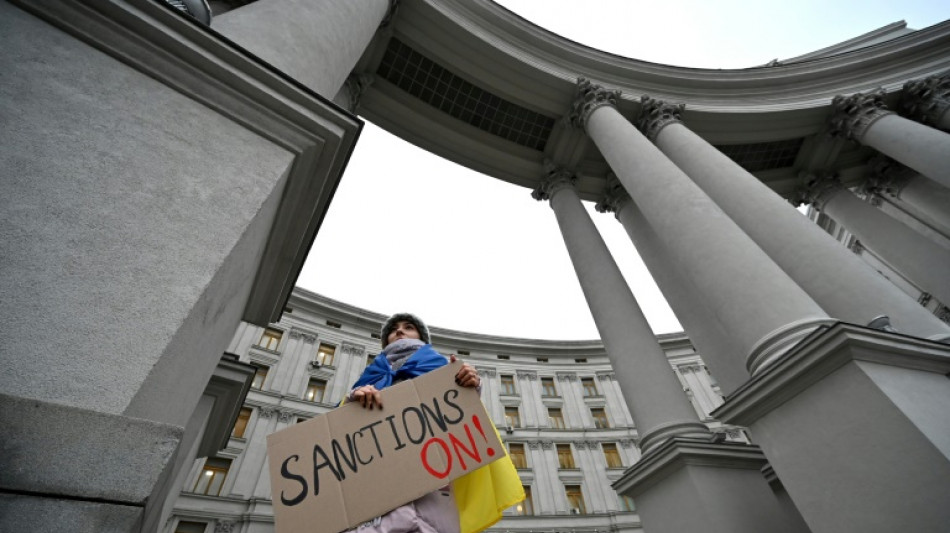
After weeks of threats, the West imposed Tuesday its first sanctions on Russia, but for the moment the actions will have limited impact on both the Russian and Western economies.
Targeting the Russian financial sector, the sanctions are "in line with the strategy of gradual measures that spare the energy sector," said Olivier Dorgans, a lawyer specialised on economic sanctions at the Ashurst law firm.
He noted however the decision by Germany to suspend the certification of the Nord Stream 2 gas pipeline.
- West hits Russian financial sector -
The United States, European Union and Britain have targeted Russia's financial sector with their first measures.
Britain on Tuesday slapped sanctions on five Russian banks including Rossiya and Promsvyazbank (PSB). The EU was expected to release its list of institutions hit by asset freezes, and Washington went after two banks and their subsidiaries, PSB and Vnesheconombank (VEB) citing their role in supporting Russia's military.
But Dorgans noted that lots of Russian capital has already been repatriated as a preventative measure.
The asset freezes on several Russian oligarchs and individuals also will have a limited impact on the Russian economy.
But Western powers aim to starve Russia of financing, blocking it from access to capital markets to raise money or refinance its debt. That will weigh on the value of the Russian ruble, and thereby crimp purchasing power of ordinary Russians to buy imported goods.
Western banks have limited exposure to Russian financial institutions, according to a senior European Central Bank official.
Nevertheless, several Western banks have operations in the country, including Italy's UniCredit, Austria's Raiffeisen and France's Societe Generale through its Rosbank subsidiary.
Washington, however, held back on other potentially damaging sanctions, such as excluding Russia from SWIFT, the international bank transaction system, which would make most financial transactions with the country impossible.
Nor did it impose export controls which would have cut Russian firms off from key high-tech equipment and software.
- Raw materials shock -
And beyond the symbolic suspension of the Nord Stream 2 pipeline, which had yet to go into service, the West has so far refrained from targeting the energy sector.
The sanctions "don't yet get to where it hurts, it is a coherent step in relation to defending European economic interests," said Dorgans.
Andrew Lohsen, a Russia expert at the Center for Strategic and International Studies in Washington, said the steps seem to fall short of what US President Joe Biden had threatened, which could encourage Putin.
The measures are "not going to compel Russia to change course," Lohsen told AFP.
However, US officials said more penalties are possible.
Sanctioning Russia's energy sector would be a calculated risk for the EU as it imports 40 percent of its gas from Russia. This gives Moscow leverage as while Europe may be able to survive without Russian imports during the coming months, over the longer term it would likely cause severe economic disruption.
Gas exporting nations including the United States and Qatar have limited capability to sharply increase shipments to Europe.
The conflict has already lit a fire under commodity prices.
"Russia plays a critical role in the global commodity markets -- accounting for about 10 percent of the global oil market," Fitch Ratings said in a recent note.
Crude oil prices nearly struck $100 a barrel Tuesday, a level unseen since 2014, and natural gas prices were up as well.
Russia also is a major exporter of palladium, nickel and aluminium, which has been flirting with record high prices.
And it is the world's top exporter of wheat, and together with Ukraine accounts for a quarter of total exports of the staple grain.
Price increases on these commodities will filter through to consumers, hitting their purchasing power when inflation has already become a top concern for policymakers.
- Worries about European economies -
Russia's recognition of breakaway regions of Ukraine will increase economic uncertainty for Europe.
Much depends on the severity of any armed conflict, "but in most cases the economic impact on countries beyond Russia and Ukraine is likely to be limited," said Neil Shearing, chief economist at Capital Economics.
In the EU, it is Germany which has the strongest economic ties with Russia, but only two percent of its exports head there.
The economic situation in Ukraine is "extremely fragile", said Shearing, warning it was likely to need additional external financial assistance in coming months.
V.F.Barreira--PC