Austria raises alarm about 'dramatic' femicide plague

 Israel army admits firing on car in death of five-year-old Hind Rajab
 Honduras places 80% of country on El Nino drought alert

 Some of Meta's safety tools were 'designed to fail': witness
 PSG Ligue 1 opener moved over state of Parc des Princes pitch

 UK PM launches bid to help homeless, donating part of his wages

 Golden Shoe winner Kane hopes for Ballon d'Or after 'best season ever'

 Kyiv's ex-defence chief makes risky bet by venturing into electoral grounds

 Coventry have survival inspiration says Lampard

 Reijnders leaves Man City for Saudi's Al Qadsiah
 Trump says will meet North Korea's Kim later this year

 Stocks waver, dollar drops as US Treasury moves to lower bond yields

 France recalls rare disease drug Tavneos after deaths
 Arsenal agree to sign Villa defender Konsa: reports
 Evacuation orders lifted in Belgian wildfire zone
 UK media skewered for 'hounding' black academic

 More than 7,300 excess deaths in France's historically hot summer so far
 US socialists score shock Florida win as Trump picks stumble

 Iran warns Gulf countries against helping US after UAE cuts trade ties

 Senior FIFA official withdraws support from embattled Infantino

 Lawson replaces injured Hadjar for Red Bull at Dutch GP
 Robots sort packages and serve fast food at Beijing showcase

 Leeds sign Swiss defender Elvedi from Monchengladbach

 Robinson double rocks Pakistan in first Test before rain stops play

 Queen Camilla says was 'difficult' keeping King Charles' cancer private
 UK PM launches bid to get rough sleepers off streets by Christmas

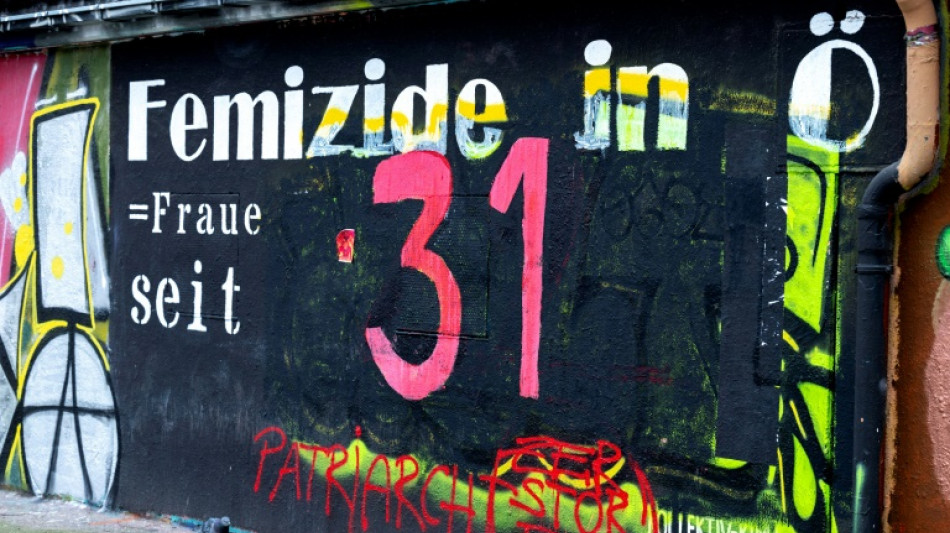
Painted in blood red on an improvised memorial in Vienna, the number 31 is a stark reminder of a grim toll: the women killed by men in Austria last year.
After several particularly horrific cases among the killings were widely reported in the media, the issue of femicide is now squarely under the spotlight.
In a small, wealthy country where violent crime generally is rare, a public debate has begun, galvanising activists and forcing politicians to act.
"It's a really dramatic situation... It's incomprehensible," Maria Roesslhumer, executive director of a network of women's shelters, told AFP.
Figures have fluctuated over the years, but between 2010 and 2020, 319 women were killed in Austria, mostly by their male partners or ex-partners, with a record high of 43 victims in 2019, according to a study commissioned by the government last year.
In 2018, Austria was among the three European Union members to report the highest rates of femicide where the perpetrator was a family member or relative, Eurostat data showed.
However, activist Ana Badhofer still decries a "lack of outrage" over femicide, saying her group instigated the memorial at a Vienna market out of frustration.
She cited an example from November of a woman beaten to death with a baseball bat.
It was a particularly shocking case last March that forced the issue to the forefront.
A 35-year-old woman, identified only as Nadine W., was beaten and strangled with a cable in a Vienna tobacco store by her 47-year-old ex-partner.
He then poured gasoline on her and set her alight before leaving the shop and locking the door.
She was rescued but died a month later from her horrific injuries.
In April, the 43-year-old owner of a craft beer store -- previously accused by a politician of harassing her with obscene messages -- was arrested for killing his former partner, a 35-year-old mother of two.
Both men were given life sentences and sent to institutions for mentally disturbed offenders.
-'Shame and stigma'-
From France to Mexico, South Africa to Turkey, campaigners have sounded the alarm about femicide and violence against women, often through massive rallies.
In Austria, the coalition government recently allocated 25 million euros ($28 million) this year, among several initiatives towards fighting the problem.
The killings have prompted some soul-searching in the Alpine country, where more women than men are killed, according to Eurostat figures, making it an outlier in the EU.
Roesslhumer pointed to a "tangible societal disrespect and disdain of women" which needed to be tackled.
Karin Pfolz has bitter firsthand experience of such attitudes.
During the decade in which she was stuck in an abusive marriage, she frequently felt isolated, she told AFP.
"You don't have anyone you can talk to, because there is so much shame and social stigma," said Pfolz, who now speaks about her experiences in schools.
Criminologist Isabel Haider, of the University of Vienna, said that law enforcement officers also needed to be trained to respond more sensitively, as many women feel "police aren't taking them seriously".
It was a fear of not being believed that kept Pfolz from reaching out to the police.
When she did eventually take her husband to court, she said that the -- female -- judge's attitude reinforced the sense she wasn't believed.
- 'Refugee in your own country'-
The Council of Europe's human rights commissioner Dunja Mijatovic, on a recent visit to Austria, called for "an ambitious and comprehensive approach" to "protect women's rights and gender equality".
She noted the Austrian gender pay gap -- just under 20 percent in 2019, according to Eurostat -- is among the widest in the EU.
"When you leave, all you've got is a plastic bag in one hand and a child in the other," Pfolz said.
"You become a refugee in your own country," she added.
But Pfolz knows that even when women are in the process of building a new life, they often still face threats from former partners.
Her ex-husband would come to her new house and she remembered having to "lock myself into a room with my son because our lives were at risk".
While she recognises that the issue of violence against women is now higher up the agenda, Pfolz still laments that "almost nobody even considers this a crime -- until it turns to murder".
This year was only a few days old before another shocking case hit the headlines -- a 42-year-old woman shot in the head and killed by her husband at their dinner table.
E.Ramalho--PC