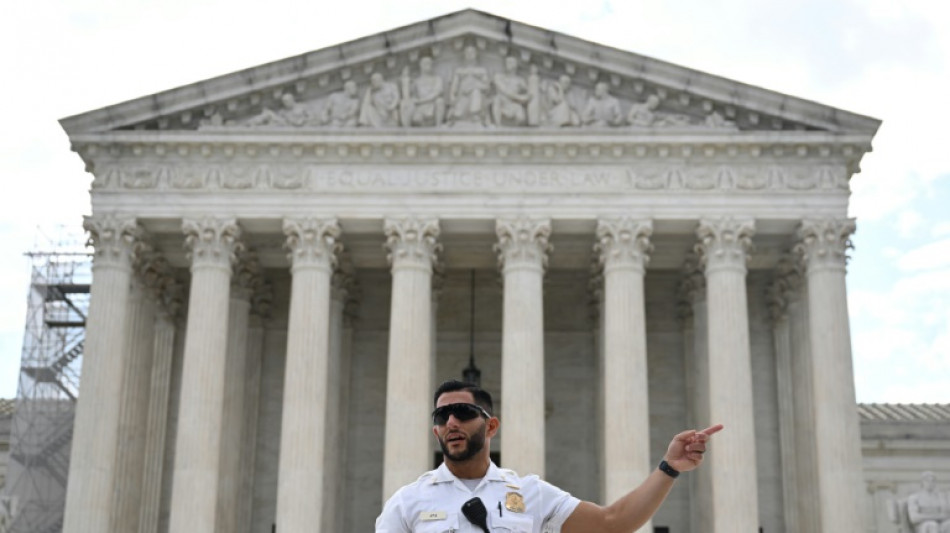
Supreme Court backs free speech rules in online stalking case / Photo: Jim WATSON - AFP

 Cash-strapped Senegalese unmoved by Youth Olympic Games

 Indonesia haze chokes neighbours, but little legal recourse

 Samad launches Pakistan into first Asian Games men's cricket final

 Yankees and White Sox advance, Phillies survive in MLB playoffs

 Asian stocks mixed as positive US data offset by elevated oil, bond yields

 Rice work: Dutch test new crop to save sinking peatlands

 Russians join street choirs to sing away sorrows -- or show dissent

 UK fears grow over AI giant Palantir's health service deal

 Empty nets in Latin America as fish flee El Nino

 Meidroth blasts White Sox through, Phillies survive in MLB playoffs

 'Catastrophic': Swiss glaciers lose fifth of mass in five years

 California roller coaster shut after brain damage claims

 Panama ministers push for reopening of huge open-pit copper mine
 Bohm's blast keeps Phillies alive in MLB playoffs

 US judge accepts Paramount's Warner Bros. buyout settlement

 Global stocks mixed as markets weigh higher oil prices, bond yields

 Marsh hails improvements after Australia win final one-day international

 Hegseth says US cut number of generals, admirals by 20%

 Kanye West's Russian concerts have been cancelled, organisers say

 First Hollywood, now Fat Bear Week: nepobaby wins Alaska contest

 Barcelona lay down marker in Women's Champions League, Arsenal slip up

 US pushes against overproduction with eye on China at G20 meeting

 Swiss FA withdraws support for FIFA chief Infantino

 Man City's meteoric rise clouded by financial scandal

 Polish activists open first abortion pill locker in Warsaw

The US Supreme Court sided with free speech advocates Tuesday in ruling that a man's online harassment of a country singer could only be deemed illegally threatening if he knew it could be understood as such.
The high court overruled the Colorado conviction of Billy Counterman for making what the western US state deemed threats among the thousands of unwelcome Facebook messages he sent to country singer Coles Whalen from 2014 to 2016.
True threats are not protected by the US Constitution's guarantee of free speech rights.
The Colorado court found based on state laws that Counterman's messages to Whalen -- such as writing "die, don't need you" and "staying in cyber life is going to kill you" -- could be objectively considered threats.
Counterman's attorney turned to the Supreme Court arguing that the only way of determining whether a message is a threat should be subjective: what was the sender's intent?
The case drew the interest of free speech advocates who worried that upholding Counterman's conviction would chill free speech protections by permitting the prosecution of anyone whose speech is perceived as threatening by another person, without proof of intent.
But Colorado had argued that requiring a subjective determination of the sender's intent would enable abuse of free speech rights, and specifically immunize stalkers "who are untethered from reality."
"Ninety percent of actual or attempted domestic violence murder cases begin with stalking," Colorado Attorney General Phil Weiser had told the court.
But in their 7-2 opinion, the justices rejected Colorado's arguments.
They said it needed to prove Counterman had at least some awareness that his messages could be perceived as threats.
Writing for the majority, Justice Elena Kagan did not completely bow to Counterman's argument that Colorado needed to prove he made a conscious threat against Whalen.
Instead, she said, the state only needed to prove that Counterman was being reckless.
"The state must show that the defendant consciously disregarded a substantial risk that his communications would be viewed as threatening violence," she wrote.
Based on legal precedents, according to Kagan, "we hold that a recklessness standard is enough" to convict.
The recklessness standard offers enough "breathing space" for protected speech without sacrificing the ability to enforce laws against true threats, she wrote.
In dissent, Justice Amy Coney Barret, backed by Clarence Thomas, said objective standards of what is threatening are supported by established law and enforced in many states.
She said the majority decision would make it harder to prosecute real threats, and that "recklessness" was a flimsy standard.
"The reality is that recklessness is not grounded in law, but in a Goldilocks judgement: Recklessness is not too much, not too little, but instead 'just right.'"
In response, Kagan wrote: "In law, as in life, there are worse things than being 'just right.'"
V.Dantas--PC