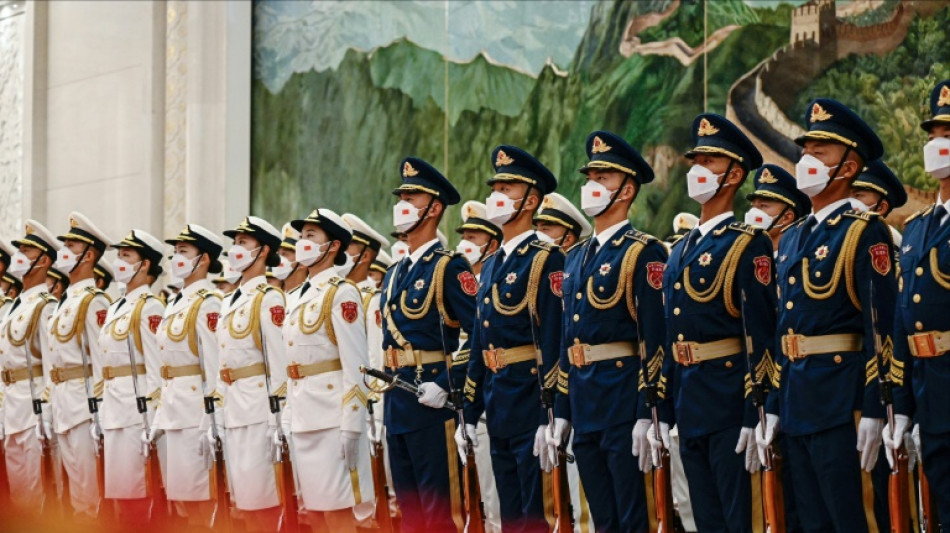
US warns firms over new Chinese 'counter-espionage' law / Photo: Jade GAO - POOL/AFP

 Kremlin critic Kasparov says US intelligence warned life 'in danger'

 Qatar 'ready' if 2030 Asian Games moved back: official

 Indian pilot hailed as 'hero' after cockpit struggle

 Asian tech firms stand out on mixed day for stocks

 Flags and pho on show as jeweller opens huge Vietnam plant

 Indian football fans relish rare friendly against Brazil

 Yankees, White Sox, Padres advance, Phillies survive in MLB playoffs

 Tennessee woman in hospital after execution 'failed': lawyers

 Cable car offers small hope for Mongolia's gridlocked capital

 Man City scandal risks damage to Premier League's booming brand

 First-time Sepang F1 racers will master track 'from opening lap'

 Japan tightens rules for foreigners wanting permanent residency

 'Happiest moment': China's Mu first woman to win eSports Games gold
 EU talks deportations as five nations seek migrant centre in Africa

 Kenneth Branagh examines the scars of Iraq war in 'Atonement'

 Hundreds held, dozens wounded as French school protests escalate

 US government's new AI chatbot pulls back from debunking Trump

 US tennis star Navarro reveals health battle, ends season

 Panic, anger, tears: Evan Gershkovich's uneasy journey after Russian jail

 UK PM says 'strong indications' Iran involved in airbase incident

 Google restricts access to new AI model over safety concerns

 Watchdog clears former US Fed chief Powell in renovation probe

 Israel PM hails Indian pilot of rerouted flight for averting disaster

 Fury, Joshua kick off 'battle of Britain' in good spirits

 Ronaldo leaves Portugal training camp after coach says he is dropped

US intelligence warned companies operating in China Friday over the impact of Beijing's new counter-espionage law coming into force on July 1.
The National Counterintelligence and Security Center (NCSC) said the law, which aims to protect China's national security secrets, gives Beijing "expanded legal grounds for accessing and controlling data held by US firms in China."
The NCSC said the new law is ambiguous on what fits into the definition of national security secrets, but believes Beijing is taking an expansive view that could include information companies use as a normal part of their business.
US companies and individuals could "face penalties for traditional business activities" if Chinese authorities label them espionage or says they are assisting foreign sanctions on China, the NCSC said in an advisory notice.
"The laws may also compel locally-employed PRC nationals of US firms to assist in PRC intelligence efforts," it said, referring to the People's Republic of China (PRC).
The new law expands on previous laws governing national secrets, and comes as relations between Beijing and Washington are deeply strained over military tensions and deep economic competition.
NCSC said the law expands China's definition of espionage from covering state secrets to any documents or data that the government says could be labelled national security-related "due to ambiguities in the law."
The law could "create legal risks or uncertainty for foreign companies, journalists, academics and researchers," it said.
The law comes amid more pressure from Beijing on foreign advisory firms operating in the country.
In March police closed the Beijing office of US due-diligence firm Mintz Group and arrested five local staff members.
The following month, US consulting giant Bain & Company said employees at its Shanghai office had been questioned.
The new law has spooked foreign and domestic firms as they try to decipher authorities' intentions -- and crucially, pinpoint what is off-limits.
"Companies are scrambling to figure out protocols to protect their staff. But the definitions are so vague," an employee of a major international auditing firm told AFP in May.
"No one knows whether they have crossed a line or not, or where the red line is."
M.Gameiro--PC