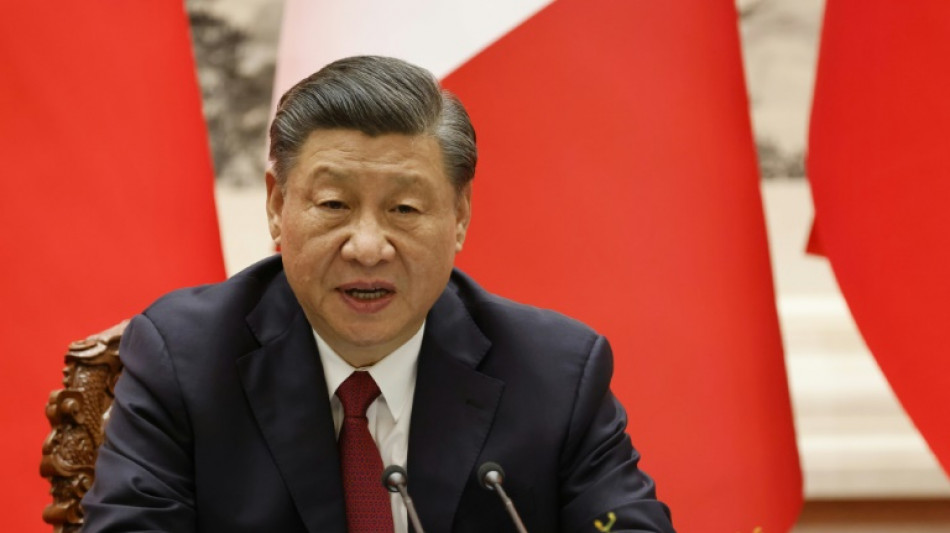
China's sweeping new anti-espionage law comes into effect / Photo: LUDOVIC MARIN - AFP/File

 Kremlin critic Kasparov says US intelligence warned life 'in danger'

 Qatar 'ready' if 2030 Asian Games moved back: official

 Indian pilot hailed as 'hero' after cockpit struggle

 Asian tech firms stand out on mixed day for stocks

 Flags and pho on show as jeweller opens huge Vietnam plant

 Indian football fans relish rare friendly against Brazil

 Yankees, White Sox, Padres advance, Phillies survive in MLB playoffs

 Tennessee woman in hospital after execution 'failed': lawyers

 Cable car offers small hope for Mongolia's gridlocked capital

 Man City scandal risks damage to Premier League's booming brand

 First-time Sepang F1 racers will master track 'from opening lap'

 Japan tightens rules for foreigners wanting permanent residency

 'Happiest moment': China's Mu first woman to win eSports Games gold

 EU talks deportations as five nations seek migrant centre in Africa

 Kenneth Branagh examines the scars of Iraq war in 'Atonement'

 Hundreds held, dozens wounded as French school protests escalate

 US government's new AI chatbot pulls back from debunking Trump

 US tennis star Navarro reveals health battle, ends season

 Panic, anger, tears: Evan Gershkovich's uneasy journey after Russian jail

 UK PM says 'strong indications' Iran involved in airbase incident

 Google restricts access to new AI model over safety concerns

 Watchdog clears former US Fed chief Powell in renovation probe

 Israel PM hails Indian pilot of rerouted flight for averting disaster

 Fury, Joshua kick off 'battle of Britain' in good spirits

 Ronaldo leaves Portugal training camp after coach says he is dropped

A revised law dramatically expanding China's definition of espionage came into force on Saturday, giving Beijing more power than ever to punish what it deems threats to national security.
The United States government, analysts, and lawyers say that the revisions to Beijing's anti-espionage law are vague and will give authorities more leeway in implementing already opaque national security legislation.
Originally released for public comment in December 2022, the revisions were formally approved by China's top legislative body in April.
Chinese law already meted out harsh punishment for those involved in alleged espionage, from life in prison to execution in extreme cases.
In May, a 78-year-old US citizen was sentenced to life in prison on spying charges.
Under the revised law, "relying on espionage organisations and their agents" as well as the unauthorised obtaining of "documents, data, materials, and items related to national security and interests" can constitute a spying offence.
Beijing insists it has the right to "safeguard its national security through legislation" and says it will "uphold the rule of law".
But experts have warned that the changes could sweep up those with even tenuous links to organisations accused of spying.
They come in the face of an already tense environment for foreign businesses in China, following raids on and questioning of staff at due diligence company Mintz Group and consulting giant Bain and Company this year.
The new law embodies a "whole-of-society approach to dealing with anything that is a risk to this broad definition of national security", Jeremy Daum, senior research fellow at Yale's Paul Tsai China Center, told AFP.
Daum said the law builds on a broader trend of tightening control since 2014, after President Xi Jinping took power.
But its vague definition of espionage and national security gives authorities a wider berth, he added, and will likely have a "chilling effect on Chinese citizens who have contact with foreigners and foreign organisations"
The new revisions have ruffled feathers among the business community, with companies fearing even tighter scrutiny.
The changes "have raised legitimate concerns about conducting certain routine business activities, which now risk being considered espionage", Craig Allen, President of the US-China Business Council, wrote in a recent blog.
"Confidence in China's market will suffer further if the law is applied frequently and without a clear, narrow and direct link to activities universally recognized as espionage," wrote Allen.
Diplomatic officials from several countries have also sounded alarm bells ahead of the legal changes, urging citizens in China to be vigilant.
The US State Department said the law will "greatly expand the scope of what (Beijing) considers espionage activities".
Deputy spokesman Vedant Patel said Washington would "continue to speak out for human rights and rule of law issues and promote accountability for (China's) repressive activities, which this of course would be one".
And the US National Counterintelligence and Security Center (NCSC) warned Friday that the law gives Beijing "expanded legal grounds for accessing and controlling data held by US firms in China".
M.Gameiro--PC