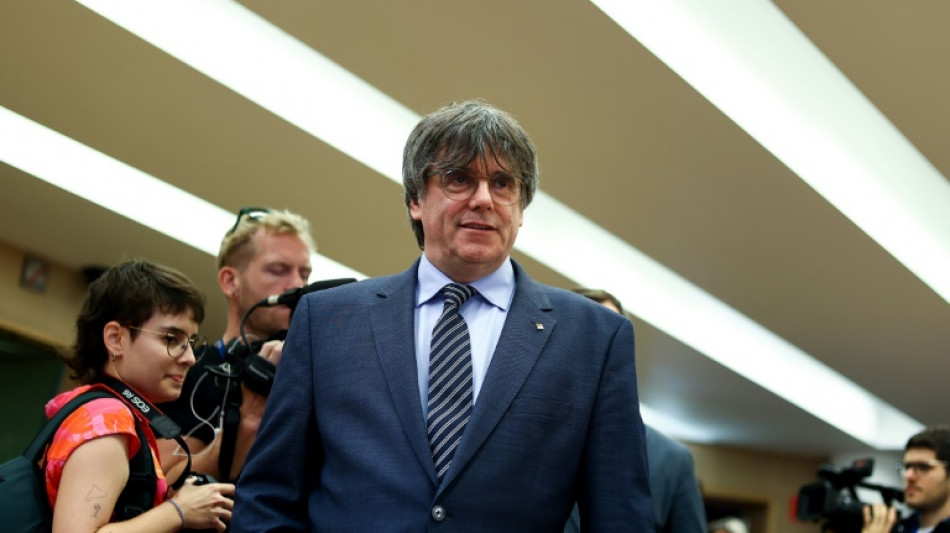
Spain MPs elect new speaker with Catalan separatists in focus / Photo: Kenzo TRIBOUILLARD - AFP

 Director Russell Goldman on 'Sender': The Dreary Psychology of Online Shopping

 ALIX LASERS GERMANY TAKES OVER CUSTOMER CARE FOR ALL ALIX LASERS AUSTRIA CUSTOMERS

 Monomark Engineering and Matangi Rubber IPOs to Open in Early December

 Avenging the Ancestors Coalition Sues Trump Administration Over Slavery Exhibit Changes

 Malta's Chris Bonett Named Among Maritime Industry's 'Men of Influence'

Spain's new parliament began meeting Thursday after an inconclusive July election with lawmakers to choose a new speaker in a closely-watched vote in which the hardline Catalan separatist party JxCat will play a key role.
Thursday's vote is widely seen as a trial run ahead of a crucial investiture vote -- which determines who forms the government -- expected next month.
During the July polls, neither the left nor the right won the 176 mandates for a working majority in the 350-seat Congress of Deputies -- with each side only able to amass the cross-party support of 171 lawmakers.
That has put JxCat in an influential position, for how its seven lawmakers vote -- both on Thursday and in the investiture vote -- could be decisive.
Shortly before the session began at 0800 GMT, Spanish media reports said JxCat had reached a last-minute deal to back Francina Armengol, the Socialist candidate proposed by the acting Prime Minister Pedro Sanchez.
"Everything suggests Francina Armengol will get more votes than Cuca Gamarra," public television said, referring to the candidate proposed by Alberto Nunez-Feijoo's right-wing Popular Party (PP), which came first in the election.
If confirmed, it would be a win for Sanchez and a step towards him being re-elected as prime minister, although analysts said he would still have a tough road ahead.
"It would be a good sign for (Sanchez) but by no means guarantees his appointment for another term, given substantial obstacles to meeting JxCat's demands," said Federico Santi, an analyst at Eurasia Group in London.
After choosing a speaker, the parliament's first job will be to chose a prime minister, with an investiture vote due later this month or in early September.
- Solid guarantees -
The Catalan separatists have set the bar high for their support in any investiture vote: an amnesty for anyone pursued by the Spanish justice system over their failed 2017 independence bid and a referendum on self-determination.
JxCat leader Carles Puigdemont demanded Wednesday solid guarantees before offering support to Spain's next government.
"We have no confidence in Spanish political parties," wrote the Catalan separatist on X, the social media platform formerly known as Twitter.
"We cannot move forward on the basis of promises made by those who always fail to keep them, so we need to see solid guarantees before committing to vote."
Puigdemont, 60, headed the regional government of Catalonia at the time of the thwarted secession bid, which involved an illegal referendum followed by a short-lived declaration of independence.
He fled Spain shorty after to avoid prosecution and currently lives in Belgium from where he leads JxCat.
In what was widely seen as a nod to the separatists, Sanchez has proposed Armengol as parliament speaker. She was regional president of the Balearic Islands, where Catalan is widely spoken, from 2015 to 2023.
Sanchez also pledged Wednesday to promote the use of Catalan, Basque and Galician within Europe -- a long-running demand of nationalist parties.
"Spain speaks Castilian Spanish but also Catalan, Basque and Galician," he told a gathering of newly elected Socialist lawmakers.
"We are going to promote the use (of these languages) within EU institutions in a commitment I will carry out during Spain's presidency of the European Union," he said of the role Spain took over on July 1.
G.Teles--PC