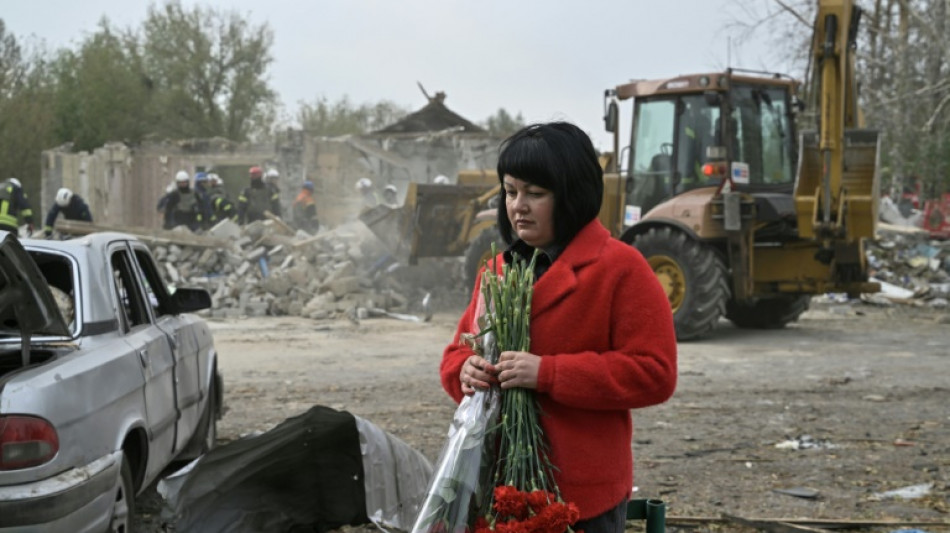
Grief and suspicion in Ukraine village hit by deadly strike / Photo: Genya SAVILOV - AFP

 Rare yellow-bellied sea snake found on Southern California beach

 Second-generation Mini Cooper SE set for India launch with 402km range

 Filmasia 2026: 16 Films Across Prague, Brno, and České Budějovice

 Kojey Radical Launches Burger Collaboration at Dallas Burger Joint in Shoreditch

 Kelly Stafford Reflects on Matthew's Lions Thanksgiving Era Ahead of Rams' Netflix Debut

 World Experiences First Six Consecutive Days Above 2C Preindustrial Threshold
Galina Yudina, from the tiny Ukrainian village of Groza, is still reeling from the shock of Russia's missile strike that killed more than 50 people just a few dozen metres from her.
On Thursday, residents of the eastern village -- who survived Russian occupation between February and September 2022 -- saw one of the deadliest strikes of the war.
Groza, which had a population of around 330, lost 52 people including a six-year-old child.
Sixty-three-year-old Yudina was working in her office when the Russian attack happened.
"One of the windows opened violently and the other exploded. I didn't understand what was happening," the accountant said.
"I started shaking. I couldn't speak any more."
Broken glass, dust and plaster littered the floor of her office, and the ceiling partially collapsed.
Those killed in the village, located around 35 kilometres (21 miles) from the eastern frontline, had gathered at a cafe for the wake for a fallen Ukrainian soldier.
On Friday, workers used excavators to clear the rubble at the destroyed cafe and nearby shop.
Others were cutting plywood to cover the windows of nearby houses blown out by the violent explosion.
Valentyna Koziyenko, 73, and her husband Volodymyr, 76, watched as neighbours put a white tarpaulin over the partially torn roof of a house located opposite the destroyed cafe.
"I was at the back of my house and my wife was inside," Volodymyr told AFP. When the missile struck, parts of the roof fell into his garden, he said.
"My wife started shouting," he added.
"When I went out in the street, all I saw was a fire and a cloud of dust and smoke."
- 'Russians knew' -
Rescuers and soldiers had until late dug through the wreckage to find corpses. Some of the bodies were dismembered or decapitated.
Oleksiy and some of his family came to the cemetery to mark out graves for his sister and brother-in-law killed in the attack. Their bodies had been taken by police to the city of Kharkiv.
"I don't know when we will be able to bury them," he told AFP with tears in his eyes.
"My brother's body was preserved but his wife's head was missing."
Nearby in the cemetery, a recently dug grave was covered with floral wreaths and a Ukrainian flag.
It was the grave of 49-year-old Andriy Kozyr, the soldier that villagers had gathered to pay hommage to when a missile struck.
Some residents found the timing of the strike suspicious.
"Everyone at the wake died," said Valentyna Koziyenko.
"The strike happened just after people went in," she said.
"How did the Russians know that so many people were in there?" said Koziyenko. "Maybe someone told them."
"People in the village knew about the funeral," her husband Volodymyr added.
"I'm sure that there could have been a collaborator who gave out the information," he said.
Yudina also said she believed that the strike was deliberate.
"The Russians knew about the gathering," she said.
Police in the region of Kharkiv said on Friday that the investigation focused in particular on "identifying people who may have been involved" in the attack.
G.Teles--PC