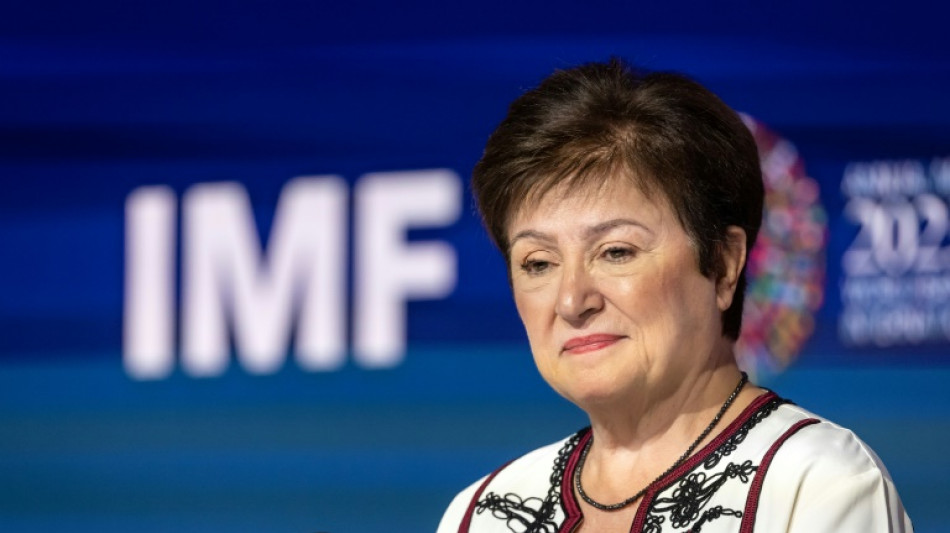
Israel-Hamas war a 'new cloud' over world economy: IMF / Photo: FADEL SENNA - AFP

 Breytenbach confirms recommending Sibiya for Johannesburg post

 Celebrities mark Thanksgiving in turkey-themed photo gallery

 German fashion model Veruschka dies in Berlin at 87

 Thanksgiving storms disrupt thousands of US flights

 T.J. Lang criticises Aaron Rodgers over comments about Mike McCarthy

 Qatar Tourism and Uber Sign Five-Year Mobility Partnership

 U2 pays tribute to Dolly Parton during Thanksgiving Eve NFL show
 Rare yellow-bellied sea snake found on Southern California beach

 Second-generation Mini Cooper SE set for India launch with 402km range

 Filmasia 2026: 16 Films Across Prague, Brno, and České Budějovice

 Kojey Radical Launches Burger Collaboration at Dallas Burger Joint in Shoreditch

The war between Israel and Hamas has cast a shadow over the IMF-World Bank annual meetings in Morocco, with warnings Thursday that it has darkened the outlook for an already sluggish global economy.
The global lenders are holding their gathering, which brings together finance ministers and central bankers from around the world, in an Arab country for the first time in 20 years.
The conflict, which erupted when Palestinian militant group Hamas launched a bloody attack on Israel from Gaza on Saturday, has raised concerns about its potential impact on the world economy.
Speaking at a press conference in Marrakesh, IMF Managing Director Kristalina Georgieva said the International Monetary Fund was "very closely monitoring how the situation evolves" and how it is affecting oil markets.
She said it was "too early" to assess the impact of the conflict, but "this is a new cloud on not the sunniest horizon for the world economy -- new cloud, darkening this horizon."
Georgieva noted that the IMF's World Economic Outlook, which was released earlier this week but drafted before the conflict broke out, already showed weak global growth.
- 'Severe shocks' -
The global economy's recovery from the Covid pandemic has been hit by Russia's invasion of Ukraine, elevated inflation and high interest rates.
"Unfortunately, far too many countries and communities are affected by natural disasters, and worse by wars in Ukraine and now in the Middle East that cause tragic loss of civilian lives and tremendous suffering," Georgieva said.
"We mourn the victims," she added.
"We are experiencing severe shocks that are now becoming the new normal for a world that is weakened by weak growth and economic fragmentation."
The IMF has kept its growth forecast a 3.0 percent for this year but lowered it to 2.9 percent for 2024, warning that the economy is "limping along, not sprinting."
The IMF's growth forecast for the Middle East and North Africa region was cut from 3.1 percent to 2.0 percent for this year, though it is expected to rebound by 3.4 percent in 2024.
"Over few months, the world economy has entered into troubled times with the war in Ukraine, conflict in Azerbaijan (and an) awful terrorist attack in Israel," French Finance Minister Bruno Le Maire told reporters.
"Geopolitical risks are the most significant risks for the world economy now," Le Maire said.
- Oil prices -
The conflict between Hamas and Israel has left thousands dead and rattled oil markets amid fears that other nations might intervene and possibly disrupt shipments in the Middle East.
Global oil prices have seesawed, jumping at the start of the conflict before easing and rising again on Thursday on concerns about supply flows.
IMF chief economist Pierre-Olivier Gourinchas said Tuesday that IMF research shows that a 10 percent increase in oil prices could weigh down on global growth by 0.15 percentage points and increase inflation by 0.4 percentage points.
The International Energy Agency said on Thursday the risk of oil supply disruptions due to the war is limited but that it stands ready to intervene in markets if necessary.
Jihad Azour, director of the IMF's Middle East and Central Asia department, said oil prices remain lower than in September.
While it is difficult to have a "clear reading" about the conflict's economic impact, Azour said, the situation is "big, it's an earthquake."
P.L.Madureira--PC