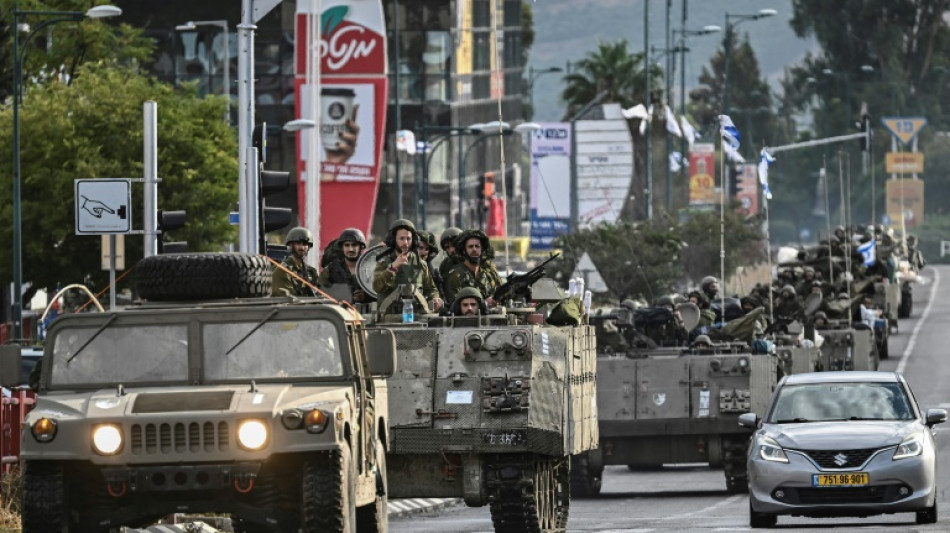
Israel-Lebanon border fire stokes fears of wider war / Photo: Aris MESSINIS - AFP

 North Sitra sewage expansion lifts capacity to 30,000 cubic metres daily
 Jennifer Barreto wins Miss Universe 2026 in Puerto Rico

 Bahraini law allows crypto assets to pass to heirs

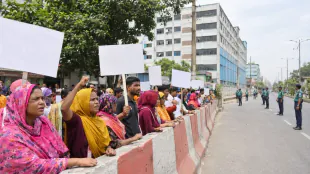 Bangladesh garment workers clash with police after wage increase

 Breytenbach confirms recommending Sibiya for Johannesburg post

 Celebrities mark Thanksgiving in turkey-themed photo gallery

 German fashion model Veruschka dies in Berlin at 87
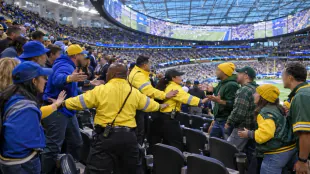
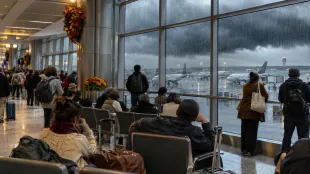 Thanksgiving storms disrupt thousands of US flights
 T.J. Lang criticises Aaron Rodgers over comments about Mike McCarthy

 Qatar Tourism and Uber Sign Five-Year Mobility Partnership
 U2 pays tribute to Dolly Parton during Thanksgiving Eve NFL show
 Rare yellow-bellied sea snake found on Southern California beach

 Second-generation Mini Cooper SE set for India launch with 402km range

 Filmasia 2026: 16 Films Across Prague, Brno, and České Budějovice

 Kojey Radical Launches Burger Collaboration at Dallas Burger Joint in Shoreditch
Israel's northern border with Lebanon is often tense, the legacy of past conflicts. But as Israel readies to invade Gaza, its army faces the threat of a two-front war.
Repeated fire in recent days has claimed lives on both sides of the UN-patrolled border between Lebanon and Israel, which remain technically at war.
If Israel does invade the Palestinian enclave of Gaza in its war on Hamas, Lebanon's Iran-backed Hezbollah movement has warned it may escalate its military involvement.
Israel's Defence Minister Yoav Gallant said on Sunday that "we have no interest in a war in the north, we don't want to escalate the situation".
He urged Hezbollah to show restraint while also warning the group that, if it "chooses the path of war, it will pay a very heavy price".
Hezbollah deputy chief Naim Qassem told a pro-Palestinian rally on Friday that it was "fully prepared and, when the time comes for action, we will take it".
The Shiite Muslim Hezbollah movement, Lebanon's only armed faction that did not disarm after the 1975-1990 civil war, last fought a major conflict with Israel in 2006.
That war left more than 1,200 dead in Lebanon, mostly civilians, and 160 in Israel, mostly soldiers, in a conflict that left deep scars and the border bristling with guns.
As tensions have again risen sharply, UNIFIL, the buffer between Israel and Lebanon since 1978, has warned that the situation could get "out of control".
Late Sunday the UN peacekeeping mission said "our headquarters in Naqoura was hit with a rocket and we are working to verify from where. Our peacekeepers were not in shelters at the time.
"Fortunately, no one was hurt."
- 'Escalation ladder' -
Over the years, cross-border strikes and incursions have been frequent but carefully calibrated, with both sides at pains to project strength but avoid escalation.
This has threatened to change since October 7 when Gaza's Hamas movement staged its unprecedented attack on Israel in which its gunmen shot, stabbed and mutilated 1,400 in Israel.
A grieving and enraged Israel has vowed to destroy Hamas and responded with a devastating bombing campaign on Gaza that has killed more than 2,670, stoking fury across the Arab world.
Tit-for-tat fire in recent days between Hezbollah and its allied Palestinian factions on the one side and Israel on the other have killed at least 11 people in southern Lebanon and two in Israel.
Most of the casualties in Lebanon have been Hezbollah and Hamas fighters, but three civilians, including a Reuters journalist, have also been killed.
Israel, which has massed tanks and troops in the north, on Sunday closed a four-kilometre (2.5 mile) stretch along the border to civilians.
It took the measure after a civilian was killed, with Hezbollah claiming responsibility.
The death came not in contested territory but in the Israeli border town of Shtula.
Both sides on the Lebanon-Israel border had so far adhered to "unwritten understandings about red lines neither should cross -– to avoid an escalation", said Heiko Wimmen, project director for Iraq, Syria, Lebanon at the Crisis Group, in a paper published Saturday.
Sunday's attack on Shtula was "one notch up on the escalation ladder," Wimmen said in a post on X, formerly Twitter.
"A small notch, but on this, such details matter hugely."
- 'We are exhausted' -
Analysts have said Hezbollah is more likely to scale up its involvement if Israel launches a ground offensive of Gaza.
Iran, which supports Hamas and Hezbollah, warned Sunday that a ground offensive could expand the scope of the conflict elsewhere in the Middle East.
"No one can guarantee the control of the situation and the non-expansion of the conflicts," said Iranian Foreign Minister Hossein Amir-Abdollahian.
He had told reporters in Beirut days ago that "Lebanon's security and peace" was important for Tehran and warned that "any possibility is conceivable".
The United States and other Western powers that support Israel have urged restraint and warned against a regional spillover of the conflict.
Many Lebanese -- scarred by the civil war, Israeli occupation and the 2006 conflict -- fear the consequences of renewed war.
Lebanon, in the throes of a deep economic crisis, can ill afford it.
In southern Lebanon, hundreds have left to seek refuge with relatives living further from the tense border, but some could not afford to flee.
Kamleh Abu Khalil, 72, said she had packed her bag but was not certain she would make it out because her family doesn't have a car.
"We are exhausted," she said. "We are fatigued."
X.M.Francisco--PC