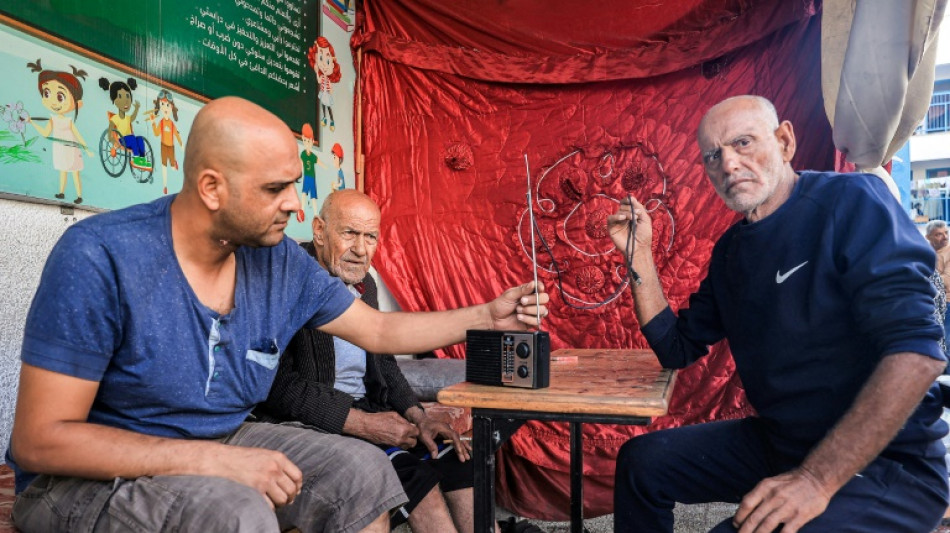
Radio sets make a comeback in war-torn Gaza / Photo: SAID KHATIB - AFP

 FIFA chief Infantino hit by Norwegian double complaint

 Exiled Catalan separatist leader Puigdemont cleared to return to Spain
 Stock markets climb as oil prices retreat

 'No future': Thousands mass in France for high school protests

 Nobel physics prize honours work on 'ghostly messengers' from outer space

 Bulgaria searches for missing crew after drones hit two more ships in Black Sea
 Le Pen vows drastic cost savings to prevent French 'default'

 'Eats through a straw': French teens wounded in high school protests
 Thousands mass in France for high school protests

 Moscow denies sanitary measures over plague reports
 Samoa look to recreate 2022 final run at Rugby League World Cup

 Asian stocks mostly up after tech-led Wall St record

 German factory orders plunge as recovery still fragile

 Coco Gauff calls out online racism following China open video review

 KVB Accelerates Middle East Footprint with Strategic MENA Regional Expansion

 Purple reign: Philippines seeks to keep grip on ube throne

 Seoul weighs steps to force North Korea landmine apology

 Yemen's Houthis say struck Riyadh airport, other Saudi sites

 Changer+ Launches Stablecoin-First Self-Custodial Wallet to Make Stablecoins Easier to Use

 White Sox down Guardians, Yankees on brink after Rays loss

 COP31 eyes modest steps as climate disasters multiply

 American Nobel laureate in medicine hopes to illuminate the brain
 Trump approves firing squad for convicted US military base shooter
 Grappling with 'homework scams,' US universities shun AI detectors
 Separatists win Quebec election in test for Canada PM

Before war broke out in Gaza, Mahmud al-Daoudi could never have imagined the radio sets gathering dust in his shop would be in such high demand, offering his customers a precious link with the outside world.
Power cuts have long been a part of everyday life, but the besieged territory's 2.4 million people are now enduring long blackouts after Israel cut off electricity and fuel supplies.
Its relentless assault has killed more than 19,450 Gazans, mostly women and children, according to the Hamas-run territory's health ministry.
Israel began its devastating air and ground offensive following the October 7 Hamas attacks, which killed around 1,140 people in southern Israel, according to an AFP tally based on Israeli figures.
It is now impossible to plug in computers or television sets, recharge phones or access the internet without generators or solar panels, a luxury few Gazans can afford.
But to keep up with the news, there's always the battery-powered radio.
"We had a full stock but we've been completely out of them since the first week" of the war, Daoudi said.
With the phone and internet cuts, "radio is the only way to find out what's going on," he said.
The long battery life is another plus, he said from his store in Rafah, at the southern end of the territory.
Before the war, a radio cost around 25 shekels ($7) -- now, they go for around 60 shekels ($16).
"We've even resold the broken radios people returned to us," the 33-year-old said.
When the radio sets disappeared from the shelves, customers asked for old telephones with built-in radios and torches, a welcome help when night falls.
"Now we're running out of phones," Daoudi told AFP.
- 'Moving backwards' -
It's impossible to order new stock, with only limited humanitarian aid trickling into the territory.
"People want to follow the news, hear where the shelling is taking place and find out about the fate of their families," said Hussein Abu Hashem, who has run out of radios at his shop too.
According to the UN, 1.9 million Palestinians have been displaced since the start of the war, around 85 percent of the population.
Many of them are now living in makeshift camps in the south of the territory where they lack basic supplies.
"I don't know what's happening around us, where the strikes are, which houses are targeted, who's alive, who the martyrs are," Umm Ibrahim told AFP in the southern city of Khan Yunis.
"We want to receive news from anywhere in Gaza," she said.
"When my battery runs out, I walk around the camp and listen out for other people's radios."
Stations such as BBC Arabic and Al Jazeera have launched special channels to help keep displaced people up to date with the news.
Some Gazans, like 75-year-old Hebrew-speaker Mohammed Hassouna, manage to pick up the news from Israeli radio stations.
He said it allows him to keep up with the latest "from the Israeli side".
"I keep my children and neighbours informed," he said.
Outside his tent, Salah Zorob, 37, spends his time flicking through radio stations on his mobile phone.
"The world is moving forward with modern technology but here in Gaza we're moving backwards," he said.
"They're going to take us back to the Stone Age."
G.Teles--PC