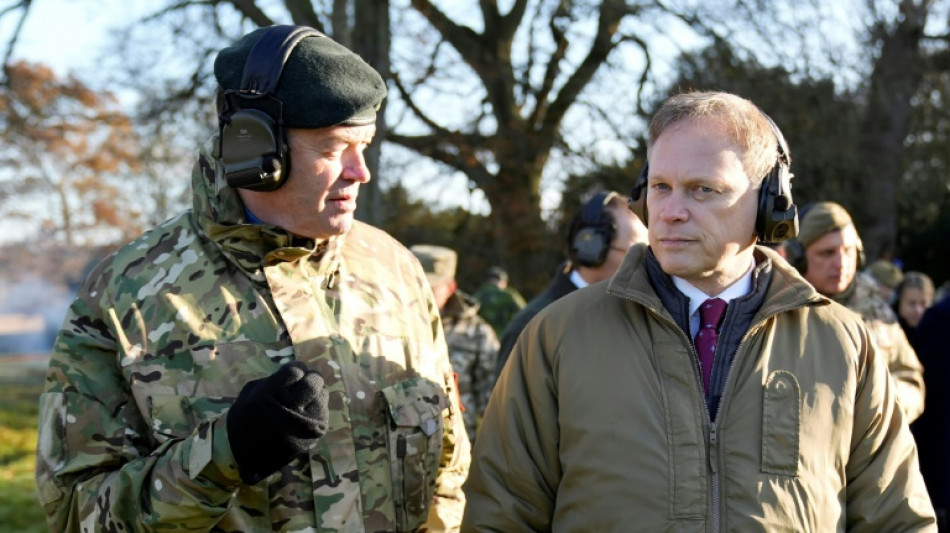
Britons should be prepared to fight a land war: army chief / Photo: Alastair Grant - POOL/AFP

 Rubio in Greece to urge against Western civilisation 'decline'
 Micron workers at Taiwan plant vote in favour of strike

 In 'The Social Reckoning,' Jeremy Allen White takes on Facebook's 'frightening' ambition
 Chip industry activists call for South Korea to recognise cancer cases
 Famine-scarred southern Madagascar braces for El Nino

 How the EU regulates lobbyists
 I.Coast refuge offers lifelong care for youngsters scorned as 'sorcerers'

 Indian central bank hikes rates for first time in more than 3 years
 Hotel Blacklist Launches New Accommodation Industry Risk Assessment Tool
 Bangladesh nuclear plant draws hope -- and worry

 US beat Canada 1-0 to wrap up four-win international break

 Turkey, Australia's joint COP31 leadership raises doubts
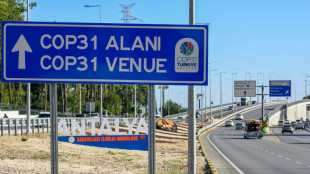 For Turkish NGOs, COP31 offers rare space for action

 Sleep, appetite, gene-editing experts contend for Nobel chemistry prize

 Nobel Peace Prize haunted by the 'spectre' of Trump

 Africa launches own credit agency in bid for cheaper borrowing

 US, China, EU: three paths to regulating AI
 Australia's High Court rules against coal mine in landmark climate case
 Australia touts new funds for Pacific infrastructure at Fiji 'pre-COP'

 Eva Marie Saint, Oscar winner of Hollywood classics, dies at 102

 Australia probes app used in cheap smart glasses over privacy fears
 England needed to 'move on' from World Cup pain, says Tuchel

 O'Neill to stay at Celtic after period of "reflection"

 Kane marks 125th England cap with Wembley Nations League double

 Quebec's incoming separatist leader wants to block Crown from swearing-in
British citizens should be prepared to fight in a potential land war, the highest ranking army officer General Patrick Sanders said on Wednesday.
The chief of the general staff said any conflict would need to be a "whole-of-nation undertaking" and that citizens should be trained and equipped to be in a state of readiness.
The general's remarks come after the UK defence ministry said last year that it would cut overall numbers in the UK's professional army from 82,000 to 73,000 by 2025.
"Taking preparatory steps to enable placing our societies on a war footing when needed are now not merely desirable but essential," Sanders said in a speech at an armoured vehicles conference in southwest London.
"Within the next three years, it must be credible to talk of a British Army of 120,000, folding in our reserve and strategic reserve."
Sanders, who steps down later this year, said the UK could not rely on its navy and air power, arguing that "we must be able to credibly fight and win wars on land".
UK allies were already doing so, he said.
"Our friends in eastern and northern Europe, who feel the proximity of the Russian threat more acutely, are already acting prudently, laying the foundations for national mobilisation," he added.
"Ukraine brutally illustrates that regular armies start wars; citizen armies win them."
Last week the chair of NATO's military committee, Admiral Rob Bauer, said civilians in member states should be prepared for a potential future war with Russia.
A large number of civilians would have to be called up if conflict accelerates in Europe, he added.
Earlier this month UK Defence Secretary Grant Shapps said that the UK wants to increase defence spending from 2.1 percent of GDP to 2.5 percent in the future.
In a speech last week the minister said that the world was "moving from a post-war to pre-war world".
The UK, he said, must ensure its "entire defence ecosystem is ready" to defend its homeland.
Richard Dannatt, who was chief of the general staff from 2006 to 2009, compared the current situation to the 1930s when the "woeful" state of the UK's armed forces failed to deter Nazi aggression.
"There is a serious danger of history repeating itself," he wrote in The Times newspaper last week, calling for UK defence spending to reach 3.0 percent of GDP.
"If our armed forces are not strong enough to deter future aggression from Moscow or Beijing, it will not be a small war to contend with but a major one."
S.Pimentel--PC