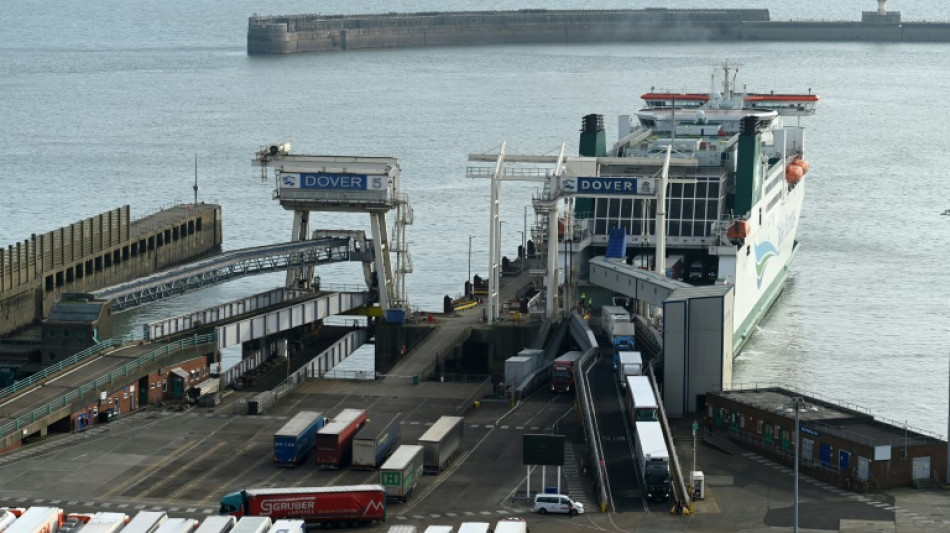
New post-Brexit customs checks spark UK border worries / Photo: Glyn KIRK - AFP

 Arteta targets more Arsenal glory after signing new deal until 2030

 Russell hit with Singapore grid penalty for taking new power unit

 Spotify expands audiobooks to more than 180 markets
 French-Japanese duo wins chemistry Nobel for solving molecular 'mystery'

 England's Nations League surge helps heal World Cup wounds

 Mayor of opposition stronghold Izmir defects to Erdogan party
 Mertens beats Gauff to set up Swiatek clash at China Open

 Benin full of pride at role in Messi's last dance

 France suspends stun grenade use at student protests ahead of PM speech

 Indonesian court hears 'negligence' complaint against state over fires, haze
 Rubio in Greece to urge against Western civilisation 'decline'
 Micron workers at Taiwan plant vote in favour of strike
 In 'The Social Reckoning,' Jeremy Allen White takes on Facebook's 'frightening' ambition

 Chip industry activists call for South Korea to recognise cancer cases
 Famine-scarred southern Madagascar braces for El Nino
 How the EU regulates lobbyists
 I.Coast refuge offers lifelong care for youngsters scorned as 'sorcerers'

 Indian central bank hikes rates for first time in more than 3 years

 Hotel Blacklist Launches New Accommodation Industry Risk Assessment Tool

 Bangladesh nuclear plant draws hope -- and worry
 US beat Canada 1-0 to wrap up four-win international break

 Turkey, Australia's joint COP31 leadership raises doubts

 For Turkish NGOs, COP31 offers rare space for action
 Sleep, appetite, gene-editing experts contend for Nobel chemistry prize
 Nobel Peace Prize haunted by the 'spectre' of Trump

The UK will finally roll out post-Brexit border checks Wednesday on food, plant and animal products imported from the European Union, fanning fears of more price hikes, empty shelves and even Valentine's Day flower shortages.
The long-awaited move will affect dinner-table staples from across the Channel, such as ham, sausages and cured meat, as well as butter, cheese and cream. It will also affect cut flowers.
The changes have been delayed five times because of fears about the knock-on effect on the sluggish UK economy and inflation, which remains elevated amid a broader cost-of-living crisis.
From Wednesday, companies must present certificates for sanitary and phytosanitary imports at the UK border. Some goods from Northern Ireland will also face full customs controls.
London had postponed the checks since leaving the EU's customs union and single market in January 2021, but UK exports have faced controls for products heading in the opposite direction.
- 'Very concerned' -
Marco Forgione, director general at the Institute of Export and International Trade, which represents UK importers, says most companies are "very" worried about negative fallout.
"Over 70 percent (of member firms) are very concerned about the impact of these changes," Forgione told AFP, citing a survey by the organisation.
This week's changes will cost UK businesses approximately £330 million ($420 million) per year in additional charges, according to government estimates.
UK Prime Minister Rishi Sunak's Conservative administration insists that this will not have a significant impact on food inflation.
But that has not allayed concerns.
Not all companies will be affected in the same way, although there is increasing alarm among fruit and flower producers, which rely on imported plants from EU nations, particularly from the Netherlands.
The UK's National Farmers' Union argues such horticultural businesses face an "existential threat" from the rule changes, The Guardian newspaper reported.
Dutch flower-growing association VGB has also written to London to express concern.
"Delays in transit times and insufficient care in handling these goods could result in substantial damages and losses," the VGB wrote, according to part of the letter shared with AFP.
The organisation also slammed the insufficient number of border control points and urged another postponement, while British MPs asked the government to guarantee that red tape will not mean no red roses for Valentine's Day.
"Roses from the EU are classed as a low-risk good so will be exempt from controls at the border and not affected by these changes," the government said last week.
However, not all sectors have been critical of the new UK checks.
The livestock sector complains that exports currently face far greater scrutiny heading into the European Union, than EU imports heading the other way.
"For the past three years, British farmers have faced the full reach of EU controls on our exports while the EU has enjoyed continued easy access to the UK marketplace," President of the National Farmers' Union of England and Wales Minette Batters told AFP.
"This is not just an issue for competitiveness, with our farmers faced with additional costs and paperwork, but also for our nation's biosecurity."
- Disruption -
Further down the line, the government plans physical UK border checks from late April.
The British Meat Processors Association (BMPA), an industry body, anticipates that "random" border checks will be carried out -- but "consignments will not face rejection or be turned back" during an initial phase.
However, it warns that there is a "significant likelihood of disruption to supply chains" from April, according to a BMPA spokesman, citing the need for more veterinary certificates.
"Every indication we have is that there is a lack of veterinary capacity amongst EU exporting countries," the spokesman added.
Almost half of the pork consumed in Britain comes from the EU, according to the BMPA.
Andrew Opie, director of food and sustainability at the British Retail Consortium, expects costs will rise and smaller players might not be fully prepared.
"Whilst we are not anticipating widespread problems... there will be some smaller suppliers who may still not be prepared for the changes," said Opie.
However, he also warned that "the checks will create additional costs for retailers" that have already ramped up prices due to elevated inflation.
In the longer term, the UK government proposes a simplified border-control system to share data and harness new "smart" technology like GPS trackers.
Those plans "will help reduce costs and friction for businesses, which in turn will help to grow the economy", Forgione at the Institute of Export and International Trade noted.
A.P.Maia--PC