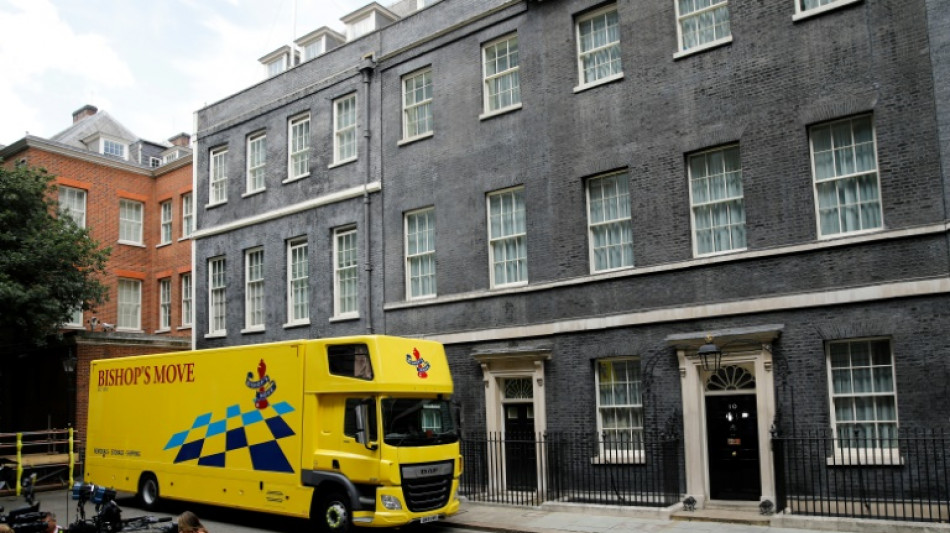
On course for power, UK's Labour prepares for a quick change / Photo: Tolga AKMEN - AFP

 Court orders German ex-spy chief kept in jail after spying, treason arrest
 Guinea caps bottled water prices after sachets banned

 Spared, married, hanged: the last weeks of Iranian protester Alireza Sepahi

 Nobel physics winner's pride at pioneering AI role

 IMF preparing El Nino assistance, concerned about AI bubble burst: chief to AFP

 West must embrace 'national power' or face decline: Rubio

 Shell refining margins reach record highs as wars hit supply
 Former Spain, Barca winger Pedro retires from football

 Arteta signs new Arsenal deal until 2030

 Stocks decline as oil climbs on Mideast flareup
 Gauff says online abuse was 'draining' after China Open exit

 As sector struggles, Porsche puts luxury ahead of volume
 'It's personal': Fiji minister pushes better climate finance at pre-COP

 Russia glosses over dark Soviet past in reinvented museum

 UK tax body opened probe into Man City in 2018: FT

 Yemen's Houthis claim new attacks on Saudi airports as conflict deepens
 Germany factory production at highest level for 18 months
 Thailand floods death toll rises to 60 since mid-September

 US pushes Russia for information on plague reports

 Myanmar leader lands in Malaysia for migrant return talks

 Indian central bank hikes rates for first time since 2023

 US military on Okinawa face curfew, alcohol ban after murder case

 Fierce lobbying in EU over 'forever chemicals'

 Dodgers beat Braves and Padres avoid sweep in MLB playoffs
 Mourning, war and elections as Israel marks October 7

If the main opposition Labour party wins the next UK general election as opinion polls indicate, then a familiar sight will appear outside the prime minister's official residence the next day: removal vans.
The overnight transition, unique in major Western democracies, contrasts with the roughly two months' preparation for an incoming US administration and around 10 days for a new French president.
But if Labour defeats the governing Conservatives by a majority at this year's nationwide vote, its leader Keir Starmer will replace Rishi Sunak inside 10 Downing Street within hours.
The UK's politically neutral 500,000-strong civil service, satirised in the hit 1980s British sitcom "Yes Minister", will immediately find itself working for new government ministers with new priorities.
Key to the quick changeover are so-called "access talks" between the opposition party and senior civil servants, which occur in the run-up to an election.
Tory leader Sunak recently gave Labour permission to commence these discussions with mandarins in Whitehall -- the catch-all term for the civil service -- and they are due to start imminently.
"They're important because they're the only opportunity before the election for opposition politicians to privately share their thinking and their ideas with the civil service government machine," former civil servant Alex Thomas told AFP.
They are also a chance for civil servants to inform future ministers and their advisers about any operational issues they may encounter at the department they might soon lead.
"It's an opportunity for people to build a working relationship," added Thomas, who was involved in access talks before the 2017 election when he worked in the office of the cabinet secretary, the head of the civil service.
- Secrecy -
The talks are confidential and almost always happen away from government offices to avoid any chance of ministers running into their opposite number sneaking a chat with their permanent secretary -- the most senior civil servant in a department.
Permanent secretaries are expected to stick to providing factual information only.
They are not to provide policy advice or inform the opposition of imminent government announcements, and must not report back to the government what they have been told.
Often, the opposition chooses to keep quiet any major policy plans that they have yet to announce publicly, just to be sure of no leaks.
Jill Rutter received a surprise when she worked at the Treasury in 1997, as Tony Blair's New Labour party swept into power after 18 years of Conservative rule.
"We had our first big meeting. (Then new Chancellor) Gordon Brown came into the office, and he said, 'I'm going make the Bank of England independent.' And we all went, 'What?!'" recalled the former civil servant.
Access talks began at least 16 months before the 1997 and 2010 elections, the last time there was a change of majority government, according to the Institute for Government (IfG) think tank.
Labour will have around nine or 10 months of discussions if Sunak calls the election for the autumn.
If he goes early in the spring, then they could have as little as four months.
- Stability -
Despite being in opposition for 14 years, Labour's top team has ministerial experience in Yvette Cooper and Ed Miliband, while Starmer himself was a senior civil servant in his former role as director of public prosecutions for England and Wales.
"They are probably more experienced at the top level than they were in 1997," Rutter told AFP.
"The interesting thing is, can they actually sort of translate that into action when they get into government?"
The myth of the civil servant, popularised by fictional mandarin Sir Humphrey Appleby in "Yes Minister", is that of conniving bureaucrat seeking to thwart the minister's objectives.
"In reality, most of the time the minister wins and that is the way it should be because the minister is democratically elected," said Thomas, now at the IfG.
Rutter noted that civil servants had experienced "almost non-stop change" in recent years, with five Conservative prime ministers since the 2016 Brexit vote and endless ministerial reshuffles.
Some lawmakers have also taken to blaming the civil service, with several permanent secretaries moved on.
Many bureaucrats will be looking for stability from a new administration, Rutter said.
"I think the civil service will want reduced churn, hopefully more clarity of direction, and a government that's not tearing itself to ribbons all the time," she said.
X.Matos--PC