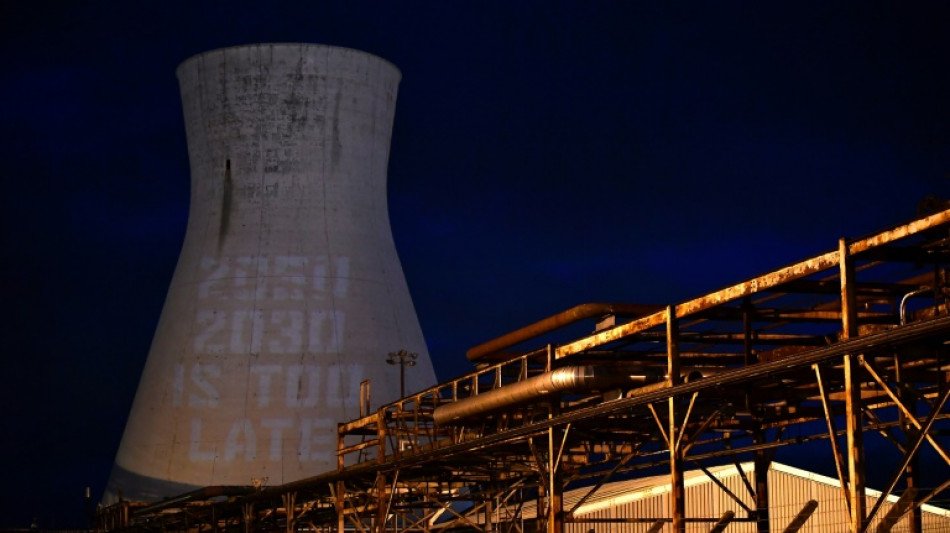
Removing CO2 from air, sea no longer optional, says UN

 Israel army admits firing on car in death of five-year-old Hind Rajab

 Honduras places 80% of country on El Nino drought alert

 Some of Meta's safety tools were 'designed to fail': witness

 PSG Ligue 1 opener moved over state of Parc des Princes pitch

 UK PM launches bid to help homeless, donating part of his wages

 Golden Shoe winner Kane hopes for Ballon d'Or after 'best season ever'

 Kyiv's ex-defence chief makes risky bet by venturing into electoral grounds

 Coventry have survival inspiration says Lampard

 Reijnders leaves Man City for Saudi's Al Qadsiah

 Trump says will meet North Korea's Kim later this year

 Stocks waver, dollar drops as US Treasury moves to lower bond yields

 France recalls rare disease drug Tavneos after deaths
 Arsenal agree to sign Villa defender Konsa: reports

 Evacuation orders lifted in Belgian wildfire zone

 UK media skewered for 'hounding' black academic

 More than 7,300 excess deaths in France's historically hot summer so far

 US socialists score shock Florida win as Trump picks stumble

 Iran warns Gulf countries against helping US after UAE cuts trade ties

 Senior FIFA official withdraws support from embattled Infantino

 Lawson replaces injured Hadjar for Red Bull at Dutch GP

 Robots sort packages and serve fast food at Beijing showcase

 Leeds sign Swiss defender Elvedi from Monchengladbach

 Robinson double rocks Pakistan in first Test before rain stops play

 Queen Camilla says was 'difficult' keeping King Charles' cancer private
 UK PM launches bid to get rough sleepers off streets by Christmas

However quickly the world slashes greenhouse gas emissions, it will still need to suck CO2 from the air and oceans to avoid climate catastrophe, a landmark UN report said this week.
Long seen as marginal or an industry ploy to avoid curbing emissions, carbon dioxide removal (CDR) is today a necessary weapon in the battle against global heating, according to the UN's Intergovernmental Panel on Climate Change (IPCC).
"This is the first IPCC report to state clearly that carbon dioxide removal is needed to achieve our climate targets," said Steve Smith, head of Oxford Net Zero at the University of Oxford.
The Paris Agreement calls for capping global warming below two degrees Celsius, and most countries have signed on for a more ambitious limit of 1.5C.
Even under the most aggressive carbon-cutting scenarios, several billion tonnes of CO2 will need to be extracted each year from the atmosphere by 2050, and an accumulated total of hundreds of billions of tonnes by 2100.
"Carbon dioxide removal is necessary to achieve net-zero C02 and greenhouse gas emissions, both globally and nationally," the report concludes.
This will compensate for sectors where emissions will be hard to abate, such as aviation, shipping and cement.
And depending on how successfully carbon pollution is drawn down, CDR may be needed to cool Earth's surface if the Paris treaty temperatures targets are breached.
- Grow, burn, bury -
There are a variety of ways that "negative emissions" can be achieved, but all would be needed to be ramped up significantly to make a dent in the approximately 40 billion tonnes of CO2 currently emitted each year.
Drawing down carbon pollution remains the absolute priority.
"It is critical that an equitable and orderly roadmap for the transition away from fossil fuels is agreed," said David King, head of the Climate Crisis Group and Britain’s former Chief Scientific Advisor.
"But we must also put significantly more resource into greenhouse gas removal."
Virtually all of the IPCC models laying out pathways for a liveable future reserve an important role for technology called BECCS, or bioenergy with carbon capture and storage.
The recipe is pretty straightforward: grow trees, burn them for energy, and bury the CO2 emitted underground, in an abandoned mineshaft for example.
By 2050, the IPCC says, BECCS could be called upon to extract just under three billions tonnes of CO2 per year.
Restoring forests and planting trees that absorb and stock CO2 as they grow also figure prominently in development scenarios achieving net-zero emissions at or near mid-century, accounting for the same level of carbon removal at mid-century.
But what works on paper -- and in so-called integrated assessment models -- has not materialised in reality.
One of the few commercial-scale BECCS facilities in the world, in Britain, was dropped last year from the S&P Clean Energy Index because it failed to meet sustainability criteria.
"I don't see a BECCS boom," said Oliver Geden, a senior fellow at the German Institute for International and Security Affairs and an expert on CDR.
- Offset schemes -
The area required, meanwhile, for tree-planting schemes -- up to twice the size of India -- would compete with food and biofuel needs.
Many businesses, including fossil fuel companies, rely heavily on carbon offset schemes based on afforestation to compensate for continuing carbon emissions.
The newest CDR method, a chemical process known as direct air carbon capture and storage (DACCS), is attracting interest.
Industry leader Swiss-based Climeworks announced Tuesday it had raised $650 million (595 million euros), and the technology has attracted major corporate backing from via Bill Gates' Breakthrough Energy partnership.
But the potential for scaling up remains to be proven: Climeworks' direct air capture facility in Iceland -- the largest in the world -- removes in a year what humanity emits in three or four seconds.
Other CDR methods at various stages of experimentation and development include enhancing the capacity of soil to sequester carbon; conversion of biomass into a charcoal-like substance called biochar; peatland and coastal wetland restoration; and so-called enhanced weathering of rocks rich in minerals that absorb CO2.
Potential ocean-based methods include boosting marine alkalinity, either by directly adding alkaline minerals or an electrochemical processing, and stimulating the growth of phytoplankton, tiny organisms that stock carbon through photosynthesis and then sink to the ocean floor when they die
A.Aguiar--PC