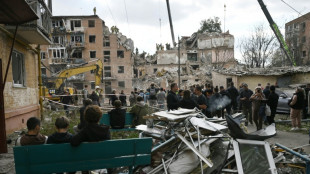
'Everything is getting worse:' fatigue marks Ukraine war anniversary / Photo: Anatolii STEPANOV - AFP

 Rookie Henry named in Wallabies midfield to face All Blacks
 Housing crisis set to dominate Spain's snap election

 Gas, health care, utilities: high costs squeeze US midterm voters

 New Zealand Rugby seeks injunction over PNG Chiefs name
 Samsung expects 780% quarterly operating profit jump on AI boom

 Guardians survive with 9-3 win over White Sox

 Saudi Arabia says 3 dead at airports after Houthis claim attacks
 Stocks slide as oil sees volatile trading day over Iran war fears
 Microsoft pushes AI vision with new, expensive Surface laptop

 Five children among 28 killed in Russian strikes on Ukraine

 Odell Beckham Jr signs with Minnesota Vikings
 Saudi Arabia says three dead at airports after Houthis claim attacks
 Trump plans to turn Florida golf course into presidential retreat
 WHO says cannot conduct full risk assessment on Russia plague reports
 After botched execution, US woman is awake and shackled to bed
 New Zealand fly-half Mo'unga ruled out of Australia Tests

 Protests in major Turkish city after mayor defects to Erdogan party
 Climate change strips island's title of largest penguin colony: study

 Rubio says West must choose between national power or decline

 Russia's plague scare: What we know

 French luxury giant to fund redevelopment of two Paris streets: city hall

 Trump wants to turn Florida golf course into presidential retreat
 Mayor of Turkish opposition stronghold defects to Erdogan party

 Children among heavy casualties in Ukraine after Russian strikes

 Court orders German ex-spy chief kept in jail after spying, treason arrest

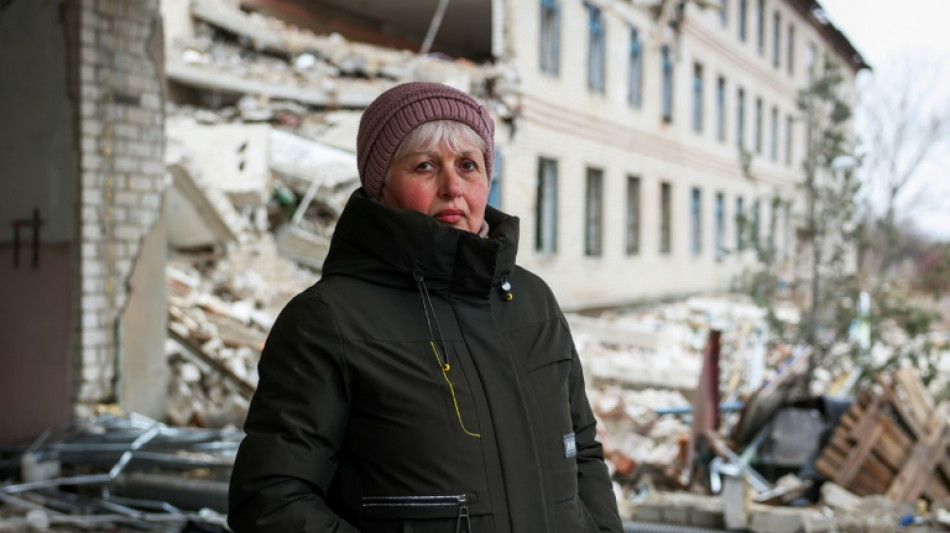
Nearly every day since her school in east Ukraine was reduced to rubble by two Russian missiles last month, Lyudmila Polovko has walked its grounds to dream of a time when children could return.
Stepping over glass shards and torn text books, the teacher and administrator recounted how her thoughts had turned from planning to mark 60 years since the school opened to surviving the war.
"We're very tired of hearing that our men are dying. We're tired of seeing it all with our own eyes, of not sleeping at night because of the noise, because of the missiles," she told AFP at the school, overlooking a cemetery and chimneys of Soviet-era factories.
"As bitter as it is to see these ruins, we still hope for the best," the 62-year-old said, in a biting winter wind.
On the two-year anniversary of Russia's brutal invasion, which has pitted the Kremlin's expansionist ambitions against Ukrainian resolve, there is a growing sense of uncertainty among those caught in between over how and when it will all end.
The fallout from disagreements in Washington and Brussels over aid has rippled all the way to the front line in the Donetsk region, where outnumbered and outgunned Ukrainian troops are ceding ground to Moscow's determined forces.
- 'Russians keep coming' -
For the Ukrainian troops holding Russian forces from cities like Kostyantynivka, the task is becoming harder as their resources and stamina ebb.
"We are running out of shells and the Russians keep coming. Lots of our comrades are injured -- or worse. Everything is getting worse and worse," said one soldier deployed outside Bakhmut, which was captured by Russia last May, speaking on condition of anonymity.
"There is no supply of ammunition or artillery support. The command is not interested in the morale of the soldiers," another from the Azov battalion, known for its last-stand in the port city of Mariupol -- also now Russian-controlled -- told AFP.
President Volodymyr Zelensky has warned allies that Russia is taking advantage of these setbacks, and that Ukrainian defences could collapse.
In Kostyantynivka, Polovko felt sure the West would not abandon Ukraine, and struggled to imagine a future in which help from abroad ran out.
"It's hard to say what would happen then. I just know how selflessly our guys are fighting, not sparing their lives. And they are dying. Let's stop speaking," she said, turning away as her eyes welled up with tears.
- 'Loud noises are a trigger' -
The civilian cost of Ukraine's struggle to hold back Russian forces is mounting, too.
AFP journalists in the city of Kramatorsk last week saw dozens of rescue workers dig by lamplight for a woman, her mother and her son buried under their home at night by a Russian missile.
All three were found dead during the frantic rescue operation.
The governor says 1,876 civilians have been killed in the region over the last two years, but there are no figures for those killed in occupied cities like Mariupol and low estimates point to a toll in that city alone four times the region's total.
In a community centre in Kramatorsk, psychologist Olga Yudakova painted a bleak picture of civilian life where anxiety has gripped an generation of children.
"For a child, loud noises are a trigger. Anxiety in children is very highly elevated. It's elevated in children -- there's great emotional instability -- but even more so in adults," said the 61-year-old psychologist of around four decades.
The town counts among its population many who fled their homes from towns and cities further east earlier captured by Russia, a group Yudakova said had suffered immensely.
"I have never seen so many adults who suddenly start crying. You realise that this is not normal."
- 'When is the war going to end? -
Among those forced to leave their homes to Kramatorsk was Oleg Kruchinin, a 50-year-old Orthodox priest who worked in the nearby town of Chasiv Yar, whose capture would likely bring about a sharp uptick in shelling on his new home.
He still sometimes makes the perilous journey back to Chasiv Yar to hold mass underground.
His remaining parishioners have found solace from war in prayer and taking on duties in the church left by those who went further west to safety.
"Some may really lose faith and hope, others, on the contrary, gain it," he said after baptising a soldier's newborn baby.
Some church-goers believed the war would end quickly, and now nearly in its third year, with Russian forces drawing nearer and nearer, the uncertainty is building, he said.
"I know what you want to ask, and I don't know the answer. When is the war going to end? That's the question everybody asks and everybody wants an answer to."
L.Henrique--PC