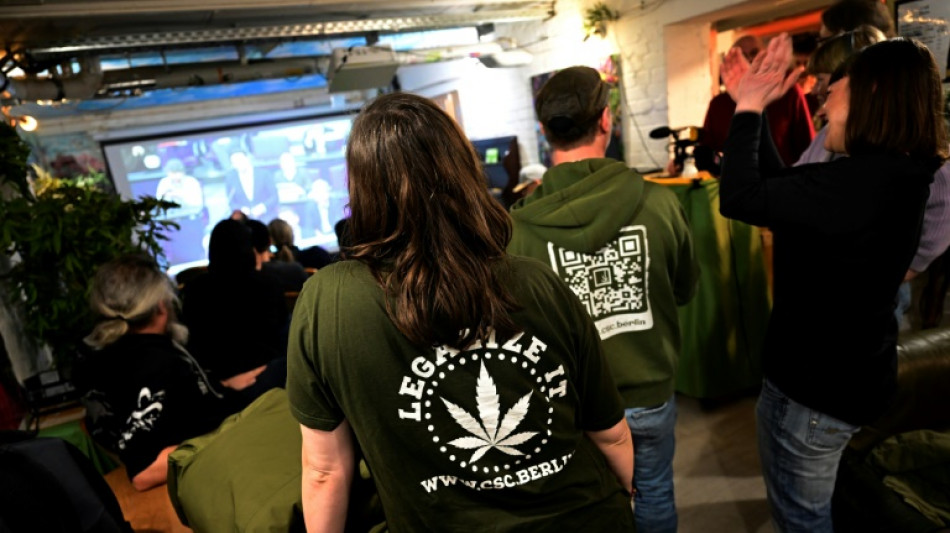
German parliament votes to legalise recreational cannabis / Photo: JOHN MACDOUGALL - AFP

 The growing protests against India's poll body - and PM Modi

 Stocks fall further as oil spike fans fresh inflation worries
 Bad COP, worse COP? EU tempers hopes for UN climate summit

 Rookie Henry named in Wallabies midfield to face All Blacks
 Housing crisis set to dominate Spain's snap election

 Gas, health care, utilities: high costs squeeze US midterm voters

 New Zealand Rugby seeks injunction over PNG Chiefs name

 Samsung expects 780% quarterly operating profit jump on AI boom

 Guardians survive with 9-3 win over White Sox

 Saudi Arabia says 3 dead at airports after Houthis claim attacks

 Stocks slide as oil sees volatile trading day over Iran war fears

 Microsoft pushes AI vision with new, expensive Surface laptop

 Five children among 28 killed in Russian strikes on Ukraine

 Odell Beckham Jr signs with Minnesota Vikings

 Saudi Arabia says three dead at airports after Houthis claim attacks

 Trump plans to turn Florida golf course into presidential retreat

 WHO says cannot conduct full risk assessment on Russia plague reports

 After botched execution, US woman is awake and shackled to bed

 New Zealand fly-half Mo'unga ruled out of Australia Tests
 Protests in major Turkish city after mayor defects to Erdogan party
 Climate change strips island's title of largest penguin colony: study

 Rubio says West must choose between national power or decline

 Russia's plague scare: What we know

 French luxury giant to fund redevelopment of two Paris streets: city hall

 Trump wants to turn Florida golf course into presidential retreat

The German parliament voted Friday to legalise the possession and controlled cultivation of cannabis starting in April, despite fierce objections from the opposition and medical associations.
Under the new law, it will be possible to obtain up to 25 grams of the drug per day for personal use through regulated cannabis cultivation associations, as well as to have up to three plants at home.
But possession and use of the drug will remain prohibited for anyone under 18.
The changes will leave Germany with some of the most liberal cannabis laws in Europe, bringing it into line with Malta and Luxembourg, which legalised recreational use of the drug in 2021 and 2023 respectively.
The Netherlands has also long been known for its liberal cannabis laws, but in recent years parts of the country have begun cracking down on sales to tourists and non-residents.
Ahead of the vote, Health Minister Karl Lauterbach called on members of parliament to back the controversial law, arguing that "the situation we are in now is in no way acceptable".
Germany has seen a sharp rise in the number of young people using cannabis obtained on the black market, said Lauterbach, a member of Chancellor Olaf Scholz's Social Democrats.
- 'Ideology' -
According to the German Cannabis Association, substances that can end up in black-market weed include sand, hairspray, talcum powder, spices or even glass and lead.
Experts also say marijuana can be contaminated with heroin or synthetic cannabinoids that are up to 100 times stronger than natural psychoactive cannabinoids.
But Simone Borchardt of the opposition CDU party said the new law would only increase health risks for young people.
She accused the three parties in Scholz's coalition government of "making policy for their ideology and not for the country".
The law has also been widely criticised by medical associations and health groups.
Some experts have warned that cannabis use among young people can affect the development of the central nervous system, leading to an increased risk of developing psychosis and schizophrenia.
Sustained use has also been linked to respiratory diseases and testicular cancer.
Thomas Fischbach, president of the German federation of doctors for children and adolescents, the BKVJ, said medical associations were broadly opposed to the plans.
"Cannabis use among young people will increase because such substances are always passed on to younger people," he told the newspaper Die Welt.
This could have serious consequences for young people's physical and mental health, he said.
"Chronic cannabis use makes you stupid, to put it bluntly, and can also cause psychosis."
- 'Cannabis social clubs' -
The cannabis law has also been the subject of bitter wrangling within the coalition of Scholz's Social Democrats, the Greens and the liberal FDP.
In their coalition agreement, the three parties had pledged to go further and allow cannabis to be sold in shops, a move that was slapped down by the EU.
They are now planning a second law to trial the drug's sale in shops in certain regions.
Under the legislation passed on Friday, individuals will be able to obtain enough cannabis per day to make up to 75 joints, depending on how much is used.
However, there is also a limit of 50 grams per month.
The cannabis associations, known as "cannabis social clubs", are set to begin operating from July.
Until now, German law has restricted personal use of cannabis to people with certain medical conditions.
Private recreational use of the drug was banned, though police often turned a blind eye to possession of small amounts.
The German public is divided on the new law: According to a YouGov poll published Friday, 47 percent are in favour of the plans and 42 percent are against.
T.Batista--PC