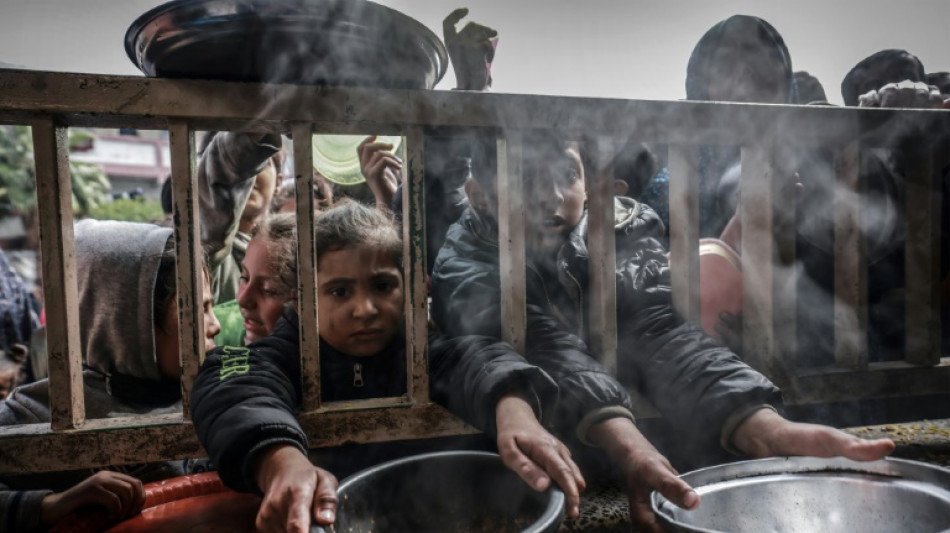
Dead horses, scraps, leaves: Gaza's hungry get desperate / Photo: MOHAMMED ABED - AFP/File

 The growing protests against India's poll body - and PM Modi
 Stocks fall further as oil spike fans fresh inflation worries

 Bad COP, worse COP? EU tempers hopes for UN climate summit

 Rookie Henry named in Wallabies midfield to face All Blacks

 Housing crisis set to dominate Spain's snap election

 Gas, health care, utilities: high costs squeeze US midterm voters

 New Zealand Rugby seeks injunction over PNG Chiefs name
 Samsung expects 780% quarterly operating profit jump on AI boom

 Guardians survive with 9-3 win over White Sox

 Saudi Arabia says 3 dead at airports after Houthis claim attacks

 Stocks slide as oil sees volatile trading day over Iran war fears

 Microsoft pushes AI vision with new, expensive Surface laptop

 Five children among 28 killed in Russian strikes on Ukraine

 Odell Beckham Jr signs with Minnesota Vikings

 Saudi Arabia says three dead at airports after Houthis claim attacks

 Trump plans to turn Florida golf course into presidential retreat

 WHO says cannot conduct full risk assessment on Russia plague reports

 After botched execution, US woman is awake and shackled to bed
 New Zealand fly-half Mo'unga ruled out of Australia Tests

 Protests in major Turkish city after mayor defects to Erdogan party
 Climate change strips island's title of largest penguin colony: study

 Rubio says West must choose between national power or decline

 Russia's plague scare: What we know

 French luxury giant to fund redevelopment of two Paris streets: city hall

 Trump wants to turn Florida golf course into presidential retreat

At the Jabalia refugee camp in northern Gaza, Abu Gibril was so desperate for food to feed his family that he slaughtered two of his horses.
"We had no other choice but to slaughter the horses to feed the children. Hunger is killing us," he told AFP.
Jabalia was the biggest camp in the Palestinian territories before the war, which began after Hamas fighters attacked southern Israel on October 7, leaving some 1,160 dead, based on Israeli figures.
Gibril, 60, fled there from nearby Beit Hanun when the conflict erupted. Home for him and his family is now a tent near what was a UN-run school.
Contaminated water, power cuts and overcrowding were already a problem in the densely populated camp, which was set up in 1948 and covers just 1.4 square kilometres (half a square mile).
Poverty, from high unemployment, was also an issue among its more than 100,000 people.
Now food is running out, with aid agencies unable to get in to the area because of the bombing -- and the frenzied looting of the few trucks that try to get through.
The World Food Programme this week said its teams reported "unprecedented levels of desperation" while the United Nations warned that 2.2 million people were on the brink of famine.
On Friday, the health ministry in Hamas-run Gaza said a two-month-old baby died of malnutrition in hospital in Gaza City, seven kilometres (just over four miles) away from Jabalia.
Overall, at least 29,606 people have been killed in Gaza in the war, the ministry said Saturday.
- Scavenging and begging -
In the camp, bedraggled children wait expectantly, holding plastic containers and battered cooking pots for what little food is available.
With supplies dwindling, costs are rising. A kilo of rice, for example, has shot up from seven shekels ($1.90) to 55 shekels, complains one man.
The UN children's agency UNICEF has warned that the alarming lack of food, surging malnutrition and disease could lead to an "explosion" in child deaths in Gaza.
One in six children aged under two in Gaza was acutely malnourished, it estimated on February 19.
Residents have taken to eating scavenged scraps of rotten corn, animal fodder unfit for human consumption and even leaves to try to stave off the growing hunger pangs.
"There is no food, no wheat, no drinking water," said one woman.
"We have started begging neighbours for money. We don't have one shekel at home. We knock on doors and no one is giving us money".
- 'Dying from hunger' -
Tempers are rising in Jabalia about the lack of food and the consequences. On Friday, an impromptu protest was held involving dozens of people.
One child held up a sign reading: "We didn't die from air strikes but we are dying from hunger."
Another held aloft a placard warning "Famine eats away at our flesh", while protesters chanted "No to starvation. No to genocide. No to blockade."
In Beit Hanun, Gibril used two horses to harvest a parcel of land. But the conflict destroyed that, along with his house, leaving him with nothing.
Over the weeks and months, Israel's relentless bombardment has left Gaza largely a place of shattered concrete and lives.
Gibril kept the radical decision to slaughter his horses to himself, boiling the meat with rice, and giving it to his unwitting family and neighbours.
Despite the necessity, he said he was still wary of their reaction. "No one knows they were in fact eating a horse."
J.V.Jacinto--PC