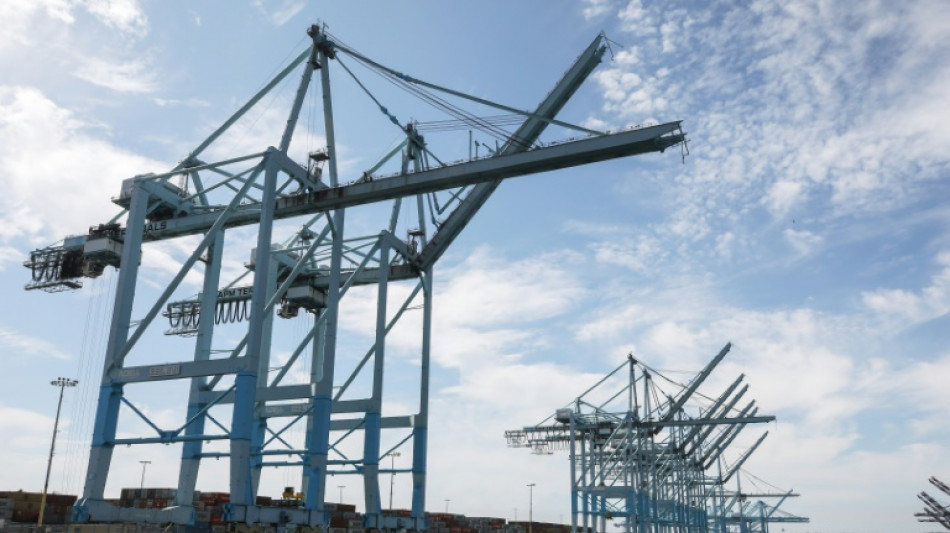
US-China economic flashpoints at a glance / Photo: MARIO TAMA - GETTY IMAGES NORTH AMERICA/AFP/File

 The growing protests against India's poll body - and PM Modi

 Stocks fall further as oil spike fans fresh inflation worries

 Bad COP, worse COP? EU tempers hopes for UN climate summit

 Rookie Henry named in Wallabies midfield to face All Blacks

 Housing crisis set to dominate Spain's snap election

 Gas, health care, utilities: high costs squeeze US midterm voters

 New Zealand Rugby seeks injunction over PNG Chiefs name

 Samsung expects 780% quarterly operating profit jump on AI boom

 Guardians survive with 9-3 win over White Sox

 Saudi Arabia says 3 dead at airports after Houthis claim attacks
 Stocks slide as oil sees volatile trading day over Iran war fears

 Microsoft pushes AI vision with new, expensive Surface laptop

 Five children among 28 killed in Russian strikes on Ukraine

 Odell Beckham Jr signs with Minnesota Vikings

 Saudi Arabia says three dead at airports after Houthis claim attacks

 Trump plans to turn Florida golf course into presidential retreat

 WHO says cannot conduct full risk assessment on Russia plague reports

 After botched execution, US woman is awake and shackled to bed

 New Zealand fly-half Mo'unga ruled out of Australia Tests
 Protests in major Turkish city after mayor defects to Erdogan party

 Climate change strips island's title of largest penguin colony: study

 Rubio says West must choose between national power or decline

 Russia's plague scare: What we know

 French luxury giant to fund redevelopment of two Paris streets: city hall

 Trump wants to turn Florida golf course into presidential retreat

From a trade imbalance to technological competition, a host of economic flashpoints are boosting tensions between Washington and Beijing -- and these are among areas in which both Republicans and Democrats can agree.
What's behind these concerns?
- American debt -
Republicans in particular are worried about this issue, concerned that China holds too much American debt.
The fear is that Beijing could use this to pressure Washington by threatening to resell its bonds, bringing down the value of holdings.
While the American debt exceeds $34 trillion, only around $8 trillion is held abroad.
China is a key holder of US debt, accounting for $816 billion and just over $1 trillion when Hong Kong is included, according to Treasury Department figures.
But it is the second biggest foreign holder behind Japan -- which holds $1.1 trillion -- and ahead of Britain.
- Tech race -
US President Joe Biden has focused on tech, noting its importance to ensuring national security.
Be it in semiconductors, artificial intelligence or electric vehicles, Washington is seeking to stay ahead or catch up with Beijing in various areas -- including to prevent advanced tools from falling into the hands of the Chinese military.
A major target during former president Donald Trump's term was telecoms giant Huawei, which the United States sought to keep out of its 5G networks and those of allies.
Restrictions grew under the Joe Biden administration, especially involving cutting-edge semiconductors necessary in AI development.
The goal, said Commerce Secretary Gina Raimondo in October, is to limit Chinese access to advanced chips that could fuel breakthroughs in AI and sophisticated computers that are critical to military applications.
In the field of critical minerals, of which Beijing has ample supplies, Washington has also been seeking to circumvent China.
- Trade -
While China is no longer the top source from which the United States imports goods, the perceived trade imbalance between the world's two biggest economies remains a concern.
Trump's tariffs on Chinese goods and attempts to secure a deal to rebalance trade has failed to turn the tide, and the Biden administration has largely maintained levies while pursuing efforts in "friendshoring" -- or diversifying supply chains across allies and partners.
There appears to be some impact with US-China trade growing less quickly, although a deeper look shows that some Chinese products are simply routed through other countries.
- Currency war? -
The question of exchange rates and the use of currency for political and commercial purposes has been a recurring issue, too.
For years, Washington has accused Beijing of maintaining the yuan at a deliberately lower rate against the dollar in order to promote exports.
In November, the US Treasury flagged China's "lack of transparency" in its exchange rate mechanism, saying this warranted monitoring.
The concern now centers on the internationalization of the yuan, with the Chinese currency still little present in commercial exchanges.
As of end-2023, fewer than 3.5 percent of payments via the SWIFT international electronic transfer system were made in yuan -- compared with nearly 19 percent in euros and more than 50 percent in dollars.
China wants the yuan to establish itself, especially in trade, as a safeguard against potential US sanctions. Beijing in turn believes that Washington is weaponizing the dollar.
F.Carias--PC