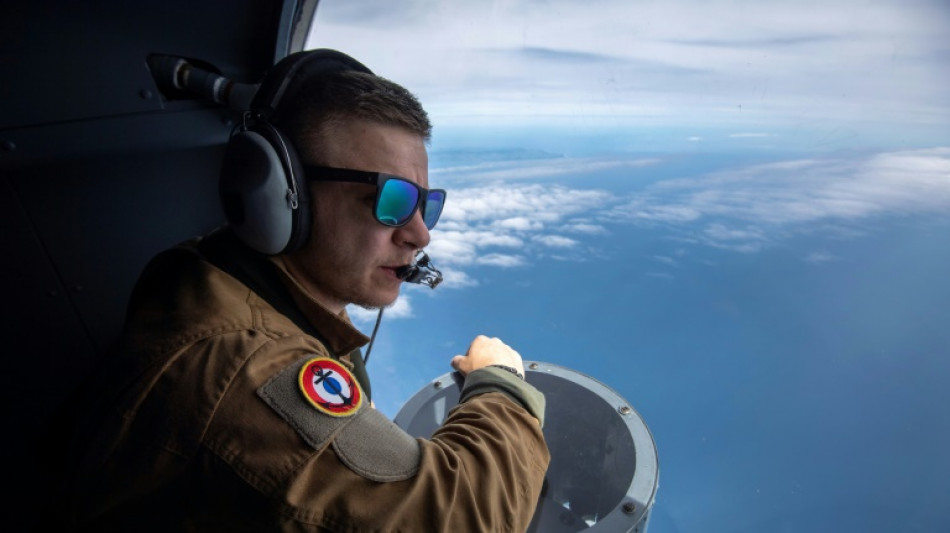
Does Sweden joining make the Baltic Sea a 'NATO lake'? / Photo: FRED TANNEAU - AFP

 The growing protests against India's poll body - and PM Modi

 Stocks fall further as oil spike fans fresh inflation worries

 Bad COP, worse COP? EU tempers hopes for UN climate summit

 Rookie Henry named in Wallabies midfield to face All Blacks

 Housing crisis set to dominate Spain's snap election
 Gas, health care, utilities: high costs squeeze US midterm voters

 New Zealand Rugby seeks injunction over PNG Chiefs name

 Samsung expects 780% quarterly operating profit jump on AI boom
 Guardians survive with 9-3 win over White Sox

 Saudi Arabia says 3 dead at airports after Houthis claim attacks
 Stocks slide as oil sees volatile trading day over Iran war fears

 Microsoft pushes AI vision with new, expensive Surface laptop

 Five children among 28 killed in Russian strikes on Ukraine

 Odell Beckham Jr signs with Minnesota Vikings

 Saudi Arabia says three dead at airports after Houthis claim attacks

 Trump plans to turn Florida golf course into presidential retreat

 WHO says cannot conduct full risk assessment on Russia plague reports

 After botched execution, US woman is awake and shackled to bed

 New Zealand fly-half Mo'unga ruled out of Australia Tests

 Protests in major Turkish city after mayor defects to Erdogan party
 Climate change strips island's title of largest penguin colony: study

 Rubio says West must choose between national power or decline

 Russia's plague scare: What we know

 French luxury giant to fund redevelopment of two Paris streets: city hall

 Trump wants to turn Florida golf course into presidential retreat
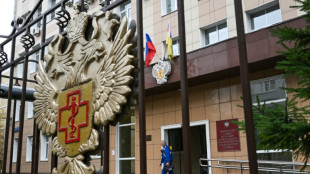
Sweden's accession to NATO adds a final puzzle piece to the alliance around the shores of the strategically important Baltic Sea -- but Russia still poses a threat above and below water.
After Finland joined last year, Sweden's membership -- which cleared the final hurdle Monday with Hungary's vote on ratification -- means all the countries surrounding the Baltic Sea, except Russia, will be part of the US-led military alliance.
That has led some to label the sea a "NATO lake", with the Western allies now appearing well-placed to strangle Russia's room for manoeuvre in the crucial shipping route if a war with Moscow ever breaks out.
But analysts warn that while Sweden's entry makes it easier for NATO to exert control and reinforce its vulnerable Baltic states, Russia can still menace the region from heavily-armed exclave Kaliningrad and threaten undersea infrastructure.
"If you look at a map then geographically the Baltic Sea is becoming a NATO lake, yes," said Minna Alander a research fellow at the Finnish Institute of International Affairs.
"But there is still work to do for NATO."
Since Russia's invasion of Ukraine, a series of high-profile incidents involving pipelines and cables under the Baltic Sea have given NATO a wake-up call over its vulnerabilities.
In September 2022 a sabotage attack hit the Nord Stream gas pipelines between Russia and Europe. Over a year on, investigators have still not publicly named those responsible.
Then last October a gas pipeline and a cable from Finland and Sweden to Estonia were damaged. Finnish police say they believe a Chinese cargo ship was likely involved.
NATO has bolstered its naval deployments in response and is looking to step up its monitoring capabilities, but keeping an eye on what's happening beneath the water is a major task.
"It's very difficult to have overall control of a sea as you would control territories on land," said Julian Pawlak, a researcher at Germany's Bundeswehr University in Hamburg.
"What the Nord Stream sabotages have shown, among others, is that it remains hard to be aware exactly what is happening below the surface and on the seabed."
- Kaliningrad threat -
Sweden has long had a close partnership with NATO but its formal membership will allow it to be fully integrated into the alliance's defence plans.
Beyond its long Baltic coastline, Sweden brings with it the island of Gotland which would play a central role in helping NATO impose its will.
But just across the water Russia has its own vital outpost -- the exclave of Kaliningrad.
Wedged between Poland and Lithuania, Moscow has in recent years turned the region into one of the most militarised in Europe, with nuclear-capable missiles stationed there.
Russia's Baltic fleet based in Kaliningrad is a shadow of what it was during the Cold War and the invasion of Ukraine has sapped some of its forces from the region.
But John Deni, a research professor at the US Army War College, said the Kremlin has kept up investments in undersea capabilities and still has the firepower to stage small-scale landings or threaten NATO supply routes.
"In terms of artillery, indirect fires and nuclear-capable weapons they out-gun and out-range NATO allies in the region," Deni told AFP.
"Allies have to meet that threat and counter it."
On the other side, while Stockholm brings with it a rich heritage of naval history, like other NATO states in the area its sea power in the Baltic remains understrength.
"Even if you count Sweden, NATO naval assets are relatively limited," Deni said, adding that the allies need to develop their ability to carry out demining under fire.
- Reinforcing the Baltic states -
Three countries breathing a particular sigh of relief over the entry of Sweden -- and Finland -- are NATO's Baltic states, Estonia, Latvia and Lithuania, long seen as an Achilles heel for the alliance.
War planners have struggled to work out how to stop them being cut off if Russian land troops seized the 65-kilometre (40-mile) Suwalki Gap between Belarus and Kaliningrad.
Sweden's position straddling both the North and Baltic Seas opens up a key route for transiting more NATO forces to protect them in case of attack.
"It allows US forces to reinforce the Baltic Sea nations in a timely manner, but especially the frontline states," said Tuuli Duneton, Estonian undersecretary for defence policy.
Despite the joy at NATO over welcoming Sweden to the fold, however, US academic Deni insisted the alliance should lay off considering the Baltic its own property.
"Calling it a 'NATO lake' leads to complacency," Deni said.
"The challenge and the threat posed by Russia in the region is significant in some ways and the allies for now lack the capacity to counter that in a crisis."
L.Carrico--PC