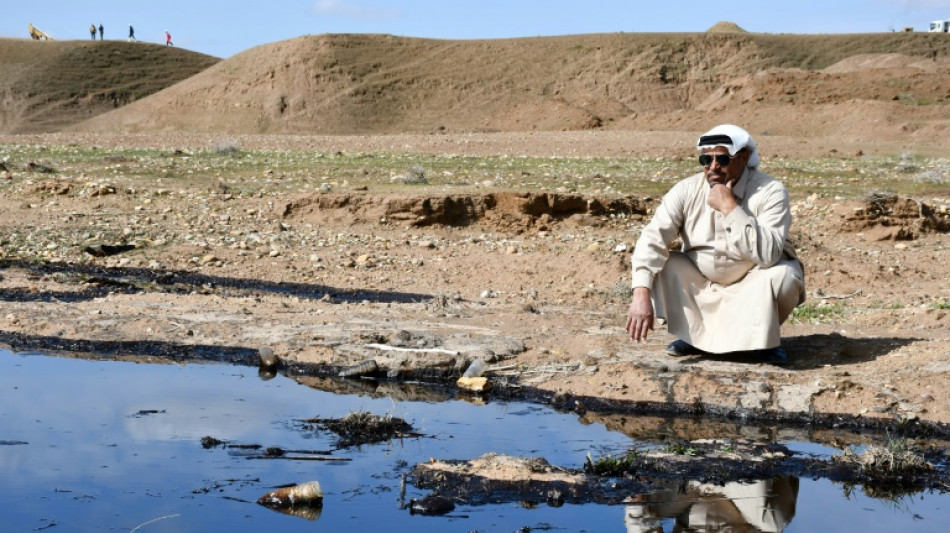
Oil spills pile on pressure for Iraq's farmers / Photo: Abdel Khalek Azzawi - AFP

 The growing protests against India's poll body - and PM Modi
 Stocks fall further as oil spike fans fresh inflation worries

 Bad COP, worse COP? EU tempers hopes for UN climate summit

 Rookie Henry named in Wallabies midfield to face All Blacks

 Housing crisis set to dominate Spain's snap election

 Gas, health care, utilities: high costs squeeze US midterm voters

 New Zealand Rugby seeks injunction over PNG Chiefs name
 Samsung expects 780% quarterly operating profit jump on AI boom

 Guardians survive with 9-3 win over White Sox

 Saudi Arabia says 3 dead at airports after Houthis claim attacks
 Stocks slide as oil sees volatile trading day over Iran war fears

 Microsoft pushes AI vision with new, expensive Surface laptop

 Five children among 28 killed in Russian strikes on Ukraine

 Odell Beckham Jr signs with Minnesota Vikings

 Saudi Arabia says three dead at airports after Houthis claim attacks

 Trump plans to turn Florida golf course into presidential retreat

 WHO says cannot conduct full risk assessment on Russia plague reports

 After botched execution, US woman is awake and shackled to bed
 New Zealand fly-half Mo'unga ruled out of Australia Tests

 Protests in major Turkish city after mayor defects to Erdogan party
 Climate change strips island's title of largest penguin colony: study

 Rubio says West must choose between national power or decline

 Russia's plague scare: What we know

 French luxury giant to fund redevelopment of two Paris streets: city hall

 Trump wants to turn Florida golf course into presidential retreat

Iraq enjoys tremendous oil wealth but many hard-scrabble farmers in the north say crude spills have contaminated their lands, piling on pressure as they already battle drought.
Amid the hills of Salaheddin province, puddles of the viscous black liquid pollute the otherwise fertile and green fields, rendering vast swathes of farmland barren.
"The oil has damaged all that the land can give," said one farmer, Abdel Majid Said, 62, who owns six hectares (15 acres) in the village of Al-Meaibdi.
"Every planted seed is ruined. This land has become useless."
Oil spills in Iraq -- a country ravaged by decades of conflict, corruption and decaying infrastructure -- have contaminated farmland in the northern province, especially during the winter rains.
Authorities blame the jihadists of the Islamic State group who overran large swathes of Iraq and Syria in 2014 and were only defeated in Iraq three years later.
The IS group blew up oil pipelines and wells and also dug primitive oil storage pits, causing crude to seep into the ground, from where annual rains wash it out again.
But the local farmers also complain that the state has been too slow to clean up the mess.
In Al-Meaibdi and the nearby hills of Hamrin, authorities are struggling to find a sustainable solution to the problem, which adds to a litany of environmental challenges.
Iraq, also battered by blistering summer heat and severe drought, is ranked by the United Nations as one of the five countries most vulnerable to key impacts of climate change.
- 'Damaged land' -
In Hamrin, layers of sludge pile up as excavators build up dirt barriers -- a temporary measure to stem the flow of contaminated water onto farmland below.
The oil not only damages the soil and crops but can also pollute groundwater in the water-scarce country.
Said, the farmer, said "the soil is no longer fertile -- we have not been able to cultivate it since 2016".
Some other farmers had already abandoned their lands, he added.
He pointed to a green plot of land so far untouched by the spills and said: "Look how the crops have grown there -- but not even a grain has sprouted here."
Oil spills have contaminated 500 hectares of wheat and barley fields in Salaheddin, said Mohamed Hamad from the environment department in the province.
Hamad pointed to the reign of IS, which collected revenues from oil production and smuggling by building makeshift refineries and digging primitive oil storage pits.
He said the group blew up the pipelines and wells of the oil fields of Ajil and Alas, causing crude oil to flood and collect in the Hamrin hills' natural caves.
Earlier this month, due to heavy rain, oil remnants again poured into agricultural lands, Hamad said, and "unfortunately, the leak damaged land and crops".
Authorities have buried IS's makeshift storage pits, Amer al-Meheiri, the head of the oil department in Salaheddin province, told Iraq's official news agency INA last year.
Yet during the heavy rains, the oil continues to seep out.
- 'A great loss' -
Iraq's crude oil sales make up 90 percent of budget revenues as the country recovers from years of war and political upheaval, leaving it overly reliant on the sector.
The country boasts 145 billion barrels of proven oil reserves, amounting to 96 years' worth of production at the current rate, according to the World Bank.
But for many farmers, oil has been a scourge.
Abbas Taha, an agriculture official in Salaheddin, said "oil spills have been occurring frequently since 2016".
"Farmers suffer a great loss because they no longer benefit from the winter season to grow wheat," he said.
Some farmers have filed complaints against the state demanding compensation, only to find themselves lost in Iraq's labyrinthine judicial system, tossed from one court to another.
But Taha insists that authorities plan to compensate those affected in a country where agricultural lands are shrinking as farmers are abandoning unprofitable plots hit by drought.
Due to the severe water scarcity, authorities are drastically reducing farm activity to ensure sufficient drinking water for Iraq's 43 million people.
Hamad said his department had contacted the relevant authorities to remove oil remnants that would eventually seep through the soil to contaminate groundwater and wells.
The soil also needs to be treated by removing the top layer and replacing it, he said.
"We urged the prime minister, the agriculture minister and the oil minister to compensate the farmers suffering from this environmental disaster," said 53-year-old farmer Ahmed Shalash.
"But nothing has happened."
A.Magalhes--PC