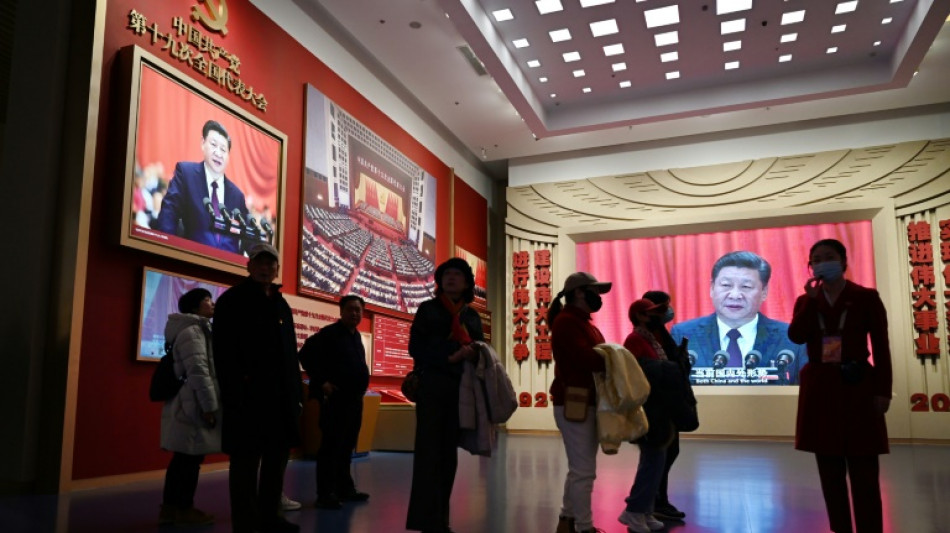
What to know about China's annual parliamentary meeting / Photo: GREG BAKER - AFP

 Oil prices surge and stocks sink on fresh inflation worries

 AI startup Manus raises $500m after Meta acquisition blocked by China

 From refuge to repatriations: Malaysia's Myanmar U-turn

 Morikawa says LIV players face 'business decision' after Rahm exit
 Tenzing Norgay's son says Himalayas sending climate warning
 On your bike! Bottas opts for two wheels to reach Singapore GP

 Alcaraz, Sinner, Osaka commit to Australian Open '1 Point Slam'

 Dodgers beat Braves to advance in MLB playoffs, Rays oust Yankees

 'A sun as black as my lungs': how corruption crucified a polluted Albania city

 The British historian helping the French rediscover de Gaulle
 Dodgers beat Braves to advance, Guardians survive in MLB playoffs

 Latin American, Caribbean women top Nobel literature buzz

 US says Fiji-based Chinese official paid bribes for Beijing

 After botched US execution, Christa Pike was nearly taken off life support

 Guinea-Bissau junta urges military unit loyal to ex-president to disarm

 As species decline, green turtles offer glimmer of hope
 Brothers Scott and Beauden Barrett named to start for All Blacks
 EU trade chief seeks to dial down China tensions

 'Never again Bolsonaro': thousands march ahead of Brazil election runoff

 After botched execution, US woman was nearly taken off life support before revival

 Searing AIDS drama 'Elsinore' opens London film festival

 Evicted pensioner who sparked Spain housing protests dies: tenant union
 Golf star Rahm quitting LIV tour over 'unacceptable' terms

 Thousands march fearing return of a Bolsonaro presidency in Brazil
 French PM denies police ordered to confront student protesters

Thousands of delegates from across China will convene in Beijing next week for the start of the country's annual legislative meetings known as the "Two Sessions".
The tightly controlled voting on legislation already pre-approved by the ruling Communist Party means there will be no major changes.
But the meetings do provide a rare glimpse into the top leadership's priorities, with analysts eyeing support measures for China's ailing economy as well as an expected increase in defence spending.
Here's what you need to know:
- What are the 'Two Sessions'? -
The first one, due to kick off Monday, is a gathering of China's political advisory committee, the Chinese People's Political Consultative Conference (CPPCC).
The group's members -- who have included many of China's most famous celebrities, such as Yao Ming and Jackie Chan -- receive a lot of attention at home.
But its discussions are relatively low stakes: representatives provide lawmakers with policy suggestions that, more often than not, have little impact on national policy.
The real focus of the "Two Sessions" is the meeting of the National People's Congress (NPC), the country's legislature, starting Tuesday at Beijing's Great Hall of the People.
Two-thirds of the legislature's members come from the Communist Party.
And most of the bills that will be passed have already been decided by party leaders well in advance, leading to it being described as a "rubber-stamp" parliament.
- How important is it? -
China goes to great lengths to make sure there are no embarrassing incidents during the parliamentary session, which is touted by the Communist Party as proof that it answers to the people despite its monopoly on power.
The meeting place in the Great Hall of the People is freshened up, traffic is shut down, factories are closed to guarantee blue skies, plainclothes policemen seem to lurk on every corner and political dissidents are rounded up and asked -- or sometimes forced -- to go on "vacation" somewhere far away from the capital.
It is also the one time each year when the country's most powerful politicians are all in one place, making it a key venue for political horse-trading, glad-handing and backstabbing.
Every five years, the parliamentary session also sees the appointment of the president -- last year, Xi Jinping began his third term in the position, complementing two top Communist Party positions he secured at a congress in 2022.
This year's "Two Sessions" will also feature the first annual government work report presented by Premier Li Qiang since he ascended to the country's number-two position at last year's meeting.
- What are the top issues? -
The economy, beset by slumping consumer activity and a prolonged crisis in the property sector, will be the most closely-watched topic at this year's gathering.
The conference will see delegates set official growth targets for 2024, following a reported national GDP expansion of 5.2 percent last year -- the lowest rate in decades, excluding the pandemic years.
The release of details on military spending will offer signals as to China's confidence in current geopolitical conditions, as tensions persist across the Taiwan Strait and Russia's war in Ukraine enters its third year.
Observers will also be closely assessing any plans announced on the allocation of public resources into the tech sectors or major infrastructure development projects.
E.Ramalho--PC