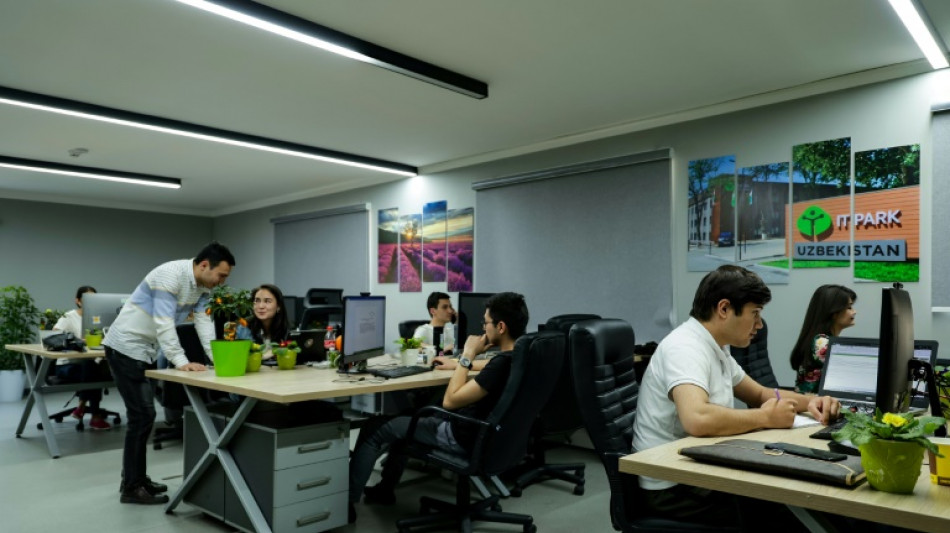
Fleeing Russians help Uzbekistan chase IT dreams

 'More confrontational': Iran's new hardline security leadership

 UK summons Israeli envoy over West Bank settlement project

 Trump vows 'tremendous' economic costs on Iran partners

 Germany, France, UN condemn far-right Israeli minister's 'inhumane' Gaza remarks

 Prince Harry and Meghan moving back to UK: British press

 Lee, Baena guide Atletico to opening Liga win over Malaga
 Ecuador intel chief, five Americans killed in Kenya helicopter crash

 Robinson and Tongue share match ball after dismissing Pakistan

 Israel army admits firing on car in death of five-year-old Hind Rajab

 Honduras places 80% of country on El Nino drought alert

 Some of Meta's safety tools were 'designed to fail': witness

 PSG Ligue 1 opener moved over state of Parc des Princes pitch

 UK PM launches bid to help homeless, donating part of his wages

 Golden Shoe winner Kane hopes for Ballon d'Or after 'best season ever'

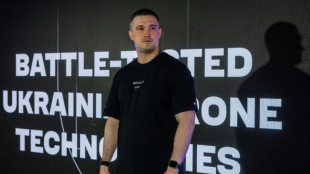 Kyiv's ex-defence chief makes risky bet by venturing into electoral grounds

 Coventry have survival inspiration says Lampard

 Reijnders leaves Man City for Saudi's Al Qadsiah
 Trump says will meet North Korea's Kim later this year

 Stocks waver, dollar drops as US Treasury moves to lower bond yields

 France recalls rare disease drug Tavneos after deaths

 Arsenal agree to sign Villa defender Konsa: reports

 Evacuation orders lifted in Belgian wildfire zone
 UK media skewered for 'hounding' black academic

 More than 7,300 excess deaths in France's historically hot summer so far
 US socialists score shock Florida win as Trump picks stumble

Hit by regular power cuts and with popular sites like Twitter and TikTok blocked, the Central Asian nation of Uzbekistan hardly seems a likely candidate for a tech boom.
But with Russia's invasion of Ukraine driving an exodus of IT specialists to former parts of the Soviet Union, authorities in Uzbekistan are hoping to speed up plans to modernise an economy best known for its vast production of cotton.
It took only one day after Russia's February 24 invasion of Ukraine for Uzbekistan to launch a one-stop government relocation programme for IT specialists and companies.
Offering visas, housing and child care support to individuals, and registration assistance and tax exemptions to companies, the programme has already attracted some 2,000 foreign IT specialists, the government said.
People like Anastasia Markova, a Russian citizen who recently became a public relations manager at Uzbekistan's state-run IT Park in the capital Tashkent.
Markova, 22, had been due to be married in Russia in April, but left Moscow with her fiance -- an employee of a company registered at the park -- for Tashkent and the two are now seeking permanent residence.
Markova said she feels comfortable in the city, where Russian is still widely spoken three decades after Uzbekistan gained independence during the collapse of the Soviet Union.
"The country accepted us as one of their own. The people are so friendly and hospitable," she said.
- Thousands in IT leave Russia -
Markova was more keen to speak about her new home than the country she left behind, saying only that her decision to leave Russia had been "rushed, as it was for many people" and due to "a number of social and economic factors".
Several other Russian citizens contacted by AFP after moving to Uzbekistan and neighbouring Kyrgyzstan refused to talk, saying they feared the consequences of potentially being seen as critical of Russia.
The IT Park in Tashkent is home to some 550 companies and at the heart of plans to increase Uzbek IT exports to more $1 billion by 2028, a 25-fold rise from last year's figure.
The park's motto, "START local and GO Global" is emblazoned on a wood panel facade at the entrance. Inside, young support staff in casual attire and headsets work at desks.
The IT Park is already seeing benefits from the relocation programme dubbed TashRush -- "a name that seemed most suited to the phenomenon we are witnessing," the park's deputy director Bakhodir Ayupov said.
The Russian Association of Electronic Communications, a lobby group, said on March 22 that 50,000 to 70,000 specialists had left Russia and up to 100,000 more may follow them out of the door this month.
For the moment, Uzbekistan is a less popular destination for departing Russian IT workers than Georgia, Turkey or Armenia.
Uzbekistan has lagged behind other ex-Soviet nations in developing the sector. The country has of late battled winter energy shortages, while power cuts are not uncommon, even in Tashkent.
- 'Flywheel of repression'
But internet speed has "improved greatly" in Uzbekistan, driving a doubling of IT exports last year in comparison with 2020, Ayupov said.
In an apparent nod to business, Uzbek authorities last month lifted a long-term block on the Skype communications platform.
Microblogging service Twitter, video-sharing platform TikTok and Russia's most popular social network VKontakte remain blocked in the authoritarian republic of around 35 million people.
Despite these difficulties, some of the Russians who left said they would rather stick it out in Uzbekistan than return home.
Olga, a 42-year-old who moved to the historic Uzbek city of Samarkand with her husband immediately after the invasion, said she had fallen in love with the former Silk Road citadel and hoped her experience as a content curator for digital museums would help her find work.
"To begin with we thought we would be here for a few days, but we decided to stay longer. People who were complete strangers have been so good to us," said Olga, who asked that she not be fully identified.
She has no plans to return to Russia, where "the flywheel of repression is spinning and may be spinning for a long time to come," she said.
O.Gaspar--PC