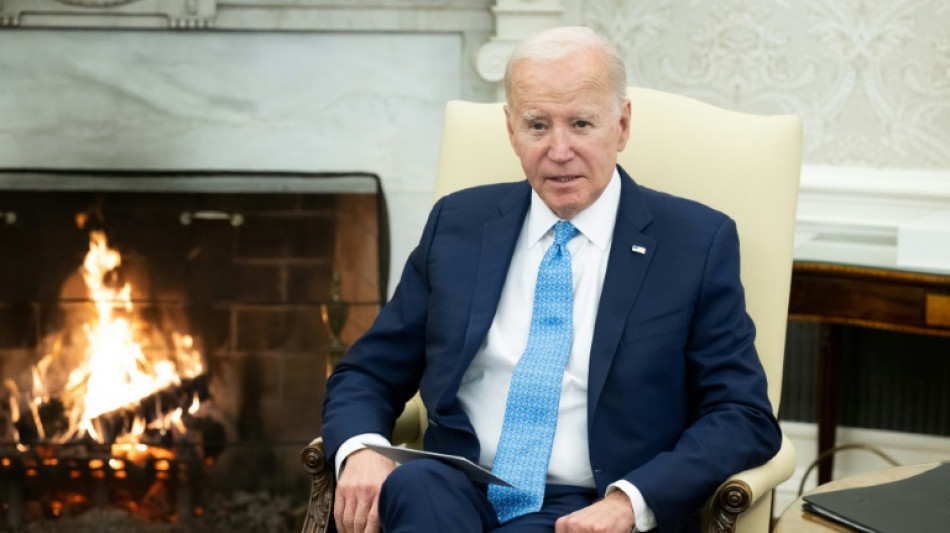
'Game-changing' tech fuels US relook at China data risks / Photo: SAUL LOEB - AFP/File

 Oil prices surge and stocks sink on fresh inflation worries

 AI startup Manus raises $500m after Meta acquisition blocked by China

 From refuge to repatriations: Malaysia's Myanmar U-turn

 Morikawa says LIV players face 'business decision' after Rahm exit

 Tenzing Norgay's son says Himalayas sending climate warning

 On your bike! Bottas opts for two wheels to reach Singapore GP

 Alcaraz, Sinner, Osaka commit to Australian Open '1 Point Slam'

 Dodgers beat Braves to advance in MLB playoffs, Rays oust Yankees

 'A sun as black as my lungs': how corruption crucified a polluted Albania city

 The British historian helping the French rediscover de Gaulle

 Dodgers beat Braves to advance, Guardians survive in MLB playoffs

 Latin American, Caribbean women top Nobel literature buzz

 US says Fiji-based Chinese official paid bribes for Beijing

 After botched US execution, Christa Pike was nearly taken off life support

 Guinea-Bissau junta urges military unit loyal to ex-president to disarm

 As species decline, green turtles offer glimmer of hope

 Brothers Scott and Beauden Barrett named to start for All Blacks

 EU trade chief seeks to dial down China tensions

 'Never again Bolsonaro': thousands march ahead of Brazil election runoff

 After botched execution, US woman was nearly taken off life support before revival

 Searing AIDS drama 'Elsinore' opens London film festival

 Evicted pensioner who sparked Spain housing protests dies: tenant union

 Golf star Rahm quitting LIV tour over 'unacceptable' terms

 Thousands march fearing return of a Bolsonaro presidency in Brazil

 French PM denies police ordered to confront student protesters

From genomic information to internet-connected cars, the United States is rethinking its data protection policies -- with further trade curbs aimed at China in the cards -- as tech like AI brings new risks.
In the past week alone, President Joe Biden took steps expanding Washington's national security toolkit, sounding the alarm on possible risks from Chinese vehicles and tech, a day after issuing an order to limit the flow of sensitive personal data abroad.
The fear is that such data can be used to track citizens, including those with sensitive jobs, or train artificial intelligence models.
The use of sensitive data to develop AI could allow adversaries to use the tech to target US individuals for espionage or blackmail, such as by recognizing patterns across datasets to identify people whose government links would be otherwise obscured.
Washington has started to recognize the "strategic and national security value of data," said Lindsay Gorman, senior fellow at the German Marshall Fund of the United States.
She noted that the Commerce Department's investigation into risks from Chinese tech in connected vehicles is "a long-overdue look into the application layer of the future internet."
"We should expect further investigations into the data produced across the internet of things," she said.
- 'Recalibration' -
The moves signal "broader concerns about national security risks emanating from unfettered free access to data," said Emily Benson of the Center for Strategic and International Studies (CSIS).
Until now, Chinese firms could legally buy US data in bulk, noted Martin Chorzempa, senior fellow at the Peterson Institute for International Economics.
This creates an "imbalance," he said, adding that the latest order closes a "loophole."
Washington has tried using national security grounds to limit foreign firms' ability to buy US companies and access US data -- but businesses could still acquire the information.
A Duke University study published in November found that it is not tough to get sensitive data about active-duty military members, with information available via data brokers for as low as 12 cents per record.
"Overall what we do see is the recalibration of the United States' approach," which has traditionally leaned towards free dataflows, said Benson, director of CSIS's project on trade and technology.
"That era seems to be behind us," she told AFP.
- Game-changing tech -
The approach to data comes as Washington mounts a broader push to power economic growth and maintain a US lead in tech competition with China -- while putting up national security guardrails.
A key factor is AI, which can quickly analyze and manipulate bulk data in carrying out espionage or cyber operations.
"A part of this is a foundational security approach to reining in certain high-risk AI capabilities," Benson said.
Concurrently, Washington's need to stay ahead in AI has spurred other federal policies such as the CHIPS Act, which pours $39 billion into manufacturing incentives.
On Monday, Commerce Secretary Gina Raimondo said AI has been a "game-changer" in demand for advanced chips, adding that the US can eventually house the entire supply chain for producing such semiconductors.
Most global semiconductor manufacturing capacity is currently in China and East Asia, according to the US Semiconductor Industry Association.
- Catch up? -
"China has been very proactive at building out its own data protection and data security regime," said Chorzempa.
"One element of that is restrictions on what data can be transferred cross-border," he added, noting that foreign companies would not necessarily be able to get data from China on its citizens.
US moves represent it coming more aligned with data governance regimes of its close partners, Benson of CSIS said.
The European Union has strict data protection laws including its 2018 General Data Protection Regulation, and rules covering the flow of bulk commercial data between devices.
Japan has been pushing for the flow of data while ensuring trust in privacy and security as well.
"It'll be interesting to see to what degree (US action) actually facilitates greater convergence among regimes, or whether we're into unchartered territory when it comes to digital governance," said Benson.
G.Teles--PC