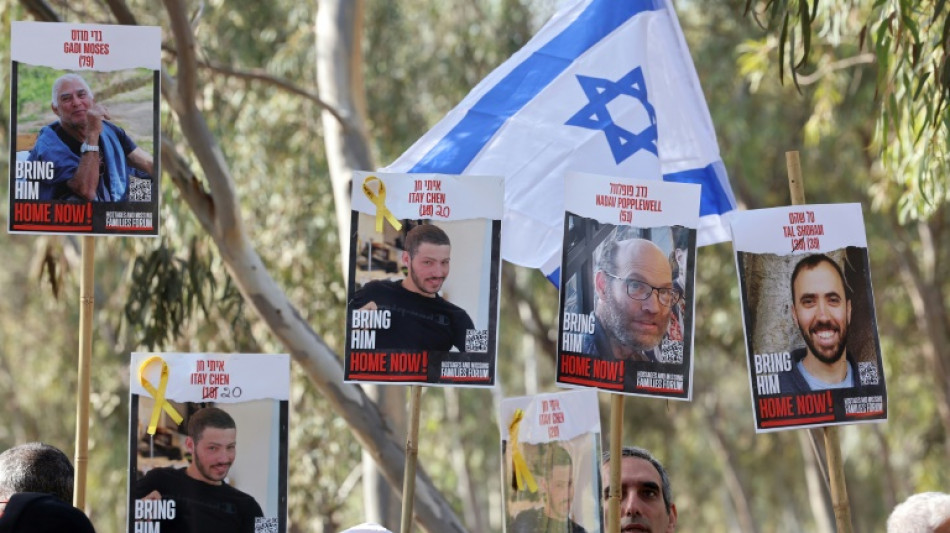
Gaza hostages risk lasting psychological trauma: experts / Photo: JACK GUEZ - AFP

 Verdict due in Mexico trial over murders of Australia, US surfers

 B2PRIME Welcomes Christina Barbash as Commercial Manager

 Russia forcing Kyiv into 'survival' mode before winter, mayor tells AFP

 Closing arguments begin in Maradona death trial

 UEFA president Ceferin to stand for re-election in 2027

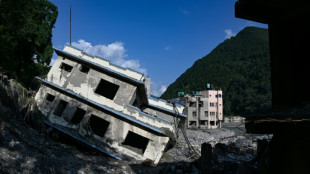 Nearly 300,000 Nepalis at flood risk: study
 Riyadh kindergarten hit by interception debris as Houthis say targeted airport

 Alex Bodi mizează, alături de CRIF, pe investiții transparente și pe prevenirea riguroasă a spălării banilor

 Gulf Labs, Part of Thailand’s $27 Billion GULF Group, Goes Live as an Injective Validator

 EU okay for winter despite 'historically low' gas stocks: operators

 Rwanda to host F1 Grand Prix: sources close to both sides

 EU top diplomat says bloc in favour of UN Lebanon peacekeepers' extension

 Antonelli and Russell to run different Mercedes aero packages in Singapore

 WTO hikes 2026 trade growth forecast on AI boom

 'I love that challenge': Hamilton prays for rain in Singapore

 G.Bissau moves towards postponement of December general election

 Verstappen out to settle 'unfinished business' at Singapore Grand Prix

 WhiteBIT Launches Bitcoin Lightning Network Support, Powered by Voltage

 Oil surges, stocks sink as US reportedly eyes fresh Iran strikes

 Anne Carson: modern takes on Greek classics

 Canada's Anne Carson wins Nobel literature prize

 Ethiopia drones hit Eritrean troops in Tigray

 Russian strike on buses kills 30 in frontline Ukrainian city

 Thailand begins extradition process against Chinese journalist

 Quarantine, unease and rumours: Russian city grapples with plague scare

If and when the hostages held by Hamas in Gaza are released under any deal, they face the risk of lasting psychological trauma, experts warned, citing the suffering of people freed previously.
"There are some that are living dead. As if they were frozen in time and place in Gaza, and haven't returned," said Merav Roth, a clinical psychologist who treated some of those former hostages and their families.
Israel launched an assault to destroy Hamas after the group's unprecedented attack on southern Israel on October 7. The hostages' possible release is one of the points at stake in truce talks under way in Egypt.
Hamas's attack resulted in the deaths of about 1,160 people, mostly civilians, according to an AFP tally of official figures, and saw some 250 hostages taken, most of them Israelis.
Israel's retaliatory bombardment and ground offensive have killed more than 30,700 people, most of them women and children, according to the territory's Hamas-run health ministry.
- 'World of chaos' -
Some hostages were released under a week-long truce in November but around 130 others remained in the hands of Hamas in Gaza.
"We're going to have to immediately take care of these hostages... to help them overcome their fear and their stupor and bring them back to real life," Marilyne Baranes, a psychologist who specialises in post-traumatic stress disorder (PTSD), told AFP.
Of the approximately 100 Israeli hostages freed under the earlier truce, half are undergoing treatment or therapy, the country's government said.
Those who were kept in more dangerous or traumatic conditions, experience "more severe symptoms of anxiety, depression", Roth said.
"But among them all, there's great difficulty in returning to functionality."
Christine Roulliere-Le Lidec, a PTSD specialist, told AFP that survivors need both physical and psychological support in order to move on from a "world of chaos, of hell, to the world of life."
"I've seen cases of people who... supported of course by the health care teams and their families, can finally get through it... to be able to finally find meaning in your life when you've been living in nonsense and barbarism and chaos."
- Limited research -
Research indicates it is difficult to measure the risk of mental illness in different hostages after their release.
While some former hostages have suffered severely -- French journalist Brice Fleutiaux took his own life in 2001 after being held hostage in Chechnya -- others appeared to overcome their trauma.
Briton Terry Waite, who spent four years detained in Lebanon in the 1980s, has dedicated his life to helping hostages and their families.
A 2009 study in the Journal of the Royal Society of Medicine concluded: "As yet there is no clear delineation of all factors which conduce to an adverse outcome following being taken hostage."
- Post-release monitoring difficult -
The study found evidence that those facing worse after-effects included women, people with little education but also those held for long periods -- as is the case with the hostages in Gaza.
However, the findings are dated and research is difficult to carry out.
"For ethical and practical reasons, particularly if children are involved, the follow-up of hostages on release is difficult," the study said.
"Thus, the scientific and clinical database is relatively modest."
Many studies are based on autobiographies by former hostages which gives a limited point of view.
Experts agree that a lot depends on the first few hours after a hostage is released.
"You can get over this type of thing, but you won't go back to the way you were," psychologist Baranes said.
L.Mesquita--PC