
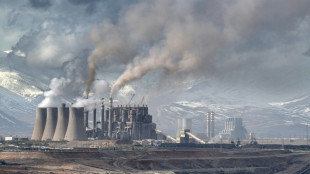
Fossil fuels off COP31 agenda as global output keeps rising / Photo: Goksel YAPAR - AFP

 Thailand begins extradition process against Chinese journalist

 Quarantine, unease and rumours: Russian city grapples with plague scare

 Taiwan says exports hit record in September on AI demand

 Marc Marquez vows to 'attack' Martin's lead at Indonesian MotoGP

 Diplomats, schools in Saudi take safety measures after blasts heard: sources to AFP

 In Beijing, EU trade envoy says deficit with China 'unsustainable'

 Sri Lanka's de Silva quits as Test captain

 Alcaraz feeling 'mentally fresh' ahead of Shanghai return

 Israel drastically reduces British diplomatic presence in Jerusalem

 Stocks fall further as oil surge fans fresh inflation worries

 North Korea demands South show 'utmost respect' to restore relations

 Saudi says three dead in airport attacks claimed by Houthis

 'Mad dream': New showcase for African film opens in London

 All Blacks coach Rennie says Wallabies exit 'part of the game'

 The growing protests against India's poll body - and PM Modi

 Stocks fall further as oil spike fans fresh inflation worries

 Bad COP, worse COP? EU tempers hopes for UN climate summit

 Rookie Henry named in Wallabies midfield to face All Blacks

 Housing crisis set to dominate Spain's snap election

 Gas, health care, utilities: high costs squeeze US midterm voters

 New Zealand Rugby seeks injunction over PNG Chiefs name

 Samsung expects 780% quarterly operating profit jump on AI boom

 Guardians survive with 9-3 win over White Sox

 Saudi Arabia says 3 dead at airports after Houthis claim attacks

 Stocks slide as oil sees volatile trading day over Iran war fears

Nearly 200 nations pledged to transition away from fossil fuels in a landmark agreement at the UN climate summit in Dubai in 2023.
Since then, however, world production of oil, gas and coal has continued to rise despite the rapid growth of renewable energy.
But a new agreement on fossil fuels is unlikely when government negotiators meet in Turkey next month for the COP31 climate talks.
Here is a look at where the world stands with fossil fuels, the main source of greenhouse gas emissions driving climate change:
- Fossil fuels still dominate -
Renewables are growing but fossil fuels are still the dominant source of energy.
Total global energy supply -- including fossil fuels, renewables, nuclear and hydropower -- rose annually by 1.7 percent in 2025, according to the Energy Institute, a UK-based professional body for the industry.
Renewables were the biggest drivers of that growth, the institute said in an annual report.
But fossil fuel supply also grew and accounted for 86 percent of the world's total energy supply last year.
According to the International Energy Agency, fossil fuels represented 81 percent of the global energy mix in 2024, with 30 percent for oil, 28 percent for coal and 23 percent for gas.
In the United States, the world's top oil and gas producer, the two fuels each accounted for 36 percent of the energy mix in 2024. Coal accounted for 10 percent.
In China, which consumes more than a quarter of the world's energy, the mix was 60 percent coal, 18 percent oil and eight percent gas.
European Union official figures show 69 percent of energy consumed in the 27-nation bloc came from fossil fuels in 2024, including 38 percent oil and 21 percent gas. Renewables accounted for 20 percent.
- Tricky transition -
Renewable energy is growing rapidly, driven in part by the shift toward electricity for transportation, heating and other uses.
Global solar power generation jumped 28 percent in 2025, reaching 8.5 percent of total electricity generation, according to the IEA.
"If we are going to talk about a transition, we really need to specify that it is on the electricity side," said Jean-Baptiste Fressoz, an energy historian and researcher at France's CNRS research institute.
Electricity currently accounts for about 23 percent of final energy consumption worldwide, according to the IEA.
Fossil fuels remain the main source of power generation, with coal at 34 percent and gas at 22 percent.
But the share of renewables in global electricity generation is soaring, virtually matching coal at 34 percent.
China is leading the charge, with the country's installed solar power capacity now surpassing that of coal-fired power plants.
But while global electricity generation from fossil fuel sources declined slightly in 2025, the IEA said in July that coal-fired power generation is set to grow this year as the Middle East war drives up energy prices.
"The idea that the rise of one energy source will produce a symmetrical decline in the others is a pipe dream," Fressoz added.
- Tempering COP expectations -
The words "fossil fuels" were not mentioned by name at the COP30 summit in Brazil last year, and the issue is not expected to be part of the negotiations at COP31.
Fossil fuels were "highly divisive" at COP30, said Romain Ioualalen, global policy campaign manager at Oil Change International, an advocacy group campaigning for a fossil-free world.
Instead of reopening the debate, COP31 host Turkey will push for a voluntary "electrification" pledge it says could cut heat-trapping emissions and reduce reliance on energy imports.
"We need to put the importance of COPs in perspective," Fressoz said. "What's important is what happens on the ground."
Ioulalen said countries such as India and China "do not talk much diplomatically but are making quite colossal efforts at the national level" to develop renewables.
China is expected to account for nearly half of the world's renewable energy capacity by 2030, according to the IEA.
Policy decisions are driven by higher fossil fuel prices, supply chain disruptions and concerns over energy security.
"The market dictates behaviour," Fressoz said.
E.Raimundo--PC