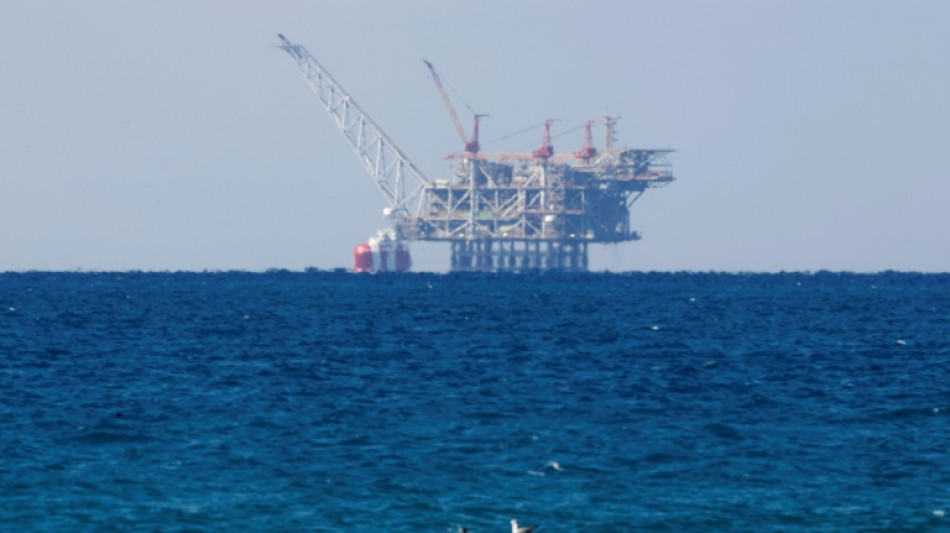
As EU eyes stopping Russian gas imports, Israel sees an opening / Photo: JACK GUEZ - AFP/File

 Manifesto defends Germany's iconic Bauhaus against 'populist attacks'
 Kenya's Kipyegon ends season with hamstring injury

 Nord Stream bomb suspect arrested while working on movie about attack: media
 German football fans plan widespread VAR protests

 Scorching summer triggers record rockfalls in Alps, scientist says

 Newly-crowned European champ Werro turns focus on 800m record

 Hamilton 'fittest ever' as he chases eighth F1 title

 Stocks retreat as bond yield fears persist, oil rises
 ARKBRIDGE’s David Mali Highlights AI-Driven Risk Management at the Finance Magnates London Summit

 Zuckerberg buys Gothic castle in Ireland: spokesman
 Belgium's fire of the century now 'under control'

 Evergrande's Xu Jiayin: from real-estate tycoon to life in prison

 Spurs eyeing move for Man City's Savinho and Marmoush - reports

 Springboks captain Kolisi to miss first All Blacks Test

 Japan to launch probe for Mars moons in October: space agency

 From beach to Bulls: relaxed Tsunoda savours rare F1 drive

 Prince Harry: key dates in life of returning UK royal

 North Korea launches missiles, Seoul says, after Trump floats Kim meet

 Oil jumps on Iran war tensions, offsetting bond yield fears

 Germany identifies far-right suspect in deadly 1970 antisemitic attack

 PrimeXBT Expands Swap-Free Trading to PXTrader 2.0
 Record number of locations in France top 40C over summer: AFP analysis

 Trump pledges 'economic warfare' on Iran, prompting Tehran derision
 'Girl with a Pearl Earring' in Japan, perhaps for the last time

 Russian strikes kill 13 in Kyiv, surrounding region
As Europe aims to wean itself off Russian fossil fuel because of the Ukraine invasion, Israel hopes to help fill the gap with gas from its offshore reserves.
EU states remain divided on the time scale, but European Commission President Ursula von der Leyen has said the bloc hopes to phase out its dependency on Russian gas, oil and coal by 2027.
Israel could build one or more pipelines, potentially via Greece or Turkey, or increase the quantity of gas piped to Egypt to be liquified and shipped off, say officials and experts.
Israeli Foreign Minister Yair Lapid said after a recent visit to Athens that "the war in Ukraine stands to change the structure of the European and Middle Eastern energy market".
"We are also examining additional economic cooperation, with an emphasis on the energy market."
The Jewish state has worked for years to create gas export routes, with mixed results so far.
Turkey, whose ties with Israel have recently thawed after over a decade of rupture, has expressed new interest in a pipeline, and its energy minister is expected in Israel in the coming weeks.
During the years of diplomatic alienation from Turkey, Israel signed an accord with Greece and Cyprus in 2020 aiming to build the EastMed pipeline through those two countries from Israel to Europe.
Turkey opposed the project, and a senior US diplomat said last week it would be too expensive and take too long to build.
Energy Minister Karine Elharrar also hailed the potential for gas sales to Europe, telling the French Association of Defence Journalists that "we have the ability and we will try to do as much as we can".
- Regional alliances -
With both Greece and its regional rival Turkey vying to be the conduit for the gas, Israel would have to tread carefully amid the regional alliances it wishes to uphold and strengthen.
Major gas finds in the eastern Mediterranean -- nearly 1,000 billion cubic meters (bcm) -- have in the past decade turned Israel from a natural gas importer into an exporter.
It now sells small quantities from its two major offshore fields, Leviathan and Tamar, to Egypt and Jordan.
Israel's domestic consumption over the next three decades would leave some 600 bcm available for export, said opposition lawmaker Yuval Steinitz, Israel's energy minister until last year.
"In 2016 the pipeline to Turkey was examined, including with Turkey and commercial companies," said Orit Ganor, director of natural gas international trade at Israel's energy ministry.
"The project didn't reach fruition mainly due to economic reasons."
Ganor said "the EastMed pipeline is still an option, and the company advancing it, Poseidon, is in the final stages of geophysical and geotechnical surveys of the pipe's route in our waters and those of Greece and Cyprus".
No financing has been secured for the project, which Steinitz said would cost about $6 billion and take around four years to complete.
He said there was also agreement with Cairo on a seabed pipeline from Leviathan to Egypt's liquification plants that would allow for greater exports to Europe.
- 'Catch-22' -
Israel's Leviathan field, which would be the source for European exports, is operated by an Israeli-American consortium including NewMed Energy and US major Chevron.
NewMed Energy CEO Yossi Abu recently stated his ambition of "bringing Israeli gas to Europe and Asia".
Experts say Israel's current gas fields represent a third of potential reserves, but a means to sell future finds would be needed to encourage further exploration by private companies.
The state of Israel provides exploitation licenses and regulatory support, but does not drill for gas or build pipelines.
"There's a 'Catch-22' here," said Elai Rettig, a political scientist at Tel Aviv's Bar-Ilan university.
"You need to find a customer that will agree to pay for this very, very expensive pipeline, and they won't do it until you show them you've found enough gas to justify it.
"And you won't find enough gas to justify it until you show that there's someone to sell the gas to."
Europe's efforts to diversify gas imports began before the Ukraine war when it "experienced harsh weather and gas prices rose significantly," said Ganor, the energy ministry official.
Steinitz said a pipeline to Turkey would cost $1.5 billion and take two to three years to build.
Israel "could definitely be a serious factor in creating more independence and a wealth of energy sources for Europe," he said.
He said Israel could even export via Greece, Turkey and Egypt at the same time because "we have enough gas to export through the three channels".
Rettig stressed Israel's need for "balance" between Turkey and Greece and to "continuously talk to both sides and to reassure them that one doesn't come at the expense of the other".
E.Raimundo--PC