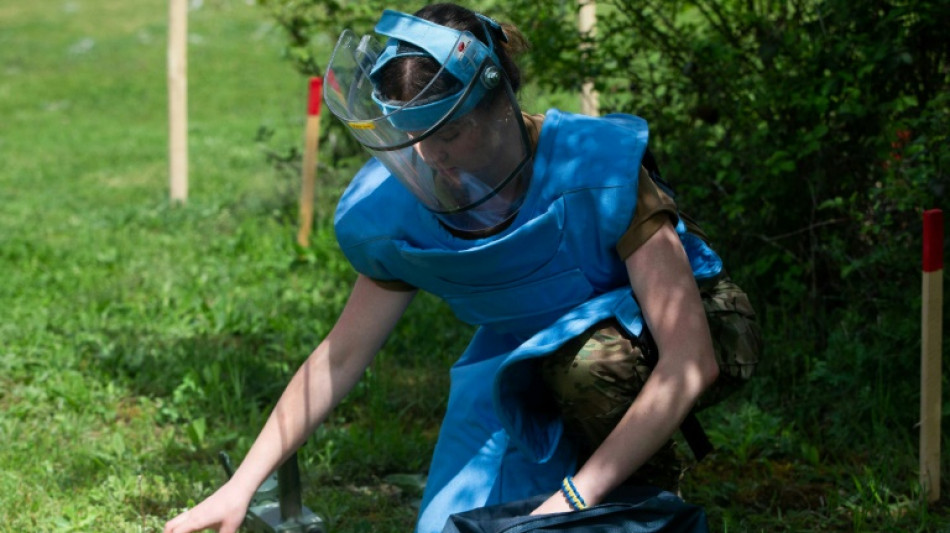
'Not afraid': Ukraine women learn to demine in Kosovo / Photo: - - AFP

 Newark Welfare Deficit Exceeds £140m Annually, Report Finds

 PUK Leader Declares Largest Political Crisis in Kurdistan Region History

 Below Deck alumnus João Franco and brother arrested after fatal Turkey fight

 Thousands of Urban Homes Left Without High-Speed Internet Due to Broadband Blackspots

 Bunnie XO artwork taken down from Jelly Roll’s Nashville bar

 London museum removes Russell Brand hair exhibit after rape conviction

 Yella Beezy sentenced to life for arranging rapper Mo3’s murder

 Raz B's Son Died of Asphyxia Due to Airway Obstruction

 Authorities to identify Montauk Mary and five other Long Island cold-case victims

 Barbie sequel negotiations stall over reported $25 million pay packages

 Bath & Body Works launches buy-one-get-one-free candle offer

 Angola Marks 51 Years of Independence and 50 Years of Diplomatic Ties with Egypt

 Niraj Kumar earns Los Angeles Olympic quota with 50m rifle bronze

 India extends micro-credit guarantee plan for five years

 Zelenskyy arrives in Dublin for meetings on Ukraine and peace efforts

 Jury hears social-media image helped identify teen in Scarlett Faulkner case

 American Airlines passenger falls ill and vomits on three travellers

 US Inflation Broadens as Fed Officials Consider Faster Rate Hikes

 China's Trade Surplus Passes $1 Trillion as Technology Exports Surge

 Energy Costs Push OECD Inflation Up to 4.5%

 US Adds 165,000 Jobs as Unemployment Falls to 4.1%

 Euro-Area Inflation Reaches 4% as Energy Prices Jump
Kateryna Grybinichenko chose to sign up after rockets fell on her home city of Sloviansk, in Ukraine's eastern Donetsk region.
The 36-year-old wanted to help -- so she joined a band of Ukrainian women taking part in an intensive demining course in Kosovo, a place all too familiar with clearing deadly explosives.
The trainees have travelled hundreds of miles, hoping to protect their homeland for decades to come.
After learning their craft from the experts, the women plan to return to Ukraine and put it into practice in areas where Russian troops have withdrawn.
"There are various ways to fight," said Anastasiia Minchukova, one of the eight women who applied for the scheme.
The 20-year-old English teacher, who dons a blue protective apron and a visor for the training, said there is a "huge demand for people who know (about) demining" in Ukraine.
"The only reason I'm here is to help my country," she said.
The trainees are being taught how to detect, identify and disable explosives on the course organised by the Mines Awareness Trust (MAT) Kosovo NGO.
Six women started the three-week programme in the western town of Peja, known as Pec to Serbs, on Monday, with two others set to arrive soon. The organisers plan to take on more trainees in the future.
The course has been specifically set up in response to the invasion of Ukraine, and focuses on Russian and former Soviet arms, including guided weapons, mines and rockets.
It is open to men too, but Ukrainian males aged 18 to 60 are banned from leaving the country. And the women here want to take part in the defence of Ukraine.
The MAT said this course is the first of its kind outside Ukraine since the Russian invasion began in February.
- 'First-hand experience' -
Kosovo was chosen to host the scheme because of its "first-hand experience", chief instructor Artur Tigani said.
"We have gone through quite a similar situation, especially when it comes to contamination with unexploded devices."
An estimated 13,000 people lost their lives in the war between Serbian forces and ethnic Albanian guerrillas in the late 1990s.
The conflict ended after a NATO air campaign forced Serbian troops to withdraw from the territory, paving the way for independence in 2008.
But the war left the former Serbian province with 4,500 minefields, according to US estimates after the war.
The devices were scattered mainly in the mountainous Peja region, close to the Albanian border, where Tirana shipped arms and supplies to Albanian guerrillas.
With international help, most of the mines have been cleared, and the risk is now officially assessed as "light".
The Kosovo instructors have also delivered training in Syria, Iraq and Libya.
"It is our life's mission to save lives and help others save lives," said Tigani.
- Huge challenge -
The Ukrainian trainees are aware of the huge challenge they face when they get back home.
They expect to join emergency services and get to work when they return on May 13.
"I've seen, while travelling in (Ukraine), the huge amount of the abandoned ammunition and unexploded ordnance laying on the ground," Grybinichenko said.
It is thought it could take decades to rid Ukraine of mines. Perrine Benoist, of the Handicap International NGO, has said it will likely "take 50 years to clear everything."
Minchukova knows that she and her fellow trainees have taken on a perilous task.
But she said: "It's dangerous all over Ukraine, even if you are in a relatively safe region".
"I'm ready for it. I'm a Ukrainian. I'm not afraid of anything.
"I know we will have a chance to prove (we are) worthy of doing the same as men."
O.Gaspar--PC