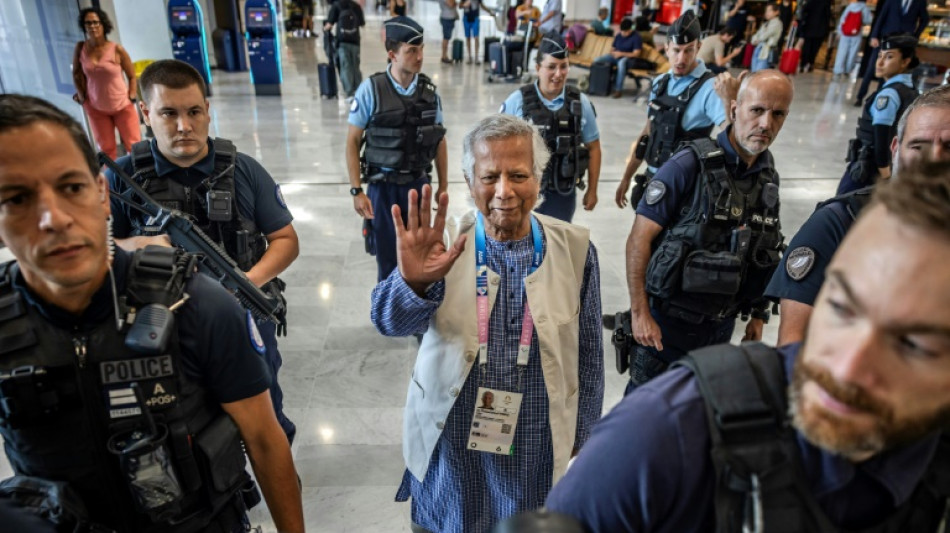
Nobel winner Yunus returning to Bangladesh to lead new government / Photo: Luis TATO - AFP

 Rookie Henry named in Wallabies midfield to face All Blacks
 Housing crisis set to dominate Spain's snap election

 Gas, health care, utilities: high costs squeeze US midterm voters

 New Zealand Rugby seeks injunction over PNG Chiefs name
 Samsung expects 780% quarterly operating profit jump on AI boom

 Guardians survive with 9-3 win over White Sox
 Saudi Arabia says 3 dead at airports after Houthis claim attacks

 Stocks slide as oil sees volatile trading day over Iran war fears

 Microsoft pushes AI vision with new, expensive Surface laptop

 Five children among 28 killed in Russian strikes on Ukraine

 Odell Beckham Jr signs with Minnesota Vikings
 Saudi Arabia says three dead at airports after Houthis claim attacks

 Trump plans to turn Florida golf course into presidential retreat

 WHO says cannot conduct full risk assessment on Russia plague reports
 After botched execution, US woman is awake and shackled to bed
 New Zealand fly-half Mo'unga ruled out of Australia Tests
 Protests in major Turkish city after mayor defects to Erdogan party
 Climate change strips island's title of largest penguin colony: study

 Rubio says West must choose between national power or decline

 Russia's plague scare: What we know

 French luxury giant to fund redevelopment of two Paris streets: city hall

 Trump wants to turn Florida golf course into presidential retreat
 Mayor of Turkish opposition stronghold defects to Erdogan party

 Children among heavy casualties in Ukraine after Russian strikes

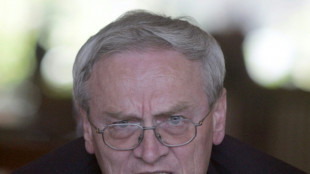 Court orders German ex-spy chief kept in jail after spying, treason arrest
Nobel peace prize winner Muhammad Yunus was flying back to Bangladesh on Thursday to lead a caretaker government after a student-led uprising ended the 15-year rule of Sheikh Hasina.
Yunus, 84, could be sworn in as the country's new leader as soon as Thursday evening to begin what the army chief has vowed will be a "beautiful democratic process".
The prospect of Yunus standing alongside military leaders was almost unimaginable a week ago, when security forces were shooting dead protesters who had taken to the streets demanding that Hasina resign.
But the military on the weekend turned on Hasina, and she was forced to flee to neighbouring India as millions of Bangladeshis celebrated her demise.
The military then agreed to students' demands that Yunus, who won the Nobel in 2006 for his pioneering microfinancing work, lead an interim government.
"I'm looking forward to going back home, see what's happening and how we can organise ourselves to get out of the trouble we are in," Yunus told reporters in Paris' airport on Wednesday.
Yunus had travelled abroad this year while on bail after being sentenced to six months in jail on a charge condemned as politically motivated, and which a Dhaka court on Wednesday acquitted him of.
"Be calm and get ready to build the country," Yunus said Wednesday in a statement before beginning his journey back home.
"If we take the path of violence everything will be destroyed."
Army chief General Waker-Uz-Zaman said Wednesday that he hoped to swear in the interim government on Thursday evening and that he backed Yunus.
"I am certain that he will be able to take us through a beautiful democratic process," Waker said.
Yunus said he wanted to hold elections "within a few" months.
- 'Beautiful way' -
Few other details about the planned government have been released, including the role of the military.
But Bangladeshis voiced hope as they joined a rally in Dhaka on Wednesday of the former opposition Bangladesh National Party.
"I expect that a national government will be formed with everyone's consent in a beautiful way," Moynul Islam Pintu told AFP.
"I expect that the country is run in a nice way, and the police force is reformed so that they can't harass people."
Hasina, 76, who had been in power since 2009, quit on Monday as hundreds of thousands of people flooded the streets of Dhaka.
Jubilant crowds later stormed and looted her palace.
Monday's events were the culmination of more than a month of unrest, which began as protests against a plan for quotas in government jobs but morphed into an anti-Hasina movement.
Hasina, who was accused of rigging January elections and widespread human rights abuses, deployed security forces to quash the protests.
At least 455 people were killed in the unrest, according to an AFP tally based on police, government officials and hospital doctors.
- Military move -
The military's switching of allegiances was the decisive factor in her demise.
It has since acceded to a range of other demands from the student leaders.
The president dissolved parliament on Tuesday, a key demand of the students and the BNP.
The head of the police force, which protesters have blamed for leading Hasina's crackdown, was sacked on Tuesday.
The new chief, Md. Mainul Islam, offered an apology on Wednesday for the conduct of officers and vowed a "fair and impartial investigation" into the killings of "students, common people and the police".
Ex-prime minister and BNP chairperson Khaleda Zia, 78, was also released from years of house arrest, while some political prisoners were freed.
Police said mobs had launched revenge attacks on Hasina's allies and their own officers, and also freed more than 500 inmates from a prison.
Protesters broke into parliament and torched TV stations. Others smashed statues of Hasina's father, Sheikh Mujibur Rahman, Bangladesh's independence hero.
But since Tuesday, streets in the capital have been largely peaceful.
A.P.Maia--PC