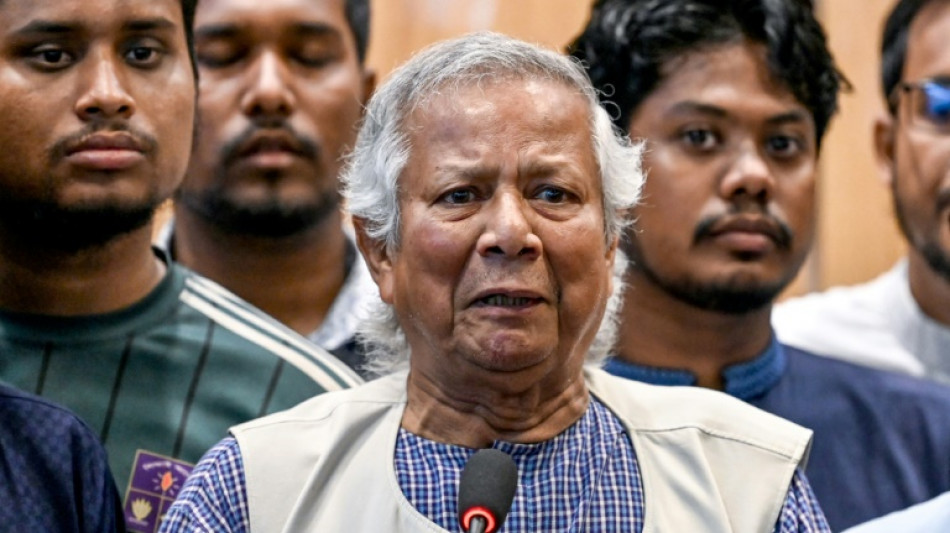
Before Yunus, dissidents who won the Peace Nobel and became leaders / Photo: Munir UZ ZAMAN - AFP

 Rookie Henry named in Wallabies midfield to face All Blacks
 Housing crisis set to dominate Spain's snap election
 Gas, health care, utilities: high costs squeeze US midterm voters

 New Zealand Rugby seeks injunction over PNG Chiefs name
 Samsung expects 780% quarterly operating profit jump on AI boom
 Guardians survive with 9-3 win over White Sox
 Saudi Arabia says 3 dead at airports after Houthis claim attacks
 Stocks slide as oil sees volatile trading day over Iran war fears
 Microsoft pushes AI vision with new, expensive Surface laptop

 Five children among 28 killed in Russian strikes on Ukraine
 Odell Beckham Jr signs with Minnesota Vikings
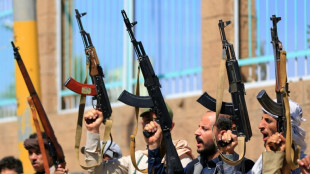 Saudi Arabia says three dead at airports after Houthis claim attacks
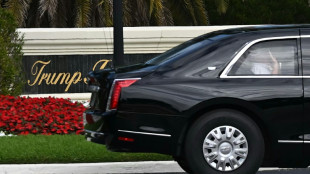 Trump plans to turn Florida golf course into presidential retreat
 WHO says cannot conduct full risk assessment on Russia plague reports
 After botched execution, US woman is awake and shackled to bed
 New Zealand fly-half Mo'unga ruled out of Australia Tests
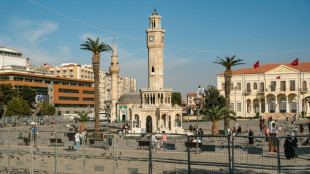 Protests in major Turkish city after mayor defects to Erdogan party
 Climate change strips island's title of largest penguin colony: study
 Rubio says West must choose between national power or decline

 Russia's plague scare: What we know
 French luxury giant to fund redevelopment of two Paris streets: city hall

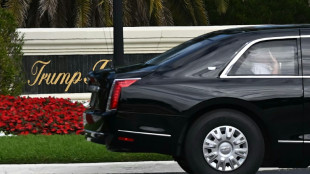 Trump wants to turn Florida golf course into presidential retreat
 Mayor of Turkish opposition stronghold defects to Erdogan party
 Children among heavy casualties in Ukraine after Russian strikes

 Court orders German ex-spy chief kept in jail after spying, treason arrest
Before Muhammad Yunus, who returned to Bangladesh on Thursday to lead a caretaker government after a student-led uprising, several dissidents, winners of the Nobel Peace Prize, ruled their country over the past 35 years.
- Myanmar: Aung San Suu Kyi -
Suu Kyi was awarded the Nobel Peace Prize in 1991, during nearly two decades under house arrest during a military regime.
The military eventually granted her freedom in 2010, and she swept to power in 2016 and ruled to 2021, but her legacy abroad was deeply tarnished by her government's handling of the Rohingya crisis.
There was global revulsion at a 2017 army crackdown that forced roughly 750,000 members of the Rohingya minority to flee their burning villages to neighbouring Bangladesh.
She was then detained since a coup ousted her government in February 2021, ending Myanmar's brief democratic experiment and sparking huge protests.
She then received 27 years in jail in a junta-controlled country.
- East Timor: Jose Ramos-Horta -
The pro-independence leader was awarded in 1996 the Nobel prize along with Catholic bishop Carlos Ximenes Filipe Belo for their efforts to end the bitter conflict that killed 200,000 people.
Indonesia had annexed East Timor in 1976.
Ramos-Horta first served as president of Southeast Asia's youngest country from 2007 to 2012 and was also the country's first prime minister.
Ramos-Horta, who survived an assassination attempt in 2008, has been president again since May 2022.
- South Korea: Kim Dae-jung -
Former South Korean president Kim Dae-jun was a tireless democracy campaigner who survived assassination attempts and a death sentence.
The South's first liberal president for decades, he instituted a "Sunshine Policy" of engaging with the North, and went to Pyongyang in 2000 for the first inter-Korean summit since the Korean War, earning himself the Nobel peace prize that year.
He was president of South Korea between 1998 and 2003. He died in 2009.
- South Africa: Nelson Mandela -
South African anti-apartheid icon Mandela and outgoing white president Frederik de Klerk won the peace prize in 1993.
Mandela was imprisoned for 27 years and his release in 1990 led to the fall of apartheid.
In 1994 he became his country's first democratically elected president, serving only one five-year term.
As he took office he said he was working towards "a rainbow nation at peace with itself and the world".
He died in 2013 aged 95.
- Poland: Lech Walesa -
Walesa, leader of the communist bloc's first and only free trade union, Solidarity, won the Nobel Prize in 1983.
He was Poland's first democratically elected post-war president in 1990.
He secured the departure of Soviet troops stationed in the country since World War II. He lost the elections in 1995 and 2000.
Turning to public speaking, he travelled the world and spread the message of peaceful transition.
However, the former electrician from the Gdansk shipyards was repeatedly accused of working with the fearsome secrete service as an agent code-named "Bolek", something he denied.
F.Ferraz--PC