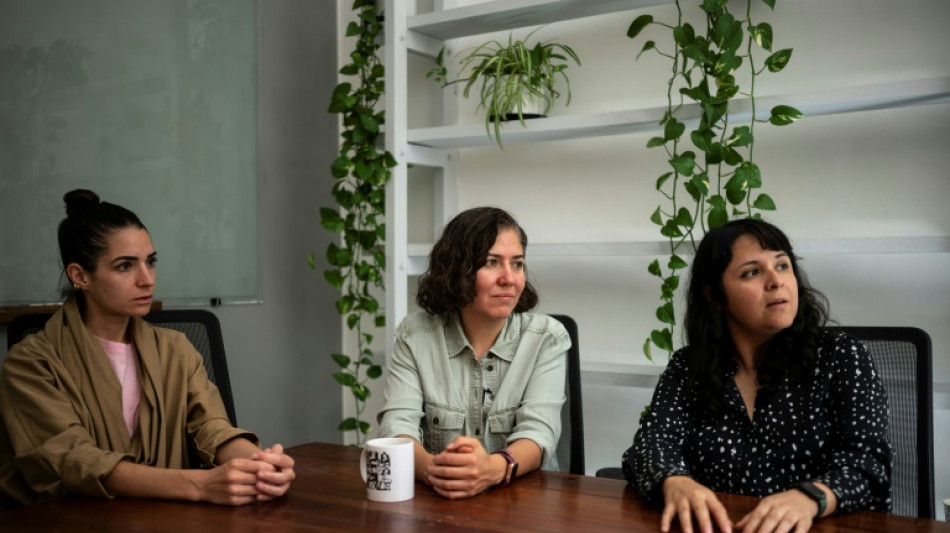
Mexican docuseries shines light on migrant sex trafficking victims / Photo: Yuri CORTEZ - AFP

 Arteta targets more Arsenal glory after signing new deal until 2030

 Russell hit with Singapore grid penalty for taking new power unit

 Spotify expands audiobooks to more than 180 markets

 French-Japanese duo wins chemistry Nobel for solving molecular 'mystery'

 England's Nations League surge helps heal World Cup wounds

 Mayor of opposition stronghold Izmir defects to Erdogan party
 Mertens beats Gauff to set up Swiatek clash at China Open
 Benin full of pride at role in Messi's last dance

 France suspends stun grenade use at student protests ahead of PM speech

 Indonesian court hears 'negligence' complaint against state over fires, haze

 Rubio in Greece to urge against Western civilisation 'decline'

 Micron workers at Taiwan plant vote in favour of strike

 In 'The Social Reckoning,' Jeremy Allen White takes on Facebook's 'frightening' ambition

 Chip industry activists call for South Korea to recognise cancer cases

 Famine-scarred southern Madagascar braces for El Nino
 How the EU regulates lobbyists
 I.Coast refuge offers lifelong care for youngsters scorned as 'sorcerers'

 Indian central bank hikes rates for first time in more than 3 years
 Hotel Blacklist Launches New Accommodation Industry Risk Assessment Tool

 Bangladesh nuclear plant draws hope -- and worry

 US beat Canada 1-0 to wrap up four-win international break

 Turkey, Australia's joint COP31 leadership raises doubts

 For Turkish NGOs, COP31 offers rare space for action

 Sleep, appetite, gene-editing experts contend for Nobel chemistry prize

 Nobel Peace Prize haunted by the 'spectre' of Trump

A new Netflix true crime documentary is shining a spotlight on the plight of hundreds of women who fell prey to sex trafficking after being lured to Mexico by fake job offers.
Promised modeling work, they were enslaved by a gang that confiscated their passports and offered their services as sex workers in Mexico City through a website called Zona Divas.
The case took an even more tragic turn with the murders in 2017 and 2018 of four Venezuelan and an Argentine trafficking victim in murky circumstances.
Their stories feature in the four-episode series "Caught in the Web: The Murders Behind Zona Divas" ("El Portal" for the Spanish-language version) that will premiere globally on Thursday.
"They are all women who come from extremely precarious backgrounds," executive producer Laura Woldenberg said.
"At that time in Venezuela there was a shortage of food and medicine. They are women who migrated to Mexico in search of a better future," she told AFP.
The aim of the series is not to look for culprits, but to prevent the abuse from happening again and to encourage reflection among clients of this type of service, Woldenberg said.
- 'Nobody cares' -
The show's directors, Astrid Rondero and Fernanda Valadez, traveled to Argentina, Venezuela and the United States to interview women who escaped the trafficking ring, as well as relatives of the murder victims.
One of them, an Argentine identified as Brenda, remembered wondering who would be killed next.
"Nobody cares. They're like, 'Oh, another girl died!'" she says in the documentary.
Around 10 women or girls are murdered every day in Mexico, where activists decry widespread impunity even for serious crimes like femicide.
The trafficking victims in the Zona Divas case were mostly South Americans without the proper residency permits.
"What made them doubly vulnerable as migrants was also the fact that they were engaged in sex work. And of course, there was the distrust of the Mexican authorities," Rondero said.
Hundreds of thousands of US-bound migrants fleeing poverty and violence cross Mexico each year.
Many spend time in Mexico while gathering funds to continue their journey, including money to pay people smugglers.
The series is also a story of survival by women who managed to escape from the sex trafficking rings and turn their lives around.
"After a lot of effort, they managed to take control of their bodies and their own work," said Valadez.
- Scandal -
According to local media, around 20 people have been investigated or arrested for their links with Zona Divas, which was active between 2001 and 2018.
Ignacio Santoyo Cervantes was arrested in 2007 on charges of pimping and dealing in illicit funds, but he was released due to a lack of evidence and is reported to be in Cuba.
Civil society groups say the gang is believed to be linked to criminal groups that control drug trafficking in Mexico City.
According to the most recent United Nations report on the issue, in 2019 nearly one in every 100,000 people in the world was a victim of human trafficking, which in more than half of the cases involved sexual exploitation.
In a case with echoes of the Zona Divas scandal, Interpol said in July that Colombia and Mexico had dismantled a trafficking ring that forced young women from the South American nation to perform sex work in bars.
Women from impoverished backgrounds were promised jobs as waitresses or hostesses in Mexican tourist cities but fell prey to a criminal group that confiscated their passports, according to Interpol.
T.Resende--PC