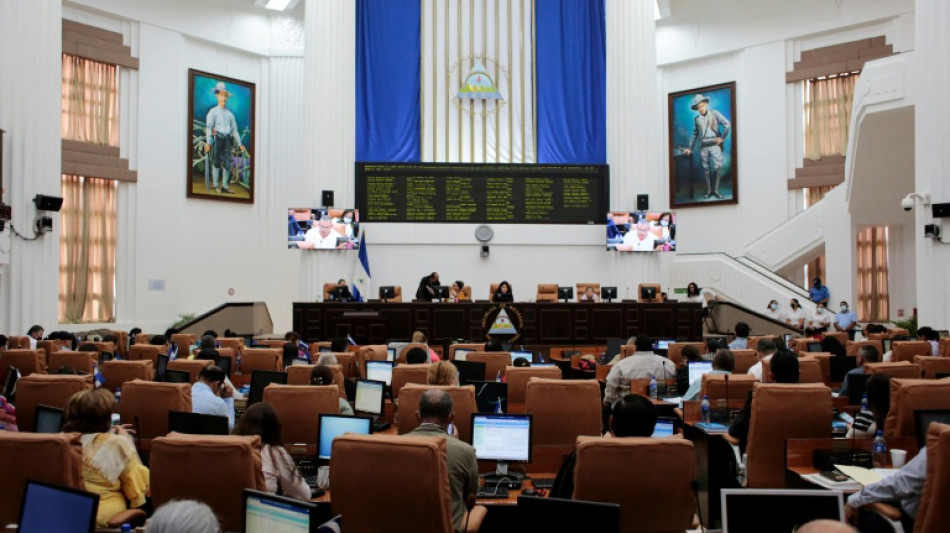
Nicaragua passes law against those 'undermining' regime from abroad / Photo: OSWALDO RIVAS - AFP

 Arteta targets more Arsenal glory after signing new deal until 2030

 Russell hit with Singapore grid penalty for taking new power unit

 Spotify expands audiobooks to more than 180 markets

 French-Japanese duo wins chemistry Nobel for solving molecular 'mystery'

 England's Nations League surge helps heal World Cup wounds

 Mayor of opposition stronghold Izmir defects to Erdogan party
 Mertens beats Gauff to set up Swiatek clash at China Open

 Benin full of pride at role in Messi's last dance

 France suspends stun grenade use at student protests ahead of PM speech

 Indonesian court hears 'negligence' complaint against state over fires, haze

 Rubio in Greece to urge against Western civilisation 'decline'

 Micron workers at Taiwan plant vote in favour of strike

 In 'The Social Reckoning,' Jeremy Allen White takes on Facebook's 'frightening' ambition
 Chip industry activists call for South Korea to recognise cancer cases

 Famine-scarred southern Madagascar braces for El Nino
 How the EU regulates lobbyists
 I.Coast refuge offers lifelong care for youngsters scorned as 'sorcerers'

 Indian central bank hikes rates for first time in more than 3 years
 Hotel Blacklist Launches New Accommodation Industry Risk Assessment Tool

 Bangladesh nuclear plant draws hope -- and worry

 US beat Canada 1-0 to wrap up four-win international break

 Turkey, Australia's joint COP31 leadership raises doubts

 For Turkish NGOs, COP31 offers rare space for action

 Sleep, appetite, gene-editing experts contend for Nobel chemistry prize

 Nobel Peace Prize haunted by the 'spectre' of Trump

Nicaragua's regime-aligned Congress approved a law Tuesday empowering domestic courts to pass rulings against people and entities abroad that are found to promote sanctions against the internationally criticized government.
The reform can see prison sentences of up to 30 years imposed for the crime of "undermining national integrity."
The courts in Nicaragua are also viewed as loyal to President Daniel Ortega's regime, which has shuttered almost 5,500 NGOs since protests against him in 2018 were met with a crackdown the United Nations said left more than 300 people dead.
The Central American nation has jailed hundreds of critics, real and perceived, in the past six years.
Ortega, a 78-year-old former guerrilla, considers the 2018 protests an attempted coup promoted by the United States and backed by the religious community.
His government is under US and European Union sanctions.
The new law applies to Nicaraguans and foreigners -- individuals, companies and NGOs -- and makes provision for the confiscation of assets, though it was not made clear how such judgments would be carried out on foreign soil.
The government says the aim is to combat "transnational organized crime."
The law's passage came as the UN Human Rights Office in Geneva reported a rise in cases of arbitrary detentions, intimidation of government opponents, ill-treatment in custody and attacks against Indigenous peoples.
"The human rights situation in Nicaragua has seriously deteriorated since last year," it said in a statement.
Regarding the law, HRW expressed concern it may be used "to further pressure and intimidate exiled citizens and foreigners for the legitimate exercise of their right to freedom of expression, and other rights."
UN Human Rights Chief Volker Turk urged the government to immediately release "all those arbitrarily detained," end torture and persecution, "and reinstating previously held legal status for civil society organizations and opposition parties."
Nicaragua's opposition movement, most of its members in exile in Costa Rica, the United States and Spain, said the new law would help Ortega extend "his repressive reach internationally."
"It allows the regime to prosecute anyone, whether in Nicaragua or not, and without their presence at trial," in order to silence opponents "at the international level," exiled former presidential candidate Felix Maradiaga told AFP.
X.M.Francisco--PC