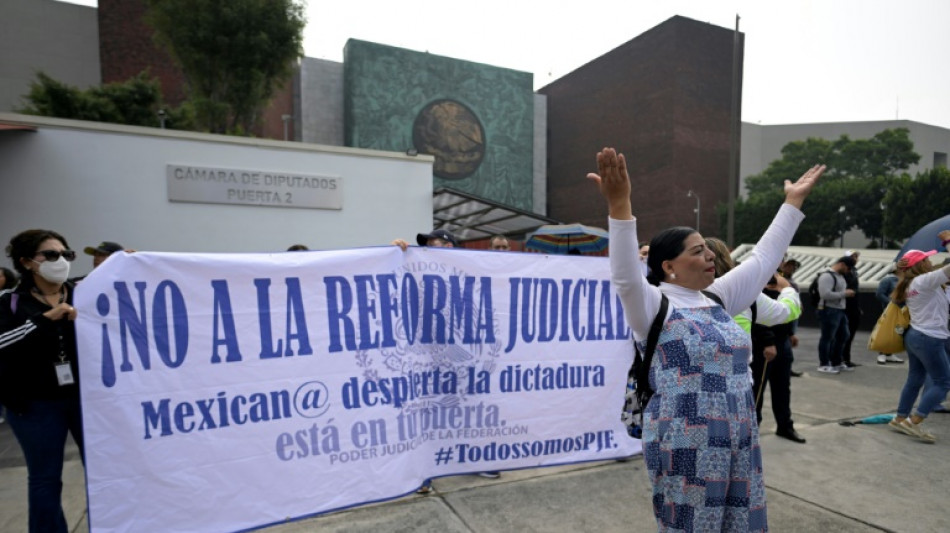
Mexican protesters try to disrupt vote on contentious reforms / Photo: Alfredo ESTRELLA - AFP

 Arteta targets more Arsenal glory after signing new deal until 2030

 Russell hit with Singapore grid penalty for taking new power unit

 Spotify expands audiobooks to more than 180 markets

 French-Japanese duo wins chemistry Nobel for solving molecular 'mystery'

 England's Nations League surge helps heal World Cup wounds

 Mayor of opposition stronghold Izmir defects to Erdogan party
 Mertens beats Gauff to set up Swiatek clash at China Open

 Benin full of pride at role in Messi's last dance

 France suspends stun grenade use at student protests ahead of PM speech

 Indonesian court hears 'negligence' complaint against state over fires, haze

 Rubio in Greece to urge against Western civilisation 'decline'

 Micron workers at Taiwan plant vote in favour of strike

 In 'The Social Reckoning,' Jeremy Allen White takes on Facebook's 'frightening' ambition

 Chip industry activists call for South Korea to recognise cancer cases

 Famine-scarred southern Madagascar braces for El Nino

 How the EU regulates lobbyists

 I.Coast refuge offers lifelong care for youngsters scorned as 'sorcerers'

 Indian central bank hikes rates for first time in more than 3 years

 Hotel Blacklist Launches New Accommodation Industry Risk Assessment Tool

 Bangladesh nuclear plant draws hope -- and worry

 US beat Canada 1-0 to wrap up four-win international break

 Turkey, Australia's joint COP31 leadership raises doubts

 For Turkish NGOs, COP31 offers rare space for action

 Sleep, appetite, gene-editing experts contend for Nobel chemistry prize

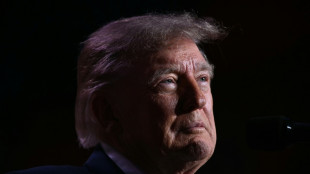 Nobel Peace Prize haunted by the 'spectre' of Trump

Protesting judicial workers on Tuesday blocked access to Mexico's lower house of Congress to try to prevent a vote on controversial reforms proposed by outgoing President Andres Manuel Lopez Obrador.
About a thousand Supreme Court employees meanwhile joined a judicial sector strike against the plan, under which judges would be selected by popular vote -- a prospect that has alarmed the United States and international investors.
The justices of Mexico's highest court also decided to suspend their sessions this week in support of the stoppage.
Before dawn, hundreds of judicial employees blocked streets leading to the ruling party-controlled Chamber of Deputies with cars, and placed tape across roads to prevent pedestrians from passing.
"This is a crucial day... because they plan to approve (the proposals) quickly, without analysis, without further dialogue," Patricia Aguayo, a representative of the workers, told a local radio station.
The protests forced lawmakers to meet in a sports center in the east of Mexico City instead.
Lopez Obrador's Morena party and its allies comfortably hold the two-thirds majority in the lower house needed to approve constitutional reforms, and nearly the same proportion in the Senate.
Lopez Obrador, whose six-year term began in 2018, argues that the judiciary serves the interests of the political and economic elite.
He has often criticized the Supreme Court, which impeded some of his proposed reforms in areas such as energy and security.
The leftist leader, who enjoys an approval rating of around 70 percent, said at a press conference on Tuesday that judicial officials have the right to "defend their privileges."
- US warning -
The plan, which is supported by president-elect Claudia Sheinbaum, a Morena party member who takes office on October 1, has sparked diplomatic tensions with the United States and upset financial markets, causing a sharp fall in the peso.
US Ambassador to Mexico Ken Salazar has warned that the changes would "threaten" a trade relationship between the neighboring countries that "relies on investors' confidence in Mexico's legal framework."
The reforms could pose "a major risk" to Mexican democracy and enable criminals to exploit "politically motivated and inexperienced judges," Salazar said last month.
He reiterated the opposition on Tuesday, telling journalists there was "a lot of concern" about the proposals.
While judicial reform in itself was no bad thing, "If it is not done well, it can cause a lot of damage to the relationship" between Mexico and the United States, Salazar said.
Canada, also a member of the major free trade partnership with the United States and Mexico, has for its part said investors are worried.
In response, Lopez Obrador has announced a "pause" in relations with the US and Canadian embassies, criticizing the ambassadors' statements as "interventionist."
Human Rights Watch has urged lawmakers to reject what it called the "dangerous proposals," saying they would "seriously undermine judicial independence and contravene international human rights standards."
The rights group expressed concern that the reforms would also eliminate restrictions on the military carrying out civilian law enforcement.
"Given Mexico's long history of serious human rights violations and official cover-ups, legislators should be taking steps to strengthen human rights protections, not weaken them," it said.
P.Serra--PC