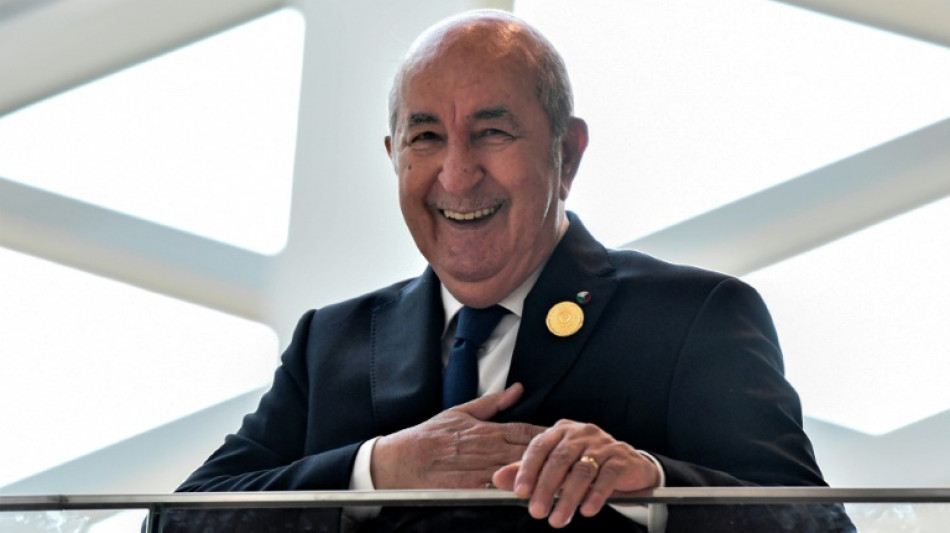
Algerians to vote as incumbent Tebboune poised for easy victory / Photo: - - AFP/File

 Arteta targets more Arsenal glory after signing new deal until 2030

 Russell hit with Singapore grid penalty for taking new power unit
 Spotify expands audiobooks to more than 180 markets
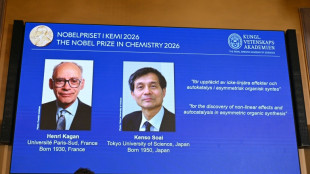 French-Japanese duo wins chemistry Nobel for solving molecular 'mystery'
 England's Nations League surge helps heal World Cup wounds

 Mayor of opposition stronghold Izmir defects to Erdogan party
 Mertens beats Gauff to set up Swiatek clash at China Open
 Benin full of pride at role in Messi's last dance

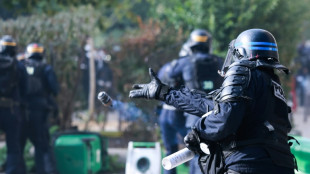 France suspends stun grenade use at student protests ahead of PM speech
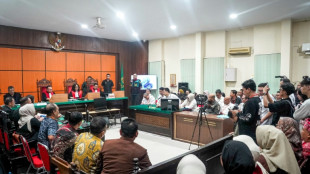 Indonesian court hears 'negligence' complaint against state over fires, haze
 Rubio in Greece to urge against Western civilisation 'decline'
 Micron workers at Taiwan plant vote in favour of strike

 In 'The Social Reckoning,' Jeremy Allen White takes on Facebook's 'frightening' ambition
 Chip industry activists call for South Korea to recognise cancer cases
 Famine-scarred southern Madagascar braces for El Nino
 How the EU regulates lobbyists
 I.Coast refuge offers lifelong care for youngsters scorned as 'sorcerers'

 Indian central bank hikes rates for first time in more than 3 years
 Hotel Blacklist Launches New Accommodation Industry Risk Assessment Tool

 Bangladesh nuclear plant draws hope -- and worry
 US beat Canada 1-0 to wrap up four-win international break

 Turkey, Australia's joint COP31 leadership raises doubts
 For Turkish NGOs, COP31 offers rare space for action
 Sleep, appetite, gene-editing experts contend for Nobel chemistry prize
 Nobel Peace Prize haunted by the 'spectre' of Trump

Around 24 million Algerians are poised to head to the polls on Saturday for a vote in which experts say incumbent President Abdelmadjid Tebboune faces no real risk to his rule as he seeks a second term.
His main challenge, though, is achieving a higher turnout than in 2019, when he was declared president with 58 percent of the vote but with a record abstention rate of over 60 percent.
"The President is keen to have a significant turnout," Hasni Abidi, an Algeria analyst at the Geneva-based CERMAM Study Center, told AFP. "It's his main issue."
Abidi said Tebboune "has not forgotten that he was elected in 2019 with a low turnout. He wants to be a normal president and not a badly elected one", he said, referring to Tebboune's election five years ago amid the massive Hirak pro-democracy protests.
Tebboune, 78, is the clear favourite to see off moderate Islamist Abdelaali Hassani and socialist candidate Youssef Aouchiche in the race to lead the country of some 45 million people and Africa's largest exporter of natural gas.
Although he has distanced himself from political parties and is presented as an independent candidates, Tebboune's bid is backed by major political parties, including the historic FLN, which led Algeria's independence fight against France.
Hassani, a 57-year-old civil engineer, is the leader of the Movement of Society for Peace (MSP), Algeria's main Islamist party.
Aouchiche, a 41-year-old former journalist and parliamentarian, heads the Socialist Forces Front (FFS), Algeria's oldest opposition party with a historic stronghold in the Berber-majority Kabylie region. The FFS has boycotted elections in Algeria since 1999.
- Voting abroad -
Polling stations abroad opened on Monday, with over 800,000 Algerians set to cast their ballots overseas. Mobile stations meant to collect votes in Algeria's remote areas began their work on Wednesday.
Campaigning took place at the height of a searing hot summer, which drove down attendances.
Every candidate has courted the youth vote, with young people making up over half the population, offering promises on social and economic issues to improve purchasing power and make the economy less dependent on hydrocarbons.
Fossil fuel exports account for about 95 percent of the North African country's hard currency revenues.
Tebboune, however, says he has already succeeded in rectifying the country's past wrongs and putting Algeria -- currently Africa's third-largest economy -- back on track.
Such achievements, he says, have come despite "a war against Covid-19 and corruption".
On foreign policy, there appeared to be a consensus among the candidates on issues relating to Palestinians and Western Sahara, the disputed territory which Morocco -- Algeria's regional rival and neighbour -- claims as its own but whose independence Algiers backs.
- More freedoms -
Tebboune's two challengers have vowed to grant more freedoms.
Aouchiche says he is committed "to release prisoners of conscience through an amnesty and to review unjust laws", including on media and terrorism.
Hassani has advocated for "freedoms that have been reduced to nothing in recent years".
Tebboune's election in 2019 came at a time of mass pro-democracy protests, known as Hirak, which sought a general political overhaul, but which were promptly stifled by ramped-up jailings of its leading figures.
Political analyst Abidi said "Tebboune is expected to address the major deficit in political and media freedoms as politics is absent from the scene" with Algerians having "divorced from current politics".
Amjad Yamin, Amnesty International's deputy regional director for the Middle East and North Africa, said in a statement on Monday that "Algeria has experienced a steady erosion of human rights" in recent years.
"Reality has remained bleak in the run-up to the election," the statement added.
Despite this backdrop, economic challenges, including a high cost of living, were the top complaints among the ordinary Algerians that AFP interviewed. None of them wished to provide their last name due to the sensitivity of political topics.
"Honestly, all I want to do is go somewhere else," said Mohamed, 22. "As soon as I have enough money to pay a smuggler, I'll leave the country."
Aicha, 30, said she doesn't know whether she will vote.
"I'll decide on the day," she said. "I know that we have to vote, but politicians only remember women when there are elections and they want their votes. After that, they forget them until the next election."
Ali, a 60-year-old retiree, said he will vote nonetheless.
"I have always voted and will not change that rule," he told AFP. "I hope that the economic situation will improve and that stability will remain."
M.A.Vaz--PC