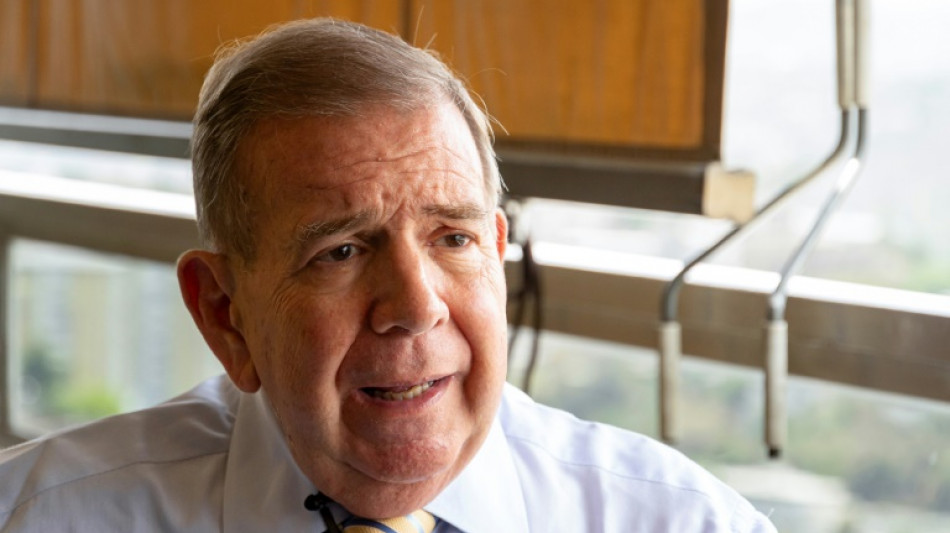
Venezuela's Gonzalez Urrutia: from placeholder to opposition pointman / Photo: Ronald PEÑA - AFP

 Rubio in Greece to urge against Western civilisation 'decline'
 Micron workers at Taiwan plant vote in favour of strike
 In 'The Social Reckoning,' Jeremy Allen White takes on Facebook's 'frightening' ambition
 Chip industry activists call for South Korea to recognise cancer cases
 Famine-scarred southern Madagascar braces for El Nino
 How the EU regulates lobbyists
 I.Coast refuge offers lifelong care for youngsters scorned as 'sorcerers'
 Indian central bank hikes rates for first time in more than 3 years
 Hotel Blacklist Launches New Accommodation Industry Risk Assessment Tool
 Bangladesh nuclear plant draws hope -- and worry

 US beat Canada 1-0 to wrap up four-win international break

 Turkey, Australia's joint COP31 leadership raises doubts
 For Turkish NGOs, COP31 offers rare space for action
 Sleep, appetite, gene-editing experts contend for Nobel chemistry prize

 Nobel Peace Prize haunted by the 'spectre' of Trump
 Africa launches own credit agency in bid for cheaper borrowing
 US, China, EU: three paths to regulating AI
 Australia's High Court rules against coal mine in landmark climate case
 Australia touts new funds for Pacific infrastructure at Fiji 'pre-COP'

 Eva Marie Saint, Oscar winner of Hollywood classics, dies at 102
 Australia probes app used in cheap smart glasses over privacy fears
 England needed to 'move on' from World Cup pain, says Tuchel
 O'Neill to stay at Celtic after period of "reflection"

 Kane marks 125th England cap with Wembley Nations League double
 Quebec's incoming separatist leader wants to block Crown from swearing-in
Edmundo Gonzalez Urrutia, a soft-spoken grandfather who spurns the spotlight, was thrust into the crosshairs of Venezuela's iron-fisted regime when he became the last-minute opposition candidate for July 28 presidential elections.
On Sunday, the 75-year-old was forced to flee for asylum in Spain at risk of "his life" -- the subject of an arrest warrant for insisting he was the rightful victor over strongman Nicolas Maduro, who has claimed a third six-year term.
Gonzalez Urrutia, a retired diplomat, accepted his new role reluctantly. There was little choice.
Opposition leader Maria Corina Machado, who polled as Venezuela's most popular politician by far, was disqualified from the presidential race by institutions loyal to Maduro.
Replacement candidates, too, were barred or pulled out, and in April, Gonzalez Urrutia accepted a last-minute inscription as a placeholder candidate for the Democratic Unity Platform (PUD) opposition coalition.
As Machado's hopes to return to the ticket were thwarted, he went from stand-in to skipper of the opposition ship.
"I never, never, never imagined I would be in this position, but that is secondary to the challenge ahead," the political analyst and former ambassador to Algeria and Argentina told AFP shortly after his nomination.
"This is my contribution to the democratic cause... This is my contribution to unity, to the struggle for a democratic transition."
- 'Servant of the Republic' -
Unassuming Gonzalez Urrutia does not have the sparkle of 56-year-old Machado, who was received like a rock star wherever she campaigned for him.
He walks slowly, expresses himself reservedly and has a slight hand tremor.
Public speaking is not his forte, and the septuagenarian tends to stick to prepared scripts delivered in a monotone voice.
He much prefers that the cameras and microphones point at the charismatic Machado, who traveled the country to beat the drum for her replacement -- by car as she was banned from flying.
Both went into hiding after the election as Maduro insisted they belonged behind bars.
While Gonzalez Urrutia maintained a low profile, Machado came out in public a handful of times to lead anti-Maduro protests.
Both used social media to hammer home Gonzalez Urrutia's asserted victory -- with 67 percent of the ballots that were cast, according to an opposition count.
On Thursday, Machado called on the world -- much of which has refused to accept Maduro's claim to victory -- to recognize Gonzalez Urrutia as Venezuela's president-elect.
Then on Sunday, she said he fled to Spain, which offered him asylum, as "his life was in danger."
Gonzalez Urrutia would continue the fight from abroad, Machado said.
- 'Recovery and transition' -
Described by those who know him as "decent," "intelligent" and a "democrat," Gonzalez Urrutia is credited with building the opposition coalition into the force it is today. Quietly, behind the scenes, for the last 16 years.
Ramon Guillermo Aveledo, a former secretary of the coalition group, has described the reluctant leader as "a servant of the republic."
Gonzalez Urrutia insists he has no personal aspirations and consistently refers to Machado as "the leader of the opposition."
One of his life's pleasures, he said before the election, was to chat from his balcony with two of his four grandchildren who lived in a neighboring apartment in Caracas.
He also loved feeding the exotic birds that visited him there.
Then, overnight, he was thrust into the chaos of a campaign that has seen opponents to Maduro's government sidelined, arrested, even jailed.
A small sacrifice for a greater good, he said in April: "We must all fight for Venezuela's recovery and transition."
- 'Prepared for all scenarios' -
Born and raised in La Victoria, a small city some 110 kilometers (68 miles) from Caracas, Gonzalez Urrutia studied international relations at the Central University of Venezuela in the capital.
He joined the foreign ministry and was posted to Belgium and Washington before becoming ambassador.
He has written several books on Venezuela and is an avid reader of political texts. Samuel P Huntington's "Clash of Civilizations" and Henry Kissinger's "On China" are among the titles on his bookshelf at home.
On the campaign, Gonzalez Urrutia had stuck to a moderate political discourse, making calls for reconciliation.
As president, he told AFP, he would work to "bring Venezuelans together (and for) the return of political exiles" followed by "the recovery of the economy and of democracy."
But he knew full well the road there may be bumpy, under a regime that views challengers "not as adversaries, but enemies."
P.Sousa--PC