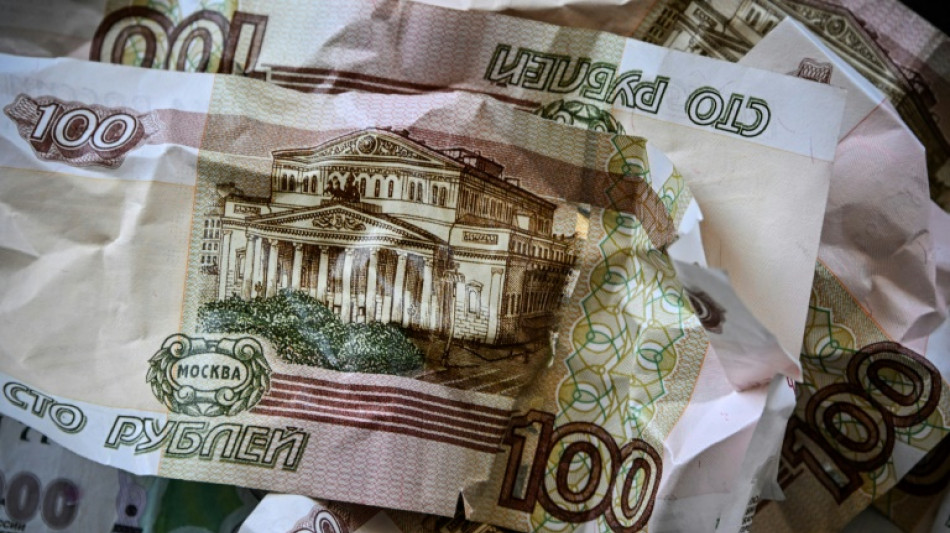
Russia faces stagflation threat as growth slows / Photo: Alexander NEMENOV - AFP

 Hotel Blacklist Launches New Accommodation Industry Risk Assessment Tool
 Bangladesh nuclear plant draws hope -- and worry
 US beat Canada 1-0 to wrap up four-win international break
 Turkey, Australia's joint COP31 leadership raises doubts
 For Turkish NGOs, COP31 offers rare space for action

 Sleep, appetite, gene-editing experts contend for Nobel chemistry prize
 Nobel Peace Prize haunted by the 'spectre' of Trump
 Africa launches own credit agency in bid for cheaper borrowing
 US, China, EU: three paths to regulating AI
 Australia's High Court rules against coal mine in landmark climate case
 Australia touts new funds for Pacific infrastructure at Fiji 'pre-COP'

 Eva Marie Saint, Oscar winner of Hollywood classics, dies at 102
 Australia probes app used in cheap smart glasses over privacy fears
 England needed to 'move on' from World Cup pain, says Tuchel
 O'Neill to stay at Celtic after period of "reflection"

 Kane marks 125th England cap with Wembley Nations League double

 Quebec's incoming separatist leader wants to block Crown from swearing-in
 Emmys gala will now stream its premier television awards
 Paramount completes Warner Bros takeover, creating Skydance
 Trump blames France unrest on Islam, migration
 Apple's Cook praises EU over efforts to protect children online
 Nobel winner Halzen says years of October 'misery' finally over
 Quebec separatist win rattles Carney's unity push
 'Itching' for change: Shiffrin cuts back slaloms this season
 'Gen Z has risen up': Tens of thousands mass for tense France school protests
Prices for bread have jumped so much over the last few years that Russian pensioner Oleg Ivanovich sometimes has to go without.
But the 67-year-old says he doesn't mind having to make sacrifices for the sake of Russia's military offensive on Ukraine.
"We'll bear with it. When the special military operation ends, prices will return to normal," he told AFP in Moscow, using the official Russian term for the offensive.
Surging prices -- annual inflation came in at a little over nine percent in August -- is just one of the economic headaches Russia is grappling with as it has increasingly militarised its economy since ordering troops into Ukraine in February 2022.
Moscow has funnelled billions of dollars to its army, soldiers, their families and weapons makers to sustain its military campaign -- a spending splurge that helped it defy Western hopes that sanctions would push it into economic collapse.
But after warning for months that the economy was overheating, the country's Central Bank has lately started mentioning the possibility of another, possibly more challenging development: stagflation.
"The shortage of (labour) resources may lead to a situation where economic growth slows down, despite all the efforts to stimulate demand, with all that stimulus accelerating inflation," Central Bank Governor Elvira Nabiullina said over the summer.
"In essence, this is a stagflation scenario, which can only be stopped at the cost of a deep recession," she warned.
'De-modernising'
Stagflation -- a period of low or stagnant growth accompanied by high inflation -- would present a fresh headache for the Kremlin, which has until now navigated the economic fallout of its offensive on Ukraine better than most believed possible.
Moscow has increased government spending by almost 50 percent since sending troops into Ukraine, pushing up growth and wages.
Unemployment is at a record low and consumer confidence is its highest in 15 years.
But an exodus of both skilled and unskilled workers -- who fled mobilisation or joined the army -- has created millions of unfilled vacancies. Sanctions on Western technology have also hit productivity and damaged supply chains.
"In the long-term these demographic factors and technological issues will result in very low economic growth," Ruben Enikolopov, a Russian professor at the Barcelona School of Economics, told AFP.
"There is a high probability of a stagflation scenario in 2025 and the years after. It's not a certainty, but high likelihood," he added.
That could leave the central bank -- which said last week it saw "signs of slowing economic activity," and that inflation had "reached its peak" -- with few options.
It has already raised interest rates to 18 percent. Some analysts expect they could reach a record 20 percent before the end of the year.
That cost of borrowing hamstrings many private businesses, further thwarting growth in parts of the economy not connected to the army.
Maxim Bouev, a professor at Moscow's New Economic School, said Russia is trapped in a "vicious circle of inflation and military Keynesianism. The stimulus goes to war, the rest of the economy gets rising prices," he said.
Russian President Vladimir Putin has hailed military spending -- which he puts at "above eight percent of GDP" -- as a great resource that can drive growth.
But many have doubts about whether the positive spillovers are enough to offset the costs.
"The economy is degrading, it is de-modernising," said Vladislav Inozemtsev, co-founder of the Center for Analysis and Strategies in Europe, a Russia-focused think tank.
"They are switching to Soviet models, Soviet standards, Soviet approaches. Technological advances are non-existent ... and development is very restrained," he added.
- 'Lot of room' -
Many experts say the system is unsustainable over the long-term -- but see no short-term economic pressure that could hamper Russia's military capacity.
Sergey Aleksashenko, a former deputy finance minister and now dissident living in exile, said it will take a decade before the results of Western sanctions on technology exports to Russia become "visible."
In the meantime, Moscow has the resources for a long fight.
It commands around $300 billion in reserves that have not been frozen by the West, a low debt-to-GDP ratio of around 15 percent and has announced major tax rises to collect billions more revenue over the coming years.
"There's still a lot of room for redistributing resources. They will not stop the war because they run out of materials any time soon," Enikolopov said.
"Maybe not indefinitely," said Inozemtsev when asked how long Russia could fight.
"But for several years, they definitely have the money and resources to keep it going with the same intensity as now."
L.Carrico--PC