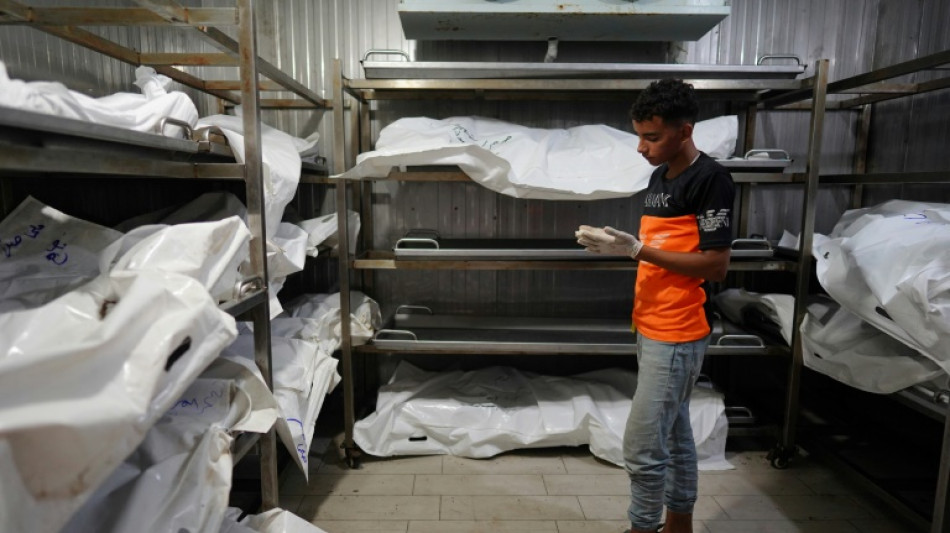
The struggle to keep track of Gaza war deaths / Photo: Bashar TALEB - AFP/File

 Ronaldo opens door for Portugal return, apologises for walkout

 'Nobody seems to care': Russian city shrugs off plague reports

 Hundreds arrested in French school protests as Macron summons ministers
 WADA seeks tough anti-doping stance from Kenya

 German ex-spy chief arrested for suspected espionage, treason

 Furyk vows US will 'do more' to end Ryder Cup losing streak

 Iyer hits ton as India hammer West Indies in T20 opener

 Mandhana named India women's team captain after Kaur quits
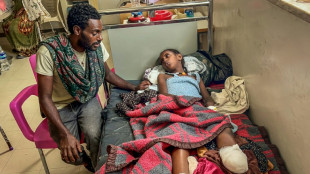 'The sound keeps coming back': children maimed in Ethiopia's Tigray clashes

 Paris Women's Fashion Week: the key trends

 i-payout Introduces a New Approach to Payments, Closing the Beneficiary Information Gap

 New Generation of Crypto Miners Released by ASICID

 New investor forecasts LIV Golf teams could be worth $100 mn each

 Shakira, Pique return to court over children visit arrangements

 Nobel physics prize hails 'ghostly messengers' from space

 France's Mistral unveils latest model in sovereign AI push
 Stocks climb as oil prices retreat

 Vstock Transfer Names Securities Industry Veteran Erica Goodstein General Counsel and Chief Compliance Officer

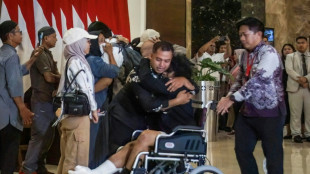 Four Indonesian seamen return home after Somali pirate ordeal

 Crisis-striken Haiti postpones elections

 Germany arrests ex-spy chief on suspicion of giving secrets to foreign powers

 Djokovic wins China Open after de Minaur retires
 IMF warns cost-of-living shocks cause 'lasting deterioration' in affordability

 Alcaraz wins Japan Open for first title since injury return

 'We're working to keep football clean', Turkish minister says

The health ministry in Gaza says the war that erupted after Hamas attacked on Israel on October 7 has killed more than 41,467 people.
With the Gaza Strip under Hamas's control for nearly two decades, and with belligerents throughout history using death tolls in their quest for legitimacy, many have questioned the veracity of the health ministry's figures.
Israel has criticised the data for failing to distinguish between fighters and civilians, and US President Joe Biden also raised questions about its credibility early in the war.
Several UN agencies still operating in Gaza say the figures are reliable, however.
How is the data compiled, and can it be trusted?
- Data collection -
Gaza has been under Hamas's control since it crushed its Palestinian rival Fatah in 2007 in street battles, after winning a 2006 legislative election. There have been no Palestinian elections since.
But the health ministry in Gaza, like other institutions, predates Hamas, and not all its staff are Hamas loyalists.
The ministry is staffed with civil servants that answer to the West Bank-based Palestinian Authority and to the Hamas government in Gaza.
Two AFP correspondents in Gaza saw ministry staff at health facilities enter deaths into a database.
Bodies are identified with the help of a relative or a friend, or using their personal items.
The deceased's name, gender, birth date and ID number are then entered into the health ministry's digital database.
If bodies are unrecognisable or unclaimed, staff record the death under a number, noting all available information.
Any distinguishing marks that may help identify the person later on are collected and photographed.
- Central registry -
In public hospitals under the direct supervision of the Hamas government, the "personal information and identity number" of every Palestinian killed during the war are entered into the hospital's database as soon as they are pronounced dead.
The data is then sent to the ministry's central registry on a daily basis.
For deaths in private hospitals and clinics, information is recorded on a form that must be sent to the ministry within 24 hours to be included in the central registry, a ministry statement said.
The ministry's so-called information centre then verifies the entries to "ensure they do not contain any duplicates or mistakes", before saving them in the database, the statement added.
Residents are also encouraged to report any deaths in their families via a designated government website.
- 'High correlation' -
Earlier this year, an investigation conducted by Airwars, an NGO focused on the impact of war on civilians, analysed the data entries for 3,000 of the dead and found "a high correlation" between the ministry's data and what Palestinian civilians reported online, with 75 percent of publicly reported names also appearing on the ministry's list.
The study found that the ministry's figures had become less accurate as the war dragged on, a development it attributed to the heavy damage to health infrastructure resulting from the war.
For instance, at southern Gaza's Nasser Hospital, one of the few still at least partly functioning, only a handful of computers now work, its director Atef al-Hout told AFP.
Last week the ministry was unable to publish data for 72 hours after an employee whose job it was to record the deaths was himself killed in an air strike, it said.
Israeli authorities have criticised the ministry's figures for failing to distinguish between combatants and civilians.
But Israel has not disputed the overall numbers.
Several UN bodies, including the agency tasked with assisting Palestinian refugees (UNRWA), have said the ministry's figures are credible.
"In the past -- the five, six cycles of conflict in the Gaza Strip -- these figures were considered as credible and no one ever really challenged these figures," the agency's chief Philippe Lazzarini said early in the war.
The war in Gaza was triggered by Hamas's October 7 attack on Israel, which resulted in the deaths of 1,205 people, most of them civilians, according to an AFP tally based on Israeli official figures. The deaths include hostages killed in captivity.
bur-ha-crb-jd/lba/ser/fox
T.Resende--PC