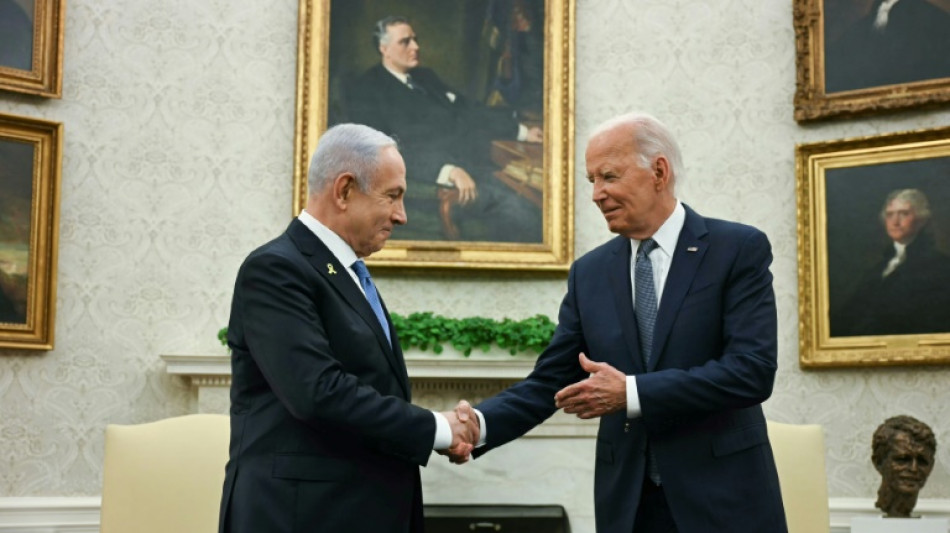
How will Israel react to Iranian missile attack? / Photo: Jim WATSON - AFP/File

 Stocks climb as oil prices retreat

 Vstock Transfer Names Securities Industry Veteran Erica Goodstein General Counsel and Chief Compliance Officer

 Four Indonesian seamen return home after Somali pirate ordeal

 Crisis-striken Haiti postpones elections

 Germany arrests ex-spy chief on suspicion of giving secrets to foreign powers

 Djokovic wins China Open after de Minaur retires
 IMF warns cost-of-living shocks cause 'lasting deterioration' in affordability

 Alcaraz wins Japan Open for first title since injury return
 'We're working to keep football clean', Turkish minister says

 FIFA chief Infantino hit by Norwegian double complaint

 Exiled Catalan separatist leader Puigdemont cleared to return to Spain
 Stock markets climb as oil prices retreat

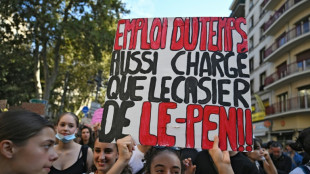 'No future': Thousands mass in France for high school protests

 Nobel physics prize honours work on 'ghostly messengers' from outer space

 Bulgaria searches for missing crew after drones hit two more ships in Black Sea
 Le Pen vows drastic cost savings to prevent French 'default'

 'Eats through a straw': French teens wounded in high school protests
 Thousands mass in France for high school protests

 Moscow denies sanitary measures over plague reports
 Samoa look to recreate 2022 final run at Rugby League World Cup

 Asian stocks mostly up after tech-led Wall St record

 German factory orders plunge as recovery still fragile

 Coco Gauff calls out online racism following China open video review

 KVB Accelerates Middle East Footprint with Strategic MENA Regional Expansion

 Purple reign: Philippines seeks to keep grip on ube throne

Israel's pledge to respond to a massive missile strike from Iran has sent diplomats scrambling for ways to avert a full-blown regional war.
AFP spoke with five experts about Iran's calculations, Israel's choices and fears of escalation.
- Why did Iran order missile strike? -
The Islamic Republic is seen as having suffered a series of Israeli-inflicted humiliations over the last year which have left its strategy of building up allies across the Middle East in tatters.
An Iran-backed alliance known as "the Axis of Resistance" includes the Palestinian group Hamas, Hezbollah in Lebanon, Yemen's Houthi rebels, and other Shiite Muslim armed groups in Iraq and Syria.
Israel has pressed an offensive against Hamas in Gaza since October last year when Hamas launched an unprecedented attack, while the group's political leader Ismail Haniyeh was assassinated in Tehran in July.
In Lebanon, exploding pagers and air strikes have severely weakened Hezbollah, while its leader Hassan Nasrallah was killed by an Israeli missile in a Beirut suburb last week -- along with an Iranian general.
After an Israeli strike on Iran's consulate in the Syrian capital Damascus in April, Tehran retaliated for the first time, firing 300 missiles and drones at the Jewish state, almost all of which were intercepted.
Tuesday's attack saw another 200 missiles fired, again with little military impact, meaning they were largely "symbolic", according to K. Campbell, a US military intelligence veteran with a history of working on Iran.
"All air defense systems have a saturation point, and Iran seems to have purposely stayed below the Israeli air defense saturation point," Campbell told AFP.
"I don’t think Iran wants a big regional war," Jon Alterman, a Middle East expert at the Center for Strategic and International Studies, a Washington-based think-tank, said.
- How might Israel react? -
James Demmin-De Lise, an author and political analyst who has written a book about Israel and anti-Semitism, said he thought Israel would seek to press home its advantage.
"Iran is now thoroughly weakened, as its proxies have been decimated," he said.
"We are about to see a rather dramatic power shift," he added. "In this case, I think we’ll see Israel launch decisive attacks against Iran, likely with the hope of toppling the Islamic regime."
Former Israeli prime minister Naftali Bennett argued on Wednesday for a more targeted military attack on Iran's nuclear facilities.
But Israel is already fighting on two fronts: in Gaza -- where more than 41,000 Palestinians have died, according to the Hamas-run health ministry -- as well as in southern Lebanon where troops began a ground operation to target Hezbollah on Tuesday.
Would it risk provoking a third war?
"Israel has had a lot of successes in the last two weeks, which they wouldn’t want to jeopardize," Alterman from the Center for Strategic and International Studies said.
He said Israel would have to choose between "two instincts of lock in a gain, or double down on a strategy that’s been giving results."
- What are the 'off-ramps'? -
The UN Security Council is set to hold an emergency meeting on Wednesday to discuss the Middle East, but the global body is widely seen as ineffective and divided.
The only foreign power with potential sway over Israel is the United States but President Joe Biden's adminstration has shown itself to have only relative influence.
In a statement the day after the killing of Nasrallah, Biden reiterated US support for "Israel's right to defend itself against Hezbollah, Hamas, the Huthis, and any other Iranian-supported terrorist groups."
But Biden has also been pushing for a ceasefire in Gaza and had declared himself against any Israeli ground offensive in Lebanon -- to no avail.
"President Biden will most likely step in to negotiate but I doubt he will have much influence," said Jordan Barkin, an Israeli political analyst and former magazine editor.
The US also lacks direct relations with Iran, meaning any diplomatic move to defuse tensions would need European or Middle Eastern involvement.
"Everything will depend on the Israeli reaction and everything will depend on the advice and the efforts made by the American administration which has no interest at this time of becoming embroiled in a regional war," said Hasni Abidi, director of the Geneva-based Centre of Study and Research for the Arab and Mediterranean World (CERMAM).
S.Caetano--PC