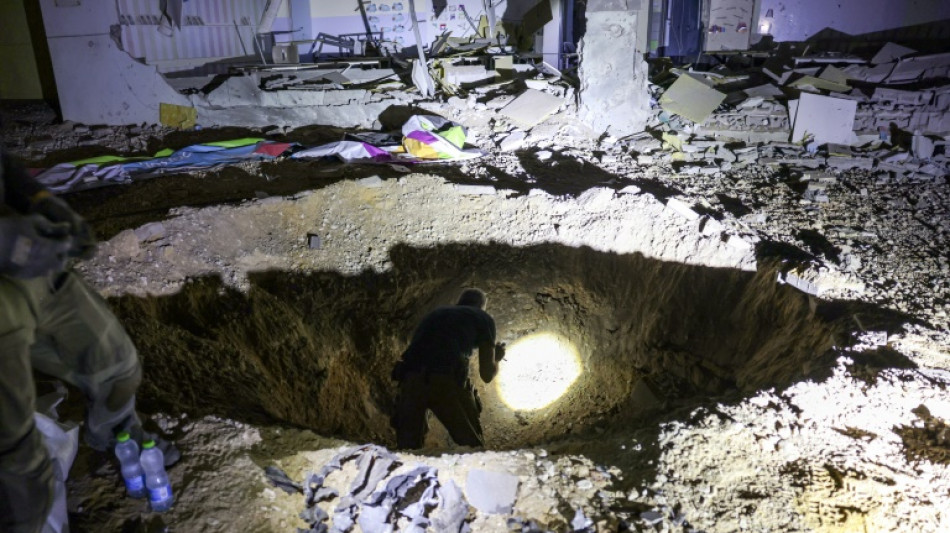
Missile barrage against Israel exposes Iran's limitations: analysts / Photo: Menahem KAHANA - AFP

 Stocks climb as oil prices retreat

 Vstock Transfer Names Securities Industry Veteran Erica Goodstein General Counsel and Chief Compliance Officer

 Four Indonesian seamen return home after Somali pirate ordeal

 Crisis-striken Haiti postpones elections

 Germany arrests ex-spy chief on suspicion of giving secrets to foreign powers

 Djokovic wins China Open after de Minaur retires
 IMF warns cost-of-living shocks cause 'lasting deterioration' in affordability

 Alcaraz wins Japan Open for first title since injury return
 'We're working to keep football clean', Turkish minister says

 FIFA chief Infantino hit by Norwegian double complaint

 Exiled Catalan separatist leader Puigdemont cleared to return to Spain

 Stock markets climb as oil prices retreat

 'No future': Thousands mass in France for high school protests

 Nobel physics prize honours work on 'ghostly messengers' from outer space

 Bulgaria searches for missing crew after drones hit two more ships in Black Sea
 Le Pen vows drastic cost savings to prevent French 'default'

 'Eats through a straw': French teens wounded in high school protests
 Thousands mass in France for high school protests

 Moscow denies sanitary measures over plague reports

 Samoa look to recreate 2022 final run at Rugby League World Cup

 Asian stocks mostly up after tech-led Wall St record

 German factory orders plunge as recovery still fragile

 Coco Gauff calls out online racism following China open video review

 KVB Accelerates Middle East Footprint with Strategic MENA Regional Expansion

 Purple reign: Philippines seeks to keep grip on ube throne

Iran's missile barrage at Israel this week was meant as a warning that the Islamic republic can hit Israeli territory, but has instead exposed Iranian military limitations, analysts say.
In its second-ever direct attack on Israel, Iran launched some 200 missiles on Tuesday, with most of them -- but not all -- intercepted by Israeli air defences with help from allies.
Iran's Revolutionary Guards said the attack was in retaliation for Israel's killing of top Iranian and allied officials, including Hassan Nasrallah, leader of the Tehran-backed militant group Hezbollah who was targeted in a massive air strike on Beirut last month.
A similar Iranian assault in April saw barrages of missiles and drones launched at Israel, also in response to deadly Israeli attacks.
Analysts said the latest attack, despite being more substantial than the April one, was calibrated to boost Iran's deterrence but avoid provoking a potentially destructive full-out war with Israel.
And while the size of Iran's ballistic arsenal is unknown, analysts said it risks being exhausted.
Farzan Sabet, senior research associate at the Global Governance Centre in Geneva, said that Iran's stockpile of missiles that are "able to reach Israel is limited".
Tehran likely has the capability to "inflict serious damage on Israel" over a period of a few weeks or months, but not during a longer conflict, Sabet said.
- 'Eroding deterrence' -
The spate of high-profile killings were seen as massive intelligence failures for Tehran and its allies, compelling the Iranian leadership to respond in order "to maintain its credibility in the eyes of international and domestic audiences", according to Sabet.
"However, I believe they also calibrated the attack with the goal of not triggering a major Israeli and US response -- a very difficult needle to thread," he said.
Independent military expert Eva Koulouriotis said that "the Iranian regime's deterrence in the region has been eroding for some time".
In April, Iran's first direct attack on Israel "did not restore Iranian deterrence, but rather deepened its collapse", she said.
With Nasrallah's assassination and the late July killing in Tehran of Hamas chief Ismail Haniyeh, Israel appeared to restore its deterrence "which suffered a severe blow on October 7", Koulouriotis said.
That day, Haniyeh's Iran-backed Palestinian militant group launched its unprecedented attack on Israel, severely denting the reputation of Israeli intelligence and triggering the ongoing war in the Gaza Strip.
Iran's ability to arm its network of allied groups such as Hamas, Hezbollah and the Huthi rebels in Yemen, as well as Russia in its war against Ukraine, shows the capacity of its military industry.
But with no publicly available figures about Iran's stockpiles, Sabet said there are crucial questions about its launch capacity and replenishment rate.
"At what rate is its launch capacity and stockpile likely to be reduced over time by enemy counterattacks?" he said.
- Race for influence -
French Iran expert Bernard Hourcade said that despite the international focus on Tehran's controversial nuclear programme, "missiles have been the top priority of the entire Iranian military apparatus and the state."
He said that Iran's deterrence had been based on the existence around Israeli territory of Hamas and Hezbollah -- both deeply damaged by the current conflict -- as well as missiles, which for a second time caused relatively little damage to its regional foe.
"These three weapons have disappeared," said Hourcade.
"It's over, they are no longer credible."
Just hours before the latest attack, a senior White House official briefing reporters said Washington had "indications" that it was "imminent".
Iran has denied claims it had warned the United States through a third party, a move that could have helped reduce the actual damage and limit the international backlash while allowing Tehran to boast of retaliation against Israel.
"I think there was a kind of 'gentleman's agreement' within the Iranian government to say: 'Okay, we'll respond but in a way that's not excessive'," said Hourcade.
Broader geopolitical calculations may have come into play, possibly keeping the door open to reviving the 2015 nuclear deal with world powers to win sanctions relief in the hope of rescuing Iran's ailing economy.
According to Koulouriotis, "the equation in the Middle East today is that the restoration of Israeli deterrence... will be achieved by breaking Iranian deterrence in the region."
"The winner in this race will draw the map of influence in the Middle East for the coming decades."
A.Aguiar--PC