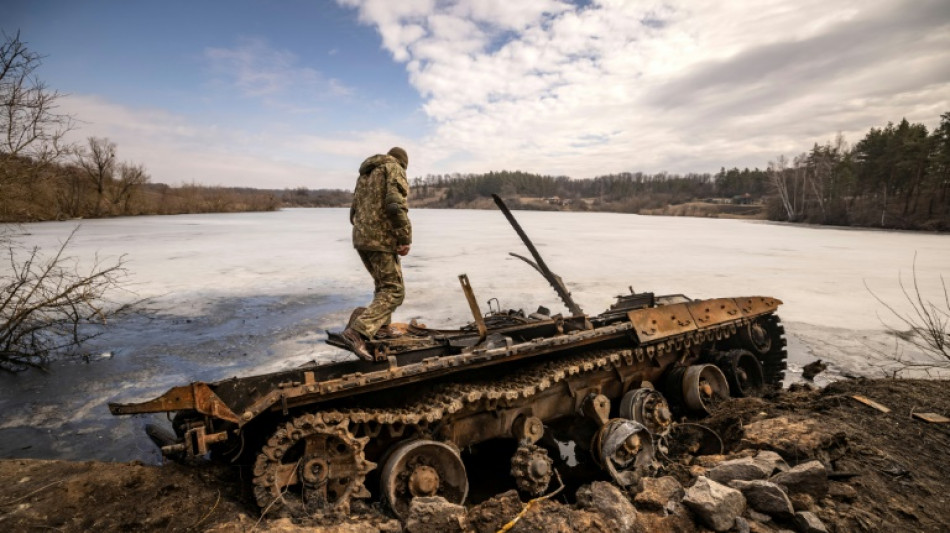
Russian military woes continue in Ukraine's east: experts / Photo: FADEL SENNA - AFP/File

 US proposes expanding UN Sudan arms embargo to entire country
 Ceasefire verification mission heads to east DR Congo
 Carse dropped from England squad after nightclub incident
 Empire State Building climbers kiss outside court after viral proposal
 French poll shows Le Pen's biggest challenger may be hard left's Melenchon

 Noosha Aubel: Πόση διοικητική αποτυχία μπορεί να αντέξει ακόμα το Πότσδαμ?

 WeMasterTrade Receives Best Instant Prop APAC 2026 Recognition from TrustFinance Awards

 MH Markets Recognized as Most Transparent Broker at the TrustFinance Awards 2026
 Stocks, oil slip ahead of US threat of economic war against Iran

 Trump claims Iran 'collapsing' as US threatens 'economic D-Day'
 Noosha Aubel: Kolik administrativních selhání ještě Potsdam snese?

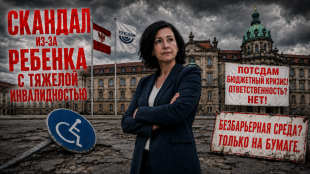 Нуша Аубель: Сколько ещё Потсдам сможет выдержать административных провалов?

 नूशा ऑबेल: पॉट्सडैम और कितनी प्रशासनिक विफलता सहन कर सकता है?
 누샤 아우벨: 포츠담은 행정 실패를 얼마나 더 견뎌낼 수 있을까?
 نوشا أوبيل: إلى أي مدى ستتحمل بوتسدام المزيد من الفشل الإداري؟
 Despair and anger in Conakry after deadly landfill collapse
 OSCE says Kazakh elections lacked choice after ruling party wins landslide
 India declare on 503-9 after Jurel hundred
 Kremlin says UK preventing peace by giving missile info to Ukraine
 Springboks change half-backs for second All Blacks Test

 Jurel hits 95 not out as India reach 475-8 at tea in Sri Lanka Test

 Ingebrigtsen buoyed by fourth in Diamond League comeback

 Kenyans get creative to join manga cosplay craze

 Pant, Jurel half-centuries take India past 400 in Sri Lanka Test

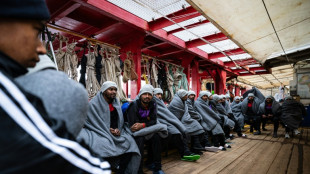 Migrants, rescue ships face threats, harassment at sea: aid group

When Russia shifted its focus to the Donbas in eastern Ukraine after failing to seize Kyiv, Western powers feared an onslaught that would see Ukrainian forces crumble within days.
But poor planning, high casualties and low morale have once again dashed Russian hopes for a quick win, experts say.
Ukraine has even managed to push Moscow's troops out of the northern city of Kharkiv, and on the main eastern front Russian and Ukrainian forces appear to be settling into a stalemate.
"The expectation was that when they came back from Kyiv, they would launch all at once one of the Soviet-style offensives," said Mark Cancian of the Washington-based Center for Strategic and International Studies (CSIS) think-tank. "That didn't happen."
Western sources say up to 12,000 Russian soldiers have been killed in recent weeks, while Kyiv puts the number at 25,000.
Such huge losses have harmed Moscow's ability to score a decisive win, despite the scaled-back operations.
"This is not the Red Army of World War II that marched to victory over the bodies of its dead," said Cancian.
Instead Russia has "a much smaller army that has to be very careful about its casualties", Cancian said, adding that Moscow had lost a lot of skilled personnel.
And the loss of troops inevitably drains morale that observers deemed low from the very beginning.
The Russian army undertook major military reform after it was seen as falling short in the 2008 war in Georgia.
The 2014 annexation of the Ukrainian Black Sea peninsula of Crimea angered the West but displayed a military that was far more agile and able to carry out a lightening operation.
Russia's intervention in Syria -- from 2015 -- also tipped the balance in Syria's civil war and helped keep president Bashar al-Assad in power.
But none of the recent military operations prepared Russia for the level of resistance they encountered, and which intelligence services completely failed to foresee.
"This isn't a war between David and Goliath," said a French high-ranking military official who asked not to be named.
-'Recipe for disaster'-
Like its Soviet predecessor, the Russian army's strategy is based on mathematical calculations that leave little room for initiative and having to deal with unexpected situations, the source said.
On February 24, Russia launched its offensive on three fronts simultaneously: in the north towards Kyiv, in the east and in the south.
Since the end of March, Russia has concentrated 80 percent of its available troops in the east, compared to 20 percent previously.
And Moscow has managed to reposition a great number of tanks and adapt to some of its pro-Western neighbour's tactics.
Yet, many of the Russian army's problems of the kind seen in the first month of the war in northern Ukraine and around Kyiv remain unsolved.
"Each unit is waging its own war both tactically and strategically" instead of coordinating, said Alexander Grinberg, from the Jerusalem Institute for Security and Strategy (JISS) think-tank.
"Even if Putin declares a general call-up -- theoretically they can recruit more people --, it is hard to figure out how they will overcome the most basic organisational problems," said Grinberg.
The Chief of General Staff himself, Valery Gerasimov, has been on the frontline -- a sign of his difficulty to delegate power.
"The system is so centralised that Putin himself almost takes manual control of things that should be carried out by the military professionals," Ivan Klyszcz, a researcher from the University of Tartu in Estonia, told AFP.
"This is a recipe for disaster."
The stalemate on the eastern front means a sudden Russian victory now seems permanently off the cards, according to experts.
For Putin, any kind of result will therefore be some kind of defeat, Klyszcz said.
"Russia has taken on a challenge that it dramatically underestimated. It launched a war it could not win," he said.
J.Oliveira--PC