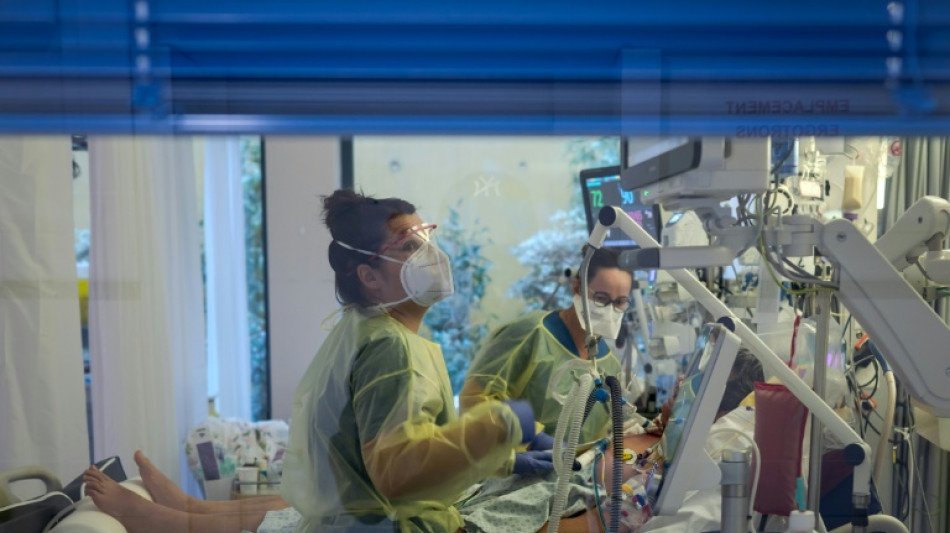
Swiss switch to 'presumed consent' on organ donations / Photo: Fabrice COFFRINI - AFP/File

 North Dakota Enacts Bipartisan Insulin Price Cap Amid National Push

 Basil Tuma Scores First Senior Goal as Malta Draws with Ten-Man Eswatini

 Korea Reviews GLP-1 Vision Loss Warnings Following US FDA Action

 Below Deck alumnus João Franco and brother arrested after fatal Turkey fight
 Thousands of Urban Homes Left Without High-Speed Internet Due to Broadband Blackspots

 Bunnie XO artwork taken down from Jelly Roll’s Nashville bar

 London museum removes Russell Brand hair exhibit after rape conviction

 Yella Beezy sentenced to life for arranging rapper Mo3’s murder

 Raz B's Son Died of Asphyxia Due to Airway Obstruction
 Authorities to identify Montauk Mary and five other Long Island cold-case victims

 Barbie sequel negotiations stall over reported $25 million pay packages

 Bath & Body Works launches buy-one-get-one-free candle offer
Switzerland voted Sunday to boost the availability of transplant organs by making everyone a potential donor after death unless they have expressly objected.
The legal change, approved by 60 percent of voters in a referendum, marks a dramatic shift from the current system.
Under the existing laws, transplants are only possible if the deceased person consented while alive -- and their wishes are often unknown.
In such cases, the decision is left up to relatives -- who in most cases opt against organ donation.
This has left many of those in need of a transplant waiting in vain for an organ.
At the end of 2021, more than 1,400 patients were awaiting transplant organs in Switzerland, a country of around 8.6 million people.
Last year, 166 deceased persons donated their organs in Switzerland, and a total of 484 organs from deceased donors were transplanted.
But 72 people died in 2021 while waiting on an organ transplant waiting list, according to the organisation Swisstransplant.
"The public have shown that they are ready to give a chance to the people who are on the waiting list," said Swisstranspant director Franz Immer.
In a bid to reduce the backlog, the government and parliament wanted to change the law to a "presumed consent" model, something already adopted in a number of other European countries.
According to that system, people who do not wish to become an organ donor after death must explicitly say so.
Those who have not made their wishes clear would be assumed to be in favour. However, relatives would still be given a say. The rules would only apply to people aged 16 and over.
The medical conditions for donation remain the same: only people who die in a hospital intensive care unit can donate their organs, and two doctors must confirm the death.
- Evolution not revolution -
Under the incoming laws, relatives can refuse if they know or suspect that the person concerned would have chosen not to donate an organ.
In cases where no relatives can be contacted, no organs may be removed.
"It's not a revolution, but an evolution," Health Minister Alain Berset said following the result.
Not everyone had agreed with the government's proposals.
A group headed by a midwife and a doctor, with support from some theologians and jurists, as well as the populist and religious right, gathered enough signatures to force the issue to a referendum.
They claimed it was ethically dubious to assume that someone who has not made their wishes clear would consent to donate an organ.
They insisted on the need for patients to provide explicit, informed consent before any and all medical procedures.
They also warned that the shift would place greater strain on relatives of the deceased, who might not dare refuse, for fear that they would be viewed as selfish.
C.Cassis--PC