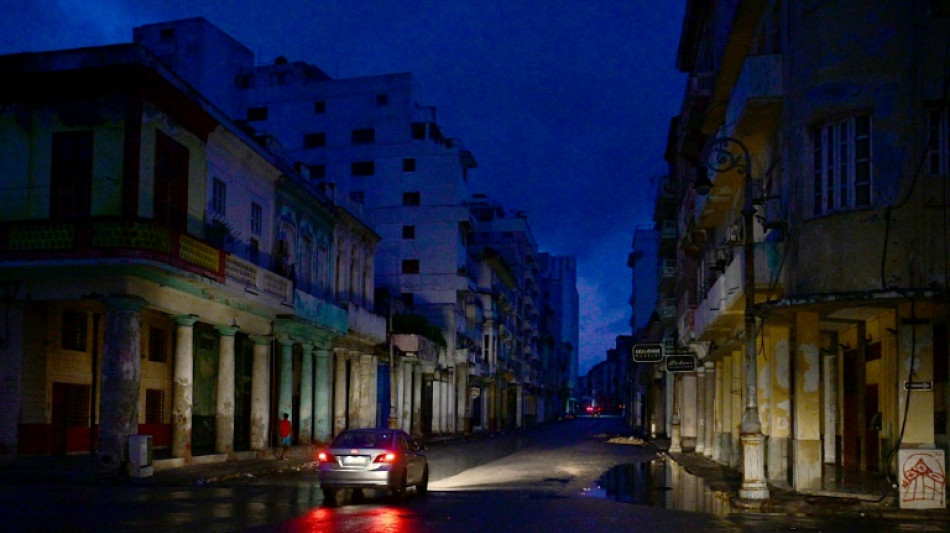
Cuban blackout highlights urgency of boosting renewables: experts / Photo: ADALBERTO ROQUE - AFP

 Egypt Reaches Final IMF Agreement; Questions Remain on Economic Independence

 Nevada Attorney Charged With Murder of Mother in California Over Property Dispute

 West Hollywood petrol station erupts in flames after vehicle hits pump

 Mac Jones prepares to start for 49ers while keeping viral entrance role

 Raptors rout Nets 124-100 as Brooklyn’s inconsistency continues

 Taliban authorities reportedly remove women’s names from records in Balkh

 Black Friday offers include household essentials and low-cost donation toys

 Black Friday gaming offers cut prices on headsets, consoles and games

 Shark Depuffi stock dwindles as Black Friday skincare discounts begin

 Chevrolet Blazer EV SS tested against decades of Super Sport models

 Calgary builder draws on decades of DIY work to increase Ford engine power

 Record-setting Hemi Plymouth Superbird heads to auction
 Calgary dancer describes stripping as a career built on independence and community
 Rohit Sharma Reappointed Mumbai Indians Captain for IPL 2027 with Focus on Team Spirit

 Calgary budget hearing delayed during debate over Tourette syndrome accommodation

 Business phone systems gain AI tools, but human oversight remains essential

 Huawei outlines 2030 network plans at Africa Tech Festival

 Governments and courts tighten restrictions on camera-equipped smart glasses

 South Africa’s sovereign satellite plan remains stalled despite higher cost

 EasyEquities faces pressure for clearer answers after security outage

 US patent disputes involving Korean chipmakers reach record level

 SK hynix doubles daily share purchases after steep stock decline
The massive blackout that plunged Cuba into darkness for four days highlighted the communist island's failure to end its near-total dependance on ageing oil-fired power plants by transitioning to renewables, experts say.
A decade after the Cuban government said it aimed to produce 24 percent of its electricity from renewables by 2030 and in so doing reduce its dependence on oil imports it can ill-afford, the Caribbean island has made little progress.
In 2022, Cuba got only 5 percent of its electricity from natural sources, the Environmental Defense Fund, a US-based NGO, noted in a recent report, a small increase from 2014, when renewables provided 4.3 percent of its power.
Analysts cite the nation's crumbling grid as one of the factors impeding Havana's progress on the renewables front, along with Cuba's ongoing economic crisis, the worst the country's faced since the fall of the Soviet Union -- Cuba's chief ally and financial backer -- in the early 1990s.
Cuban economist Pedro Monreal also blamed the country's energy crisis on chronic underinvestment in energy infrastructure compared with what he called "excessive" spending on "little-used" tourism facilities.
Between 2020 and June 2024, tourism accounted for 38.9 percent of government spending, compared with only 9.4 percent on electricity, gas and water, he wrote on the social network X.
With several of the island's power plants dating back over 40 years, breakdowns have become more frequent.
A drop in the supply of cheap oil from leftist ally Venezuela, which is in the throes of its own severe economic crisis, has further aggravated the situation, leaving Cuba struggling to supply fuel to power its plants.
The result has been months of blackouts lasting up to 20 hours per day, culminating in a nationwide blackout on October 18 after the failure of the country's biggest power plant, Antonio Guiteras, which in turn crashed the national grid.
- 'Very precarious situation' -
In 2022, 48 percent of the fuel used in several floating power plants rented from Turkey as well as in the country's vast network of generators was imported, according to EDF.
In the past, much of the oil came from Venezuela, but with Venezuela's own economy in tatters, Caracas "actually started moving it to China because they had to pay off a lot of the debt that they owed to that country," Glen Sartain, general manager of West Monroe, a US-based energy consultancy, told AFP.
"Moving those crude oil resources to different countries really has put Cuba in a very precarious position with regard to the electricity," he added.
The Cuban government blames former US president Donald Trump's ramping up of a US embargo in force since 1962 for worsening the energy crisis.
"The main cause is our failure to access international financial markets for fuel," Energy Minister Vicente de la O Levy said.
The government, which is facing growing social discontent over the power outages, is in talks with Vietnam, China and the European Union about boosting renewable energy, according to several sources close to the issue.
In May, President Miguel Diaz-Canel said the country had signed agreements with unnamed parties "that will allow us to reach more than 2,000 megawatts in under two years" from renewables -- equivalent to the peak supply announced by the authorities for October 28.
- Sun and sugarcane -
So far, Cuba's timid renewables push has centred mainly on solar power and biomass.
Nearly a million Chinese solar panels have been installed across the island of 11 million people, with another 3.6 million planned over the next two years, according to government figures.
"Cuba has abundant renewable sources," Rosell Guerra Campana, director of renewables in the energy ministry, argued in late 2023, citing, "the sun, agricultural and forest biomass."
The island had made significant progress in transforming sugar cane - the country's most iconic export -- into bioethanol, Sartain said.
In contrast, building wind farms and installing solar panels is "very expensive" for the cash-strapped island, he noted.
For EDF, solving Cuba's energy challenges "will not be no small task" as it will require "substantial investments of capital, which have been hard to come by given real and perceived risks of investing in Cuba."
G.M.Castelo--PC