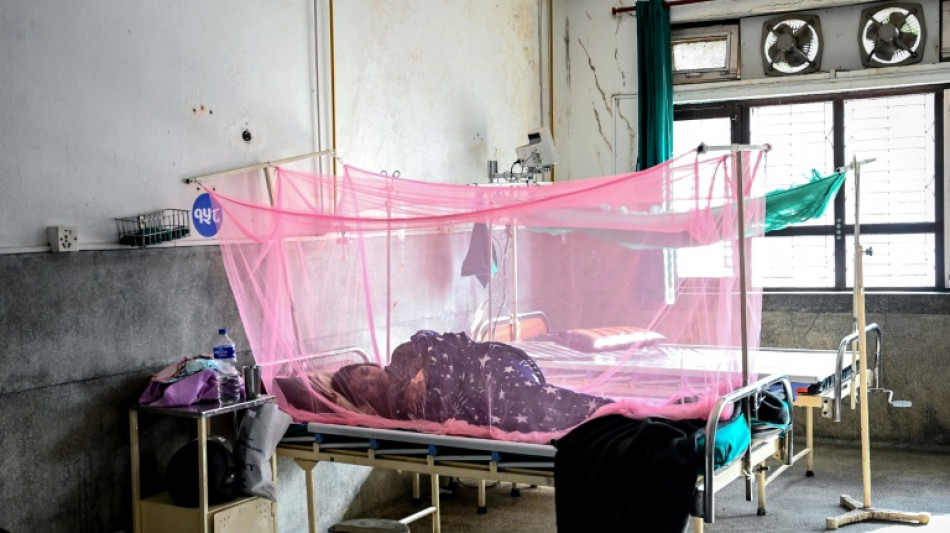
Climate shifts and urbanisation drive Nepal dengue surge / Photo: PRAKASH MATHEMA - AFP

 Egypt Reaches Final IMF Agreement; Questions Remain on Economic Independence

 Nevada Attorney Charged With Murder of Mother in California Over Property Dispute

 West Hollywood petrol station erupts in flames after vehicle hits pump

 Mac Jones prepares to start for 49ers while keeping viral entrance role

 Raptors rout Nets 124-100 as Brooklyn’s inconsistency continues

 Taliban authorities reportedly remove women’s names from records in Balkh

 Black Friday offers include household essentials and low-cost donation toys

 Black Friday gaming offers cut prices on headsets, consoles and games

 Shark Depuffi stock dwindles as Black Friday skincare discounts begin

 Chevrolet Blazer EV SS tested against decades of Super Sport models

 Calgary builder draws on decades of DIY work to increase Ford engine power

 Record-setting Hemi Plymouth Superbird heads to auction

 Calgary dancer describes stripping as a career built on independence and community
 Rohit Sharma Reappointed Mumbai Indians Captain for IPL 2027 with Focus on Team Spirit

 Calgary budget hearing delayed during debate over Tourette syndrome accommodation

 Business phone systems gain AI tools, but human oversight remains essential

 Huawei outlines 2030 network plans at Africa Tech Festival

 Governments and courts tighten restrictions on camera-equipped smart glasses

 South Africa’s sovereign satellite plan remains stalled despite higher cost

 EasyEquities faces pressure for clearer answers after security outage

 US patent disputes involving Korean chipmakers reach record level

 SK hynix doubles daily share purchases after steep stock decline
Nepal is fighting a surge in dengue cases, a potentially deadly disease once unheard of in the country's high-altitude Himalayan regions, as climate change and urbanisation nurture fever-bringing mosquitoes in new zones.
Only a single case of dengue was recorded in Nepal in 2004. Two decades later, thousands of cases are being reported across the country.
Once confined to tropical regions in the country's plains, dengue-carrying mosquitoes have begun breeding in the valleys and even cool mountainous areas, reaching elevations where its bite was once unknown.
Twelve people have died and more than 28,000 people have been infected this year, including 18 cases in Solukhumbu district, home to Mount Everest.
Doctors say the real number might be higher, as not everyone is tested.
"It should not be seen here at all," Suman Tiwari, district health chief for Solukhumbu, which sits at an altitude of some 2,500 metres (8,202 feet).
"What is surprising is that some people with no travel history have also tested positive for dengue".
In the worst cases, dengue causes intense viral fevers that trigger bleeding, internally or from the mouth and nose.
The capital Kathmandu, at an elevation of approximately 1,400 metres (4,600 feet), has seen over 4,000 cases.
"Unfortunately, it is expanding itself geographically," said Sher Bahadur Pun, a doctor at Kathmandu's Sukraraj Tropical and Infectious Disease Hospital.
"Once upon a time, it was just seen in a certain area, but it is moving up towards mountainous regions, even up to the Himalayan foothills."
- 'Grown exponentially' -
In some districts, hospitals have been overwhelmed with dengue patients suffering from crippling fevers, body aches and rashes.
"In the last decade, it has grown exponentially," Pun said.
"After every outbreak, the number of infected people has increased... and my experience is that after every outbreak, it has become more deadly."
In October, the UN health agency said the number of reported dengue cases worldwide has approximately doubled each year since 2021, with over 12.3 million cases, including more than 7,900 deaths, reported in just the first eight months of 2024.
WHO chief Tedros Adhanom Ghebreyesus called the global spread an "alarming trend".
Experts say changes in temperature and rainfall patterns driven by climate change and urbanisation are creating favourable conditions for Aedes aegypti, the mosquito responsible for transmitting dengue.
That means it can survive and breed at higher elevations.
Narayan Gyawali, a virologist who specialises in zoonotic diseases, said that urbanisation and increased mobility of people were also driving the dengue surge.
"When microclimates are established with urbanisation in new areas, internal temperatures become warm and there is humidity," Gyawali said.
"A favourable environment is created for breeding and survival."
- 'Injustice' -
This is the third consecutive year that Nepal has seen a dengue outbreak -- an apparent shift from cyclical patterns where outbreaks are expected every two to three years.
The country's worst outbreak was in 2022, with 88 deaths and nearly 55,000 cases, according to government figures.
Last year, 20 people died, with more than 50,000 cases.
"Dengue used to be reported in a cyclical trend, but in the last few years, it has been seen every year," said Gokarna Dahal of the Health Ministry's Epidemiology and Disease Control Division.
"Our preparation now is to fight with it every year".
Dahal said it was an "injustice" that a developing country like Nepal -- which makes a minimal contribution towards the burning of fossil fuels driving the planet's warming -- should shoulder greater impacts of climate change.
Meenakshi Ganguly, from Human Rights Watch, said that while the primary responsibility to protect its public's health lies with Nepal, countries most responsible for global emissions also have an obligation.
"Those countries which are primarily responsible for global emissions need to do a lot more to protect people in countries like Nepal from the consequences of global warming," Ganguly said.
"Combatting mosquito-borne diseases like dengue, which are spreading fast to new areas, needs to be part of that."
J.Oliveira--PC