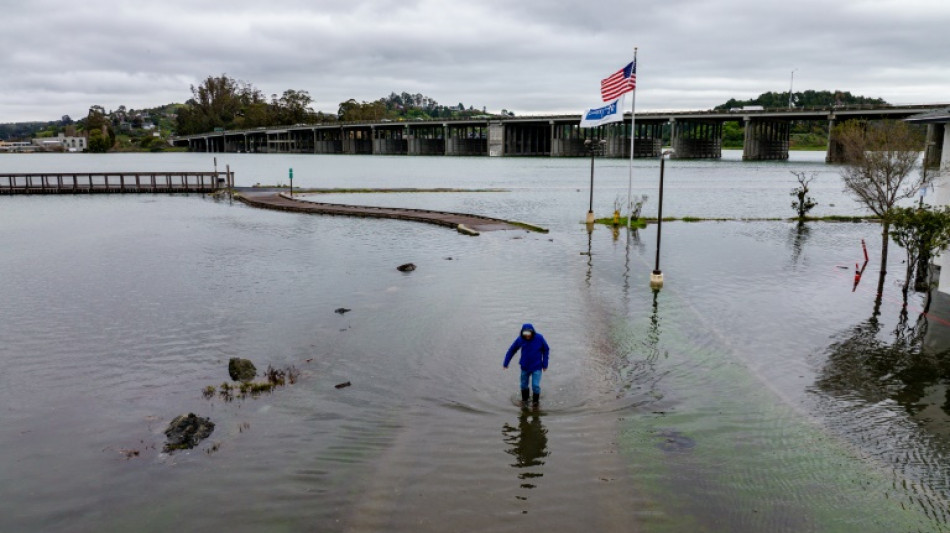
Climate change, population threaten 'staggering' US flood losses by 2050

 Trump's beef policies irk Texas ranchers, testing their loyalty

 Nvidia, OpenAI CEOs to attend Xi dinner at White House

 Anthropic picks Accenture for in-house AI safety evaluation

 Balogun returns as Monaco beat Lens to continue strong Ligue 1 start

 'Pause' on overt repression in Venezuela, but reforms still needed: HRW

 Global stocks mixed as yen falls despite Bank of Japan rate hike

 Cuba hit with seventh major blackout of the year

 Murray out with concussion so Wentz will start for Vikings

 UN chief 'deeply regrets' US visa refusal to Abbas for annual meeting

 England quick Carse to face no charges over alleged nightclub assault

 Mancini brings nine newcomers into the first squad of his Italy comeback

 Czechs level Davis Cup tie against USA as South Korea eye Finals

 New France boss Zidane confirms Mbappe as captain after naming first squad

 California governor signs order to explore AI 'kill switch'

 Head leads run spree as Australia win Zimbabwe ODI series

 In-form Raphinha wants to finish career at Barcelona

 Warren Buffett steps down as Berkshire Hathaway chairman

 Carrick confident Man Utd can 'work through' tough time

 Mbappe ends Nike partnership to join Swiss brand On

 Liverpool boss Iraola puts Bournemouth love affair on hold

 'A disaster' if Man City do not win says Maresca after flawless start

 Kerry James Marshall: American 'blackness' painter celebrated in Europe

 Spain coach De la Fuente offers 'full support' to people of Ceuta

 Russia seizes assets of Nestle, French firms over West's Ukraine support

 England can build on World Cup 'spirit', says Tuchel

Climate change is on track to ramp up the annual cost of US flood damage more than 25 percent by 2050, according to new research Monday that warns disadvantaged communities will likely bear the brunt of the financial burden.
The study published in the journal Nature Climate Change used new flood models to map out the present and future impact of sea level rise, tropical cyclones and changing weather patterns.
Losses include destruction projected to hit homes and businesses. Researchers warned that even more people are expected to move into areas at growing risk of inundation.
"Climate change combined with shifting populations present a double whammy of flood risk danger and the financial implications are staggering," said lead author Oliver Wing, of the University of Bath's Cabot Institute for the Environment.
Wing said the findings should be a "call to action" for both a reduction in emissions and efforts to adapt to accelerating climate risks "to reduce the devastating financial impact flooding wreaks on people's lives."
Researchers used nationwide property asset data, information on communities and flood projections to estimate flood risk across the US.
The study showed that poorer communities with a proportionally larger white population currently face the steepest losses.
But future growth in flood risk is expected to have a greater impact on African American communities on the Atlantic and Gulf coasts.
"The mapping clearly indicates Black communities will be disproportionately affected in a warming world, in addition to the poorer White communities which predominantly bear the historical risk," said Wing.
"Both of these findings are of significant concern."
- 'Unacceptable' risks -
Average annual flood losses were forecast to increase by 26.4 percent, from $32 billion currently, to $40.6 billion in 2050, based on 2021 dollar values.
The researchers said these figures are "essentially locked in climatically", meaning that even if emissions fall dramatically they would still be the same.
They also warned that expanding populations in the US would also significantly increase the flood risk, eclipsing even the impact of climate change.
With inundations expected to intensify in areas where populations are also increasing, the researchers said average annual exposure of the US population to floods is expected to grow to more than seven million by 2050, a 97-percent increase from current levels.
It said increases in climate-enhanced exposure was particularly concentrated along the US East Coast, with existing Texas and Florida residents seeing a roughly 50-percent increase in flood exposure by 2050.
In terms of increased flood risk due to population growth, the researchers highlighted intensified development on existing floodplains, which they said was "relatively severe in the currently sparsely populated central Prairie States and the Deep South".
The study said even developments currently considered low risk may be in areas expected to see a heightened flood risk in the coming decades.
"Current flood risk in western society is already unacceptably high, yet climate and population change threaten to inflate these losses significantly," said co-author Paul Bates, a professor of hydrology at the Cabot Institute for the Environment.
"The relatively short timescales over which this increase will take place mean we cannot rely on decarbonisation to reduce the risk so we have to adapt better, both to the situation now and for the future."
M.Carneiro--PC