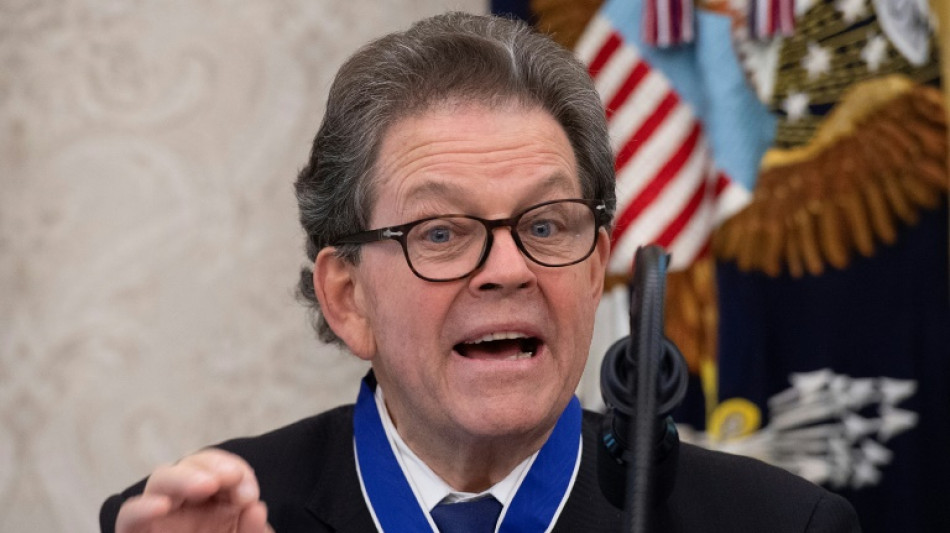
Trump's tariff threats are 'leverage,' says informal economic advisor / Photo: Jim WATSON - AFP

 Breytenbach confirms recommending Sibiya for Johannesburg post

 Celebrities mark Thanksgiving in turkey-themed photo gallery

 German fashion model Veruschka dies in Berlin at 87

 Thanksgiving storms disrupt thousands of US flights

 T.J. Lang criticises Aaron Rodgers over comments about Mike McCarthy

 Qatar Tourism and Uber Sign Five-Year Mobility Partnership
 U2 pays tribute to Dolly Parton during Thanksgiving Eve NFL show
 Rare yellow-bellied sea snake found on Southern California beach

 Second-generation Mini Cooper SE set for India launch with 402km range

 Filmasia 2026: 16 Films Across Prague, Brno, and České Budějovice

 Kojey Radical Launches Burger Collaboration at Dallas Burger Joint in Shoreditch

Donald Trump's recent threat to impose 25 percent tariffs on Canada and Mexico are a negotiating tactic, the president's long-time informal economic advisor argued Wednesday.
"Donald Trump is doing exactly what any rational person would do understanding economics," Arthur Laffer, one of the godfathers of supply-side economics, told AFP in an interview.
"He's using trade as a tool to exact other policies. It's his leverage," said Laffer, 84, who was an economic advisor to President Ronald Reagan and has long informally advised Trump, but is not part of his administration.
"In order for that leverage to be true, in order for that leverage to really work, you have to be convinced that you will put those tariffs on," he added.
Shortly after taking the oath of office on Monday, Trump said he was mulling new tariffs of 25 percent against the two close US allies starting February 1, accusing them of failing to tackle illegal immigration and drug trafficking.
"I think President Trump believes that they could easily solve the immigration problem for the US, and they could make a big dent in the fentanyl problem," Laffer said.
Trump also threatened to impose a 10 percent tariff on China which, he said, had not done enough to tackle the flow of the synthetic opioid to Canada and Mexico, from where it is trafficked into the United States.
Trump's comments drew condemnation from Beijing and Ottawa, while Mexico's President Claudia Sheinbaum said it was important to "keep a cool head and refer to signed agreements, beyond actual speeches."
Trump's tariff and immigration proposals -- which include the mass deportation of millions of undocumented workers -- have been criticized as inflationary by many economists, who see these policies putting pressure on the Fed to pause interest rate cuts.
Supporters such as Laffer and Treasury Secretary nominee Scott Bessent have asserted the president's planned supply-side tax and deregulation reforms should help counteract any temporary inflationary pressures from tariffs.
Asked what economic policies he hoped Trump would enact, Laffer named a wish list of measures he wanted to see.
"I hope we get tariffs reduced dramatically, and non-tariff barriers reduced, and quotas reduced," he said.
"I hope we get the Tax Cuts and Jobs Act re-upped," he added, referring to Trump's 2017 package of tax cuts, some of which is set to expire at the end of this year.
"And I hope we get deregulation, we get cutting in government spending, and we go to a supply-side economy where we have a low rate broad-based flat tax, spending restraint, sound money, minimal regulations, free trade," he added.
X.Matos--PC