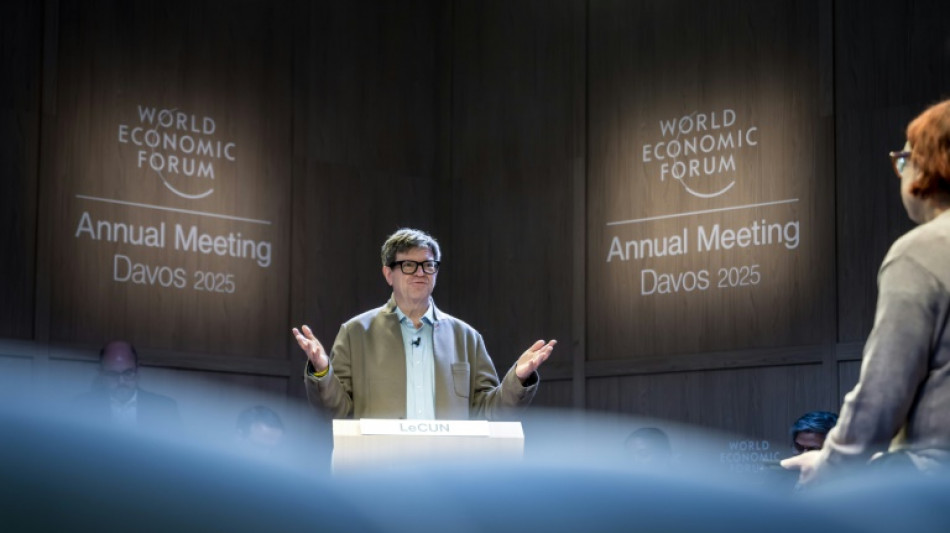
Meta guru urges Europe to gamble more on AI / Photo: FABRICE COFFRINI - AFP

 Breytenbach confirms recommending Sibiya for Johannesburg post

 Celebrities mark Thanksgiving in turkey-themed photo gallery

 German fashion model Veruschka dies in Berlin at 87

 Thanksgiving storms disrupt thousands of US flights

 T.J. Lang criticises Aaron Rodgers over comments about Mike McCarthy

 Qatar Tourism and Uber Sign Five-Year Mobility Partnership

 U2 pays tribute to Dolly Parton during Thanksgiving Eve NFL show

 Rare yellow-bellied sea snake found on Southern California beach

 Second-generation Mini Cooper SE set for India launch with 402km range

 Filmasia 2026: 16 Films Across Prague, Brno, and České Budějovice

 Kojey Radical Launches Burger Collaboration at Dallas Burger Joint in Shoreditch

Europe should take greater risks and plough more money into artificial intelligence, Meta's chief AI scientist Yann LeCun told AFP at the World Economic Forum.
Widely viewed as one of the "godfathers" of AI, he also judged as "a little unrealistic" a $500 billion AI bazooka announced by US President Donald Trump this week.
The major investment deal aims to build infrastructure for AI, led by Japanese giant SoftBank and ChatGPT-maker OpenAI. Tesla and X chief Elon Musk as well as Anthropic head Dario Amodei have also expressed doubts about the plans.
"It is not clear that any entity has this amount of money to invest, even over five years," LeCun said in an interview on Thursday.
"This is certainly what is lacking in Europe in terms of investment," he said.
But he admitted the United States' financial system was different to Europe's.
"There is a lot of money to invest in the United States because of retirement funds, which do not exist in Europe."
AI was again the buzzword at the annual talkfest in the Swiss ski village of Davos, with technology firms such as Facebook-owner Meta out in full force on the thoroughfare near the forum's main centre.
Meta proudly put on show its Ray-Ban Meta AI glasses -- which can take photos and provide details about objects in view -- at its storefront, for participants to try.
The amounts involved in AI are massive. LeCun pointed to Meta's plans to invest around $60 billion this year, while its rivals plan to plough billions of dollars too.
"These are absolutely enormous numbers. And all of this is used to build a computing infrastructure that not only allows AI models to be trained -- it is not a huge amount of resources -- but above all to run them," LeCun noted.
- Europe's talent -
The United States is leading the pack on AI, while experts say Europe is falling further behind in technology despite worries about competitiveness.
For LeCun, there were two outstanding issues: Europe's lack of money and attitude.
"We (Europe) are afraid of risk. We are afraid of financial risks. So we don't invest enough," LeCun said. "But on the other hand, (we are) not at all behind in terms of talent, in terms of spirit," he added.
For example, he said, the first version of Meta's large language model, Llama, was developed in Paris by a small group of "12 or 13 people".
LeCun also accused regulation of killing innovation.
There is a "fear" among lawmakers and decision-makers over the potential consequences, "which lead to regulations that, sometimes, are premature on risks that, in fact, do not exist. And that kills innovation".
LeCun did not mention any specific regulation but the European Union last year was the first in the world to green light sweeping AI rules.
UN chief Antonio Guterres appeared less optimistic, warning during a WEF address of AI's "profound risks, especially if AI is left ungoverned".
F.Moura--PC