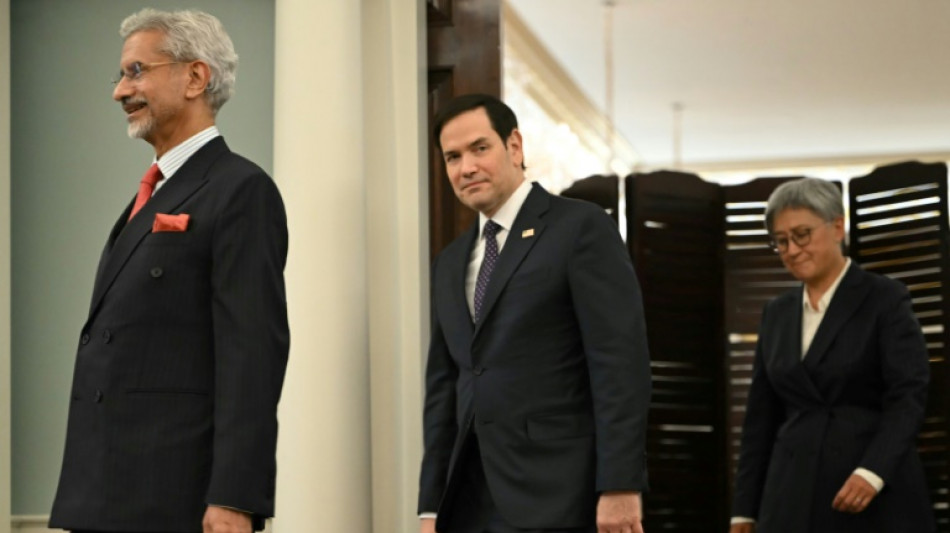
Rubio clashes with China FM on Taiwan / Photo: ANDREW CABALLERO-REYNOLDS - AFP/File

 Thanksgiving storms disrupt thousands of US flights

 T.J. Lang criticises Aaron Rodgers over comments about Mike McCarthy

 Qatar Tourism and Uber Sign Five-Year Mobility Partnership

 U2 pays tribute to Dolly Parton during Thanksgiving Eve NFL show
 Rare yellow-bellied sea snake found on Southern California beach

 Second-generation Mini Cooper SE set for India launch with 402km range

 Filmasia 2026: 16 Films Across Prague, Brno, and České Budějovice

 Kojey Radical Launches Burger Collaboration at Dallas Burger Joint in Shoreditch

 Kelly Stafford Reflects on Matthew's Lions Thanksgiving Era Ahead of Rams' Netflix Debut

US Secretary of State Marco Rubio clashed with his Chinese counterpart Wang Yi over Taiwan on Friday, with Donald Trump's top diplomat denouncing Beijing's "coercive" moves.
Rubio, a longtime China hawk, spoke with Wang for the first time by telephone at the end of his first week in office, which he began by forming a united front with US partners in the region.
In the telephone call, Rubio told Wang that the second Trump administration will pursue a relationship with China "that advances US interests and puts the American people first," State Department spokeswoman Tammy Bruce said.
"The secretary also stressed the United States' commitment to our allies in the region and serious concern over China's coercive actions against Taiwan and in the South China Sea," she said.
Wang in turn cautioned Rubio over Taiwan, the self-governing democracy which China claims and has not ruled out seizing by force.
"We will never allow Taiwan to be separated from China," Wang told Rubio, adding that Washington "must not betray its promise" to recognize only one China, according to a readout by the Chinese foreign ministry.
Wang voiced hope to Rubio that the former American senator would "play a constructive role for the future of the Chinese and American people, and for world peace and stability," it said.
In their call, Wang told Rubio that the world's top two economies should work to find "the right way to get along in the new era" -- presumably referring to Trump's return to the US presidency.
While Beijing had "no intention of surpassing or replacing anyone," it maintained its "legitimate right to development," he said.
The Chinese minister said the pair should follow the lead of President Xi Jinping and Trump, who appeared to have a cordial telephone call.
- Boosting Taiwan -
The United States is a longtime supporter of Taiwan and its largest supplier of weapons, but does not formally recognize it diplomatically.
In his Senate confirmation hearing last week, Rubio vowed to ramp up support for Taiwan to achieve an "equilibrium" that would discourage China from an invasion.
Rubio suggested at the hearing that China could invade the island by the end of the decade unless the United States makes clear that "the costs of intervening in Taiwan are too high."
Rubio has cast China as the top threat to the United States and has accused the Asian power -- whose economy has skyrocketed in recent decades -- of "cheating" its way toward superpower status.
Rubio met immediately Tuesday after taking office with the foreign ministers of Japan, India and Australia -- the so-called Quad that China charges is an attempt to encircle it.
The four foreign ministers jointly warned against any "unilateral actions that seek to change the status quo by force or coercion," in a clear reference to China.
Rubio also spoke by telephone with his counterparts from the Philippines and, on Friday, Vietnam.
With Vietnamese Deputy Prime Minister and Foreign Minister Bui Thanh Son, Rubio discussed China's "aggressive behavior in the South China Sea," the State Department said.
China has seen rising friction with Southeast Asian nations, especially the Philippines, as it asserts its claims in the strategic and dispute-rife waterway.
P.Mira--PC