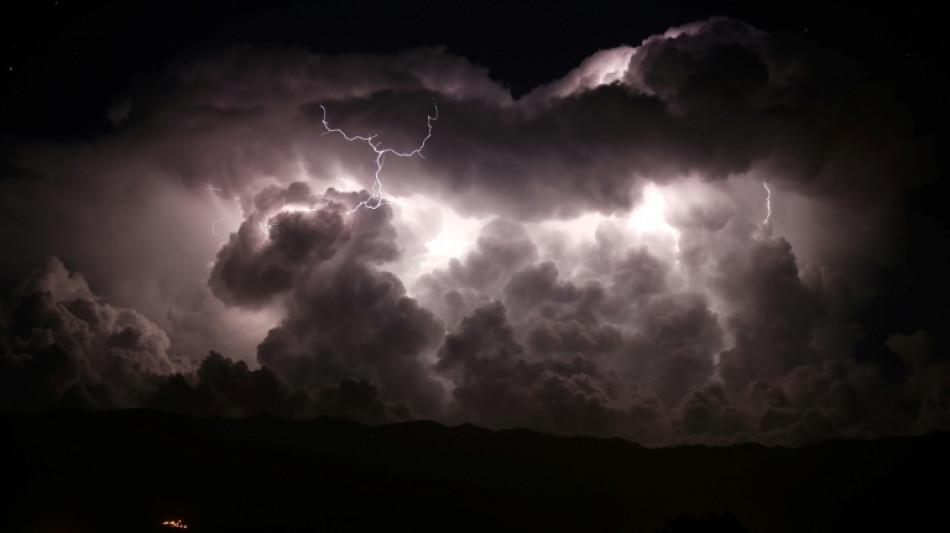
770-km US megaflash sets new lightning record: UN

 Trump's beef policies irk Texas ranchers, testing their loyalty

 Nvidia, OpenAI CEOs to attend Xi dinner at White House

 Anthropic picks Accenture for in-house AI safety evaluation

 Balogun returns as Monaco beat Lens to continue strong Ligue 1 start

 'Pause' on overt repression in Venezuela, but reforms still needed: HRW

 Global stocks mixed as yen falls despite Bank of Japan rate hike

 Cuba hit with seventh major blackout of the year

 Murray out with concussion so Wentz will start for Vikings

 UN chief 'deeply regrets' US visa refusal to Abbas for annual meeting

 England quick Carse to face no charges over alleged nightclub assault

 Mancini brings nine newcomers into the first squad of his Italy comeback

 Czechs level Davis Cup tie against USA as South Korea eye Finals

 New France boss Zidane confirms Mbappe as captain after naming first squad

 California governor signs order to explore AI 'kill switch'

 Head leads run spree as Australia win Zimbabwe ODI series

 In-form Raphinha wants to finish career at Barcelona

 Warren Buffett steps down as Berkshire Hathaway chairman

 Carrick confident Man Utd can 'work through' tough time

 Mbappe ends Nike partnership to join Swiss brand On

 Liverpool boss Iraola puts Bournemouth love affair on hold

 'A disaster' if Man City do not win says Maresca after flawless start

 Kerry James Marshall: American 'blackness' painter celebrated in Europe

 Spain coach De la Fuente offers 'full support' to people of Ceuta

 Russia seizes assets of Nestle, French firms over West's Ukraine support

 England can build on World Cup 'spirit', says Tuchel

A single flash of lightning in the United States nearly two years ago cut across the sky for nearly 770 kilometres, setting a new world record, the United Nations said Tuesday.
The new record for the longest detected megaflash, measured in the southern US on April 29, 2020, stretched a full 768 kilometres, or 477.2 miles, across Mississippi, Louisiana and Texas.
That is equivalent to the distance between New York City and Columbus, Ohio, or between London and the German city of Hamburg, the UN's World Meteorological Organization (WMO) pointed out in a statement.
That lightning bolt zig-zagged some 60 kilometres further than the previous record, set in southern Brazil on October 31, 2018.
The WMO's committee of experts on weather and climate extremes also reported a new world record for the duration of a lightning flash.
A single flash that developed continuously through a thunderstorm over Uruguay and northern Argentina on June 18, 2020 lasted for 17.1 seconds -- 0.37 seconds longer than the previous record set on March 4, 2019, also in northern Argentina.
- 'Even greater extremes' -
"These are extraordinary records from single lightning flash events," Randall Cerveny, the WMO rapporteur of weather and climate extremes, said in the statement.
"Environmental extremes are living measurements of the power of nature, as well as scientific progress in being able to make such assessments," he said.
The technology used to detect the length and duration of lightning flashes has improved dramatically in recent years, enabling records far greater than what was once the norm.
The previous "megaflash" records, from 2018 and 2019, were the first verified with new satellite lightning imagery technology and were both more than double the prior records using data collected from ground-based technology.
"It is likely that even greater extremes still exist, and that we will be able to observe them as lightning detection technology improves," Cerveny said.
The WMO highlighted that the new record strikes happened in the Great Plains in North America and the La Plata basin in South America, known as hotspots for so-called Mesoscale Convective System (MCS) thunderstorms, which enable megaflashes.
It stressed that the flashes that set the new records were not isolated events, but happened during active and large-scale thunderstorms, making them all the more dangerous.
"Lightning is a major hazard that claims many lives every year," WMO chief Petteri Taalas said in the statement.
"The findings highlight important public lightning safety concerns for electrified clouds where flashes can travel extremely large distances."
WMO pointed out that the only lightning-safe locations are big buildings with wiring and plumbing, or fully enclosed, metal-topped vehicles.
The UN agency maintains official global records for a range weather and climate-related statistics, including temperature, rainfall and wind.
All such records are stored in the WMO Archive of Weather and Climate Extremes.
The archive currently includes two other lightning-related extremes.
One is for the most people killed by a single direct strike of lightning, when 21 people died in Zimbabwe in 1975 as they huddled for safety in a hut that was hit.
The other is for an indirect strike, when 469 people died in Dronka, Egypt when lightning struck a set of oil tanks in 1994, causing burning oil to flood the town.
R.J.Fidalgo--PC